

Check the Available B2C-Solution-Architect Exam Dumps with 154 QA's UPDATED 2025
Download B2C-Solution-Architect Exam Dumps Questions to get 100% Success in Salesforce
Salesforce B2C-Solution-Architect Exam covers a wide range of topics related to B2C solution design and implementation. Some of the topics covered in the exam include data modeling, governance, design patterns, architecture, user experience design, and technology implementation. Salesforce Certified B2C Solution Architect certification program is designed to assess the candidate's ability to design, develop, and implement successful B2C solutions using Salesforce technology.
NEW QUESTION # 17
An ecommerce company has one Primary Instance Group with three instances and one Secondary Instance Group with five sandboxes.
They are expanding and adding people in multiple locations to manage the storefront. They would like additional sandboxes to support their expansion efforts into new markets with new templates, scripts, and controllers.
Which approach should a Solution Architect recommend?
- A. Add new sandboxes to the Secondary Instance Group for the current realm.
- B. Add a new realm for each new market to get additional sandboxes for each realm.
- C. Add a Tertiary Instance Group to add sandboxes to the existing realm.
- D. Add new instances to the Primary Instance Group for new sandboxes in each realm.
Answer: A
Explanation:
The Secondary Instance Group is used for sandboxes in B2C Commerce. Adding new sandboxes to this group does not require creating a new realm or adding instances to the Primary Instance Group, which is used for production and staging instances. Reference: https://developer.salesforce.com/docs/commerce/b2c-commerce/guide/b2c-developer-sandboxes.html
NEW QUESTION # 18
A company wants to integrate B2C Commerce and Marketing Cloud so that customers shopping online can be segmented for marketing campaigns like Abandoned Cart and Post Purchase Journeys.
Which two actions are needed to enable an Abandoned Cart Journey?
Choose 2 answers
- A. Implement the Marketing Cloud coilect.js through the storefront by using the Connector's reference implementation
- B. Integrate product, order, and customer data feeds into Service Cloud objects
- C. Use Mulesoft to bring order and customer data feeds from B2C Commerce to Marketing Cloud
- D. Integrate product, order, and customer data feeds into Marketing Cloud Data Extensions
Answer: A,D
Explanation:
A is correct because integrating product, order, and customer data feeds into Marketing Cloud Data Extensions is a prerequisite for enabling an Abandoned Cart Journey. Data Extensions are tables that store data in Marketing Cloud and can be used to define audience segments and personalize messages.
D is correct because implementing the Marketing Cloud collect.js through the storefront by using the Connector's reference implementation is a prerequisite for enabling an Abandoned Cart Journey. The collect.js script tracks customer behavior on the storefront and sends data to Marketing Cloud using the Connector cartridge.
B is incorrect because integrating product, order, and customer data feeds into Service Cloud objects is not needed for enabling an Abandoned Cart Journey. Service Cloud objects are used to store data in Service Cloud and can be used to manage customer service cases and interactions.
C is incorrect because using Mulesoft to bring order and customer data feeds from B2C Commerce to Marketing Cloud is not needed for enabling an Abandoned Cart Journey. Mulesoft is a platform that provides integration solutions for various systems and applications.
Reference:
1. https://help.salesforce.com/s/articleView?id=sf.mc_co_data_integration.htm&type=5
2. https://help.salesforce.com/s/articleView?id=sf.mc_co_web_and_mobile_analytics_tracking.htm&type=5
NEW QUESTION # 19
A company is In the process of defining the authoritative system for key data entitles Involved In B2C journeys. The company has about 200.000 customers, each averaging 30 orders per year.
Which two systems are considered an authoritative system for consent and compliance preferences, as well as primary person attributes such as name, address, birthday, phone, and email?
Choose 2 answers
- A. Experience Cloud
- B. B2C Commerce
- C. Marketing Cloud
- D. Service Cloud
Answer: C,D
Explanation:
Service Cloud and Marketing Cloud are considered authoritative systems for consent and compliance preferences, as well as primary person attributes such as name, address, birthday, phone, and email. Service Cloud is the system of record for customer service interactions and case management, and it can store customer consent and preferences for different channels and purposes. Marketing Cloud is the system of record for customer engagement and marketing campaigns, and it can store customer consent and preferences for email, SMS, push notifications, and other channels. B2C Commerce is not an authoritative system for consent and compliance preferences, as it does not store them natively. It can store some primary person attributes such as name, address, phone, and email, but they may not be the most up-to-date or accurate.
Experience Cloud is not an authoritative system for consent and compliance preferences, as it relies on other systems to store them. It can store some primary person attributes such as name, email, and birthday, but they may not be the most up-to-date or accurate. References:
* https://help.salesforce.com/s/articleView?id=sf.mc_co_data_integration_best_practices.htm&type=5
* https://help.salesforce.com/s/articleView?id=sf.mc_co_data_integration_considerations.htm&type=5
NEW QUESTION # 20
A company wants to implement B2C Commerce and Service Cloud, and then connect the systems with its existing instance of Marketing Cloud.
Which two tactics should a Solution Architect recommend to model a customer across all three systems' Choose 2 answers
- A. Get in touch with the Marketing Cloud Professional Services to perform a subscriber key migration.
- B. Send the Marketing Cloud Subscriber Key to Service Cloud and B2C Commerce to be held for reference.
- C. Migrate the existing Marketing Cloud data into B2C Commerce and set the subscriber key as the Customer ID.
- D. Use Service Cloud as system of record for customer data and consent preferences across all channels.
Answer: B,D
Explanation:
These answers are correct because they are ways to model a customer across all three systems using the Marketing Cloud Subscriber Key and Service Cloud as sources of truth. The Marketing Cloud Subscriber Key can be sent to Service Cloud and B2C Commerce to be held for reference, which can help link customer records across systems and enable cross-channel marketing and service. Service Cloud can be used as system of record for customer data and consent preferences across all channels, which can help comply with data privacy laws and provide a consistent customer experience. Reference: https://help.salesforce.com/s/articleView?id=sf.mc_co_marketing_cloud_connect_best_practices.htm&type=5 https://help.salesforce.com/s/articleView?id=sf.b2c_commerce_service_cloud_integration.htm&type=5
NEW QUESTION # 21
A company wants to migrate their existing in-house order management solution to the Salesforce Order Management product, which will trigger post-purchase transactional emails through Marketing Cloud. They are already using B2C Commerce, Service Cloud, and Marketing Cloud, as well as the B2C Commerce - Service Cloud Connector and Marketing Cloud Connect.
What are three actions that a Solution Architect must take when planning and deploying this solution? Choose
3 answers
- A. Configure data extensions and triggered sends in Marketing Cloud to support transactional emails for ordering scenarios.
- B. Migrate subscriber keys in Marketing Cloud to a new Order Management customer identifier.
- C. Integrate Salesforce Order Management to B2C Commerce for order history and user self service.
- D. Modify the Service Cloud Connector implementation to remove potentially conflicting features with the Order Management Connector.
- E. Replace the Service Cloud Connector with an Order Management Connector for B2C Commerce.
Answer: A,C,D
Explanation:
Salesforce Order Management is a product that allows managing orders across different channels and systems. To migrate the existing in-house order management solution to the Salesforce Order Management product, the following actions should be taken:
* Configure data extensions and triggered sends in Marketing Cloud to support transactional emails for ordering scenarios. Data extensions are tables that store data in Marketing Cloud, and triggered sends are email messages that are sent automatically based on an external event. Data extensions and triggered sends can be used to store order data and send order confirmation, shipment notification, or cancellation emails to customers.
* Modify the Service Cloud Connector implementation to remove potentially conflicting features with the Order Management Connector. The Service Cloud Connector is a cartridge that enables integration between B2C Commerce and Service Cloud. The Order Management Connector is a cartridge that enables integration between B2C Commerce and Salesforce Order Management. Some features of the Service Cloud Connector, such as order history or order cancellation, may conflict with the Order Management Connector, so they should be removed or disabled.
* Integrate Salesforce Order Management to B2C Commerce for order history and user self service. This integration allows customers to view their order history and status, track their shipments, cancel their orders, or initiate returns on the B2C Commerce storefront. This integration also allows agents to view and manage orders in Service Cloud.
Option D is incorrect because migrating subscriber keys in Marketing Cloud to a new Order Management customer identifier is not necessary or recommended. Option E is incorrect because replacing the Service Cloud Connector with an Order Management Connector for B2C Commerce is not possible or advisable.
References:
* https://help.salesforce.com/s/articleView?id=sf.order_overview.htm&type=5
* https://help.salesforce.com/s/articleView?id=sf.mc_co_transactional_messaging.htm&type=5
* https://documentation.b2c.commercecloud.salesforce.com/DOC1/topic/com.demandware.dochelp/OrderManagement/OrderManagementOverview.html
* https://documentation.b2c.commercecloud.salesforce.com/DOC1/topic/com.demandware.dochelp/OrderManagement/OrderManagementConnector.html
NEW QUESTION # 22
A merchant wants to store past purchase history in Marketing Cloud to use for segmentation and personalization of promotional emails.
All data must be encrypted at rest to comply with the merchant's security standards.
Which solution is appropriate?
- A. Transparent Data Encryption
- B. Tokenized Sending
- C. Shield Platform Encryption
- D. Field Level Encryption
Answer: D
Explanation:
Field Level Encryption is a feature that allows encrypting data at field level in Marketing Cloud. It encrypts data at rest to facilitate compliance with data privacy and security regulations. It also allows importing encrypted data into Marketing Cloud and decrypting it at send time. Reference: https://help.salesforce.com/s/articleView?id=sf.mc_overview_field_level_encryption.htm&language=en_US&type=5
NEW QUESTION # 23
An organization is considering using the Lead object in Sales Cloud to track customers who have signed up for their newsletter. The goal is to add these customers to a Marketing Cloud nurture campaign. Once they make a purchase, the suggested design is to convert the Lead to a Contact record and associate the resulting Contact with a Marketing Cloud Subscriber.
What recommendation should a Solution Architect make to avoid implementation challenges?
- A. Delete the Marketing Cloud Contact associated with the Lead object after conversion.
- B. Add prospects who have not created an account or made a purchase to Marketing Cloud directly without creating a Lead.
- C. Avoid using the Lead object by creating Contacts with different Record Types for prospects.
- D. Ensure that the Marketing Cloud Contact associated with the Lead is updated to reference the Contact after conversion.
Answer: D
Explanation:
This option ensures that the Marketing Cloud Contact is linked to the correct Salesforce record after the Lead is converted to a Contact, and that the contact utilization is not affected by duplicate records. The other options can result in data loss, inconsistent reporting, or unnecessary complexity.
NEW QUESTION # 24
Refer to the exhibit.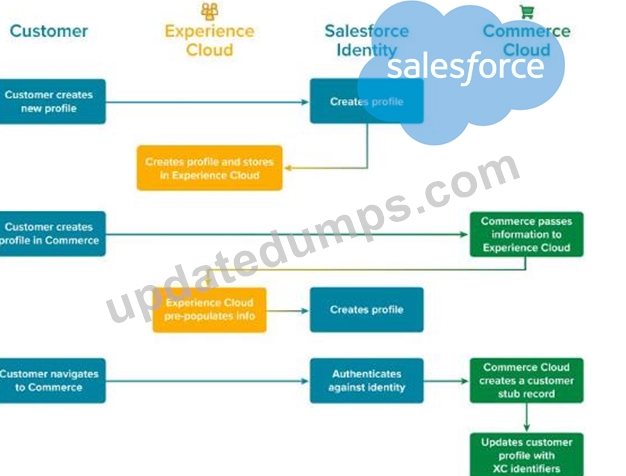
A beauty brand is planning to re-platform their existing website onto B2C Commerce. As part of the re-platform they will create a new social community where beauty insiders can view how-to videos, share tips, and favorite products. As part of the overall solution, the beauty brand is going to implement 82C Commerce, Experience Cloud, and Salesforce Identity.
Each beauty insider can store and update important profile and commerce information like email, phone number, beauty preferences, and saved addresses.
Which application should a Solution Architect recommend to set up the primary profile after reviewing the workflow and attempting to minimize migration of customer profile data?
- A. Service Cloud
- B. Experience Cloud
- C. Salesforce Identity
- D. B2C Commerce
Answer: D
Explanation:
Option D is correct because B2C Commerce should be the system of record for the primary profile after reviewing the workflow and attempting to minimize migration of customer profile data. B2C Commerce is the first point of contact for customers who register an account before making their first purchase, and it can store and update important profile and commerce information like email, phone number, beauty preferences, and saved addresses. B2C Commerce can also integrate with Experience Cloud and Salesforce Identity to provide a consistent and secure user experience across the social community and the ecommerce site.
Option A is incorrect because Salesforce Identity should not be the system of record for the primary profile after reviewing the workflow and attempting to minimize migration of customer profile data. Salesforce Identity is mainly used for authentication and identity management purposes, not for storing and updating customer profile and commerce information. Salesforce Identity can also integrate with Experience Cloud and B2C Commerce to provide a single sign-on (SSO) experience for customers across the social community and the ecommerce site.
Option B is incorrect because Address book should not be the system of record for the primary profile after reviewing the workflow and attempting to minimize migration of customer profile data. Address book is not a system or an application, but rather a feature or a data element that can be stored and updated in B2C Commerce or other Salesforce clouds.
Option C is incorrect because Wishlist should not be the system of record for the primary profile after reviewing the workflow and attempting to minimize migration of customer profile data. Wishlist is not a system or an application, but rather a feature or a data element that can be stored and updated in B2C Commerce or other Salesforce clouds.
Reference:
[Get Started with B2C Solution Architect Cert Prep - Trailhead]
[Certification - B2C Solution Architect - Trailhead]
B2C Solution Architect Certification Guide | Salesforce Ben
NEW QUESTION # 25
A company wants to use the Satesforce Platform to enable personalized l-l marketing, an online ordering platform, and a customer-centric support solution for their service agents. The goal of the company is to provide an end-to-end customer centric and personalized experience.
What is an example artifact that can be used to ensure the company understands the systems involved in the solution'
- A. Journey map
- B. Reference architecture
- C. Product backlog
- D. Storefront wireframes
Answer: B
Explanation:
This answer is correct because a reference architecture is an example artifact that can be used to ensure the company understands the systems involved in the solution. A reference architecture provides a high-level overview of the components, integrations, and interactions of the solution, which can help the company visualize how the solution will work and what systems are required. References: https://architect.salesforce.
com/diagrams/framework/reference-architecture
NEW QUESTION # 26
A nonprofit organization uses Experience Cloud for members who would like to set up recurring donations.
They integrate with an external payment gateway and want to make sure to offer the utmost security for their members. They also use Pardot for personalized communications, to ensure members have access to the most meaningful content and messages related to their donation history.
Which three options can a Solution Architect recommend to increase security for their existing users?
Choose 3 answers
- A. Add a login flow that defines the scope of user access authorized by authentication providers.
- B. Replace Pardot with Marketing Cloud to implement SMS for multi-factor authentication.
- C. Develop login flows to change the user's session security level to initiate third-party identity verification.
- D. Implement high-assurance requirements for Experience Cloud profiles.
- E. Maintain GAuth tokens for existing Experience Cloud profiles.
Answer: A,C,D
Explanation:
Experience Cloud is a product that allows creating and managing digital experiences for customers, partners, employees, and communities. Experience Cloud can be integrated with external payment gateways and Pardot to offer secure and personalized experiences for members who want to set up recurring donations. To increase security for their existing users, a Solution Architect can recommend the following options:
* Implement high-assurance requirements for Experience Cloud profiles. High-assurance requirements are settings that define the level of security and identity verification needed for users to access certain pages or features in Experience Cloud. High-assurance requirements can help prevent unauthorized or fraudulent access to sensitive or confidential data or transactions, such as recurring donations.
* Add a login flow that defines the scope of user access authorized by authentication providers. A login flow is a process that allows customizing the user login experience in Experience Cloud using various actions, such as collecting information, displaying messages, updating records, etc. A login flow can help define the scope of user access authorized by authentication providers, such as social media accounts or SAML-based identity providers. This can help limit or restrict the access of users based on their authentication method or credentials.
* Develop login flows to change the user's session security level to initiate third-party identity verification. A session security level is a setting that determines the level of security and identity verification required for a user's session in Experience Cloud. A session security level can be changed using login flows to initiate third-party identity verification, such as SMS verification, email verification, biometric verification, etc. This can help enhance the security and trust of the user's session and prevent unauthorized or fraudulent access to sensitive or confidential data or transactions, such as recurring donations.
Option C is incorrect because replacing Pardot with Marketing Cloud to implement SMS for multi-factor authentication is not a valid or feasible option to increase security for their existing users. Pardot is a product that allows creating and managing B2B marketing campaigns and activities, such as email marketing, lead generation, lead nurturing, etc. Marketing Cloud is a product that allows creating and managing B2C marketing campaigns and activities, such as email marketing, mobile marketing, social media marketing, etc.
Replacing Pardot with Marketing Cloud would not only be costly and complex, but also unnecessary and irrelevant for their use case of setting up recurring donations. Moreover, implementing SMS for multi-factor authentication does not require replacing Pardot with Marketing Cloud, as it can be done using other methods or tools, such as login flows or third-party identity verification services. Option D is incorrect because maintaining GAuth tokens for existing Experience Cloud profiles is not an option or a way to increase security for their existing users. GAuth tokens are tokens that are used by Google Authenticator, an app that generates one-time passwords for two-factor authentication. GAuth tokens are not related to Experience Cloud profiles or their security settings. References:
* https://help.salesforce.com/s/articleView?id=sf.networks_security.htm&type=5
* https://help.salesforce.com/s/articleView?id=sf.networks_login_flow_examples.htm&type=5
* https://help.salesforce.com/s/articleView?id=sf.networks_session_security_levels.htm&type=5
NEW QUESTION # 27
A company uses B2C Commerce, Marketing Cloud, and Service Cloud and requires that customers create an account before making their first purchase.
Which system creates the customer ID and which system creates an additional ID to use as the customer primary record?
- A. A B2C Commerce creates a customer ID and an additional ID to be used as the primary record.
- B. Marketing Cloud creates a customer ID but the primary ID should be created through B2C Commerce.
- C. Service Cloud creates a customer ID and an additional ID to be used as the primary record.
- D. B2C Commerce creates a customer ID but the primary record should be created through Service Cloud.
Answer: A
NEW QUESTION # 28
A financial services company wants to implement Service Cloud and Marketing Cloud. A number of profile attributes required for personalization in Marketing Cloud were identified as personally identifiable information (PII) and are too sensitive to be stored in Salesforce.
Tokenized Sending was presented as a way to address these concerns.
Which two implications should a Solution Architect consider if Marketing Cloud Connect is to be used for cloud integration?
Choose 2 answers
- A. The token with all supporting attributes will need to be stored in Service Cloud
- B. All emails will need to be sent through Marketing Cloud or Marketing Cloud Connect to avoid disruptions
- C. The synchronized data extensions will include the token and all PII attributes
- D. The standard email address field for contacts and leads needs to be populated with a token
Answer: C,D
Explanation:
Tokenized Sending is a feature in Marketing Cloud that allows sending messages with data that is too sensitive to store in Salesforce due to laws, regulations, or security policies. Tokenized Sending uses an API call to exchange data from an external system with Marketing Cloud at send time, without storing the data in Salesforce. Marketing Cloud Connect is a feature that enables integration between Marketing Cloud and other Salesforce clouds such as Service Cloud. When using Tokenized Sending with Marketing Cloud Connect, the following implications should be considered:
* The synchronized data extensions will include the token and all PII attributes. Synchronized data extensions are tables in Marketing Cloud that store data from other Salesforce clouds using data synchronization in Marketing Cloud Connect. When using Tokenized Sending, the synchronized data extensions will include the token as well as all personally identifiable information (PII) attributes such as name, email, phone, etc. The token will serve as the subscriber key and contact key in Marketing Cloud, while the PII attributes will be used for personalization and segmentation.
* The standard email address field for contacts and leads needs to be populated with a token. When using Tokenized Sending, the standard email address field for contacts and leads in other Salesforce clouds needs to be populated with a token instead of an actual email address. The token resembles a standard email address but contains encrypted information about the subscriber. The token is used to exchange data with the external system at send time and send messages to the actual email address.
Option B is incorrect because not all emails need to be sent through Marketing Cloud or Marketing Cloud Connect to avoid disruptions when using Tokenized Sending. However, it is recommended to do so to ensure consistent tracking and deliverability data across clouds. Option D is incorrect because the token with all supporting attributes does not need to be stored in Service Cloud when using Tokenized Sending. The token and the attributes are stored in the external system and only exchanged with Marketing Cloud at send time.
References:
* https://help.salesforce.com/s/articleView?id=sf.mc_overview_tokenized_sending1.htm&type=5
* https://help.salesforce.com/s/articleView?id=sf.mc_co_tokenized_sending.htm&type=0
NEW QUESTION # 29
A US-based pet superstore wants to build a stronger relationship with their customers by offering an ominichannel, seamless experience at each customer interaction. Currently, they have over 1,500 stores, and numerous pet websites, services, and applications that are siloed, which is a major functional pain point.
Recently, they purchased Service Cloud and B2C Commerce and want to integrate their systems as part of their digital transformation.
Which design and approach should a Solution Architect recommend for a robust and scalable multi-cloud integration?
- A. Implement a custom integration solution using lightweight middleware tools like Jitterbit or Talend.
- B. Implement an integration solution using an outbound messaging design pattern and Salesforce Connect as the integration approach, to connect the multiple clouds and on-premises applications.
- C. Build an application network by adopting an API-led connectivity approach that packages underlying connectivity and orchestration services as easily discoverable and reusable API building blocks.
- D. Build multiple point-to-point application integrations connecting the multi-cloud and on-premises applications using SOA (Service-Oriented Architecture) and SOAP web services.
Answer: C
Explanation:
A multi-cloud integration is a solution that allows connecting and integrating data and applications across different cloud platforms and systems. A multi-cloud integration can provide various benefits, such as scalability, flexibility, resilience, and innovation. To design and implement a robust and scalable multi-cloud integration, a Solution Architect should recommend the following:
* Build an application network by adopting an API-led connectivity approach that packages underlying connectivity and orchestration services as easily discoverable and reusable API building blocks. An application network is a way of organizing applications, data, and devices into a network of reusable services that can be composed and recomposed to meet changing business needs. An API-led connectivity approach is a methodical way to connect data and applications through reusable and purposeful APIs that are developed to play a specific role: unlocking data from systems, composing data into processes, or delivering an experience. By building an application network using an API-led connectivity approach, the Solution Architect can enable a composable, connected, and automated solution that can leverage the capabilities of different cloud platforms and systems in a flexible and agile way.
Option A is incorrect because implementing an integration solution using an outbound messaging design pattern and Salesforce Connect as the integration approach is not suitable or scalable for a multi-cloud integration. An outbound messaging design pattern is a way of sending notifications from Salesforce to external systems when a record is created or updated. Salesforce Connect is a feature that allows accessing and integrating external data from various sources without copying or storing it in Salesforce. These approaches are limited in functionality, performance, security, and reliability for a complex multi-cloud integration scenario. Option B is incorrect because implementing a custom integration solution using lightweight middleware tools like Jitterbit or Talend is not optimal or sustainable for a multi-cloud integration. Lightweight middleware tools are software applications that provide basic integration capabilities, such as data transformation, routing, orchestration, etc. However, these tools are not designed for building an application network or supporting an API-led connectivity approach. They also require custom code or configuration that can increase the cost and complexity of the solution. Option D is incorrect because building multiple point-to-point application integrations connecting the multi-cloud and on-premises applications using SOA (Service-Oriented Architecture) and SOAP web services is not advisable or scalable for a multi-cloud integration. Point-to-point integrations are direct connections between two applications or systems that are tightly coupled and hard to maintain. SOA is an architectural style that organizes applications into loosely coupled services that communicate through standardized interfaces. SOAP web services are protocols that allow exchanging structured data between applications using XML messages. However, these approaches are outdated and inefficient for a modern multi-cloud integration scenario. They also create complexity and fragility in the solution. References:
* https://www.mulesoft.com/resources/api/what-is-api-led-connectivity
* https://www.mulesoft.com/resources/api/what-is-an-application-network
* https://help.salesforce.com/s/articleView?id=sf.datacloud_connect_overview.htm&type=5
* https://help.salesforce.com/s/articleView?id=sf.workflow_om_outboundmessaging.htm&type=5
NEW QUESTION # 30
A B2C Commerce merchant has multiple live sites across different brands and geographies all supported by Service Cloud and Marketing Cloud. Unfortunately, the merchant is having customer service challenges caused by fragmented views of the customer. Customers occasionally use alternate email addresses, make purchases as guests, and contact customer service anonymously. The Success Manager believes that Customer Data Platform (CDP) could help them solve their problem.
How should a Solution Architect describe the role of CDP in this context7
- A. CDP cannot be used across multiple brands within a single merchant environment because the customer as human view cannot support different accounts under separate brands.
- B. When CDP is provisioned, B2C Commerce, Service Cloud, and Marketing Cloud will automatically use a common core Customer Profile managed by Customer 360 Data Manager.
- C. CDP can be used to recognize customers as humans and extend existing records related to that human across connected systems with a consistent Global Party ID.
- D. CDP can be used to identify multiple records within each separate system representing the same person and assigning them a consistent Global Party ID; additional custom development is then required to relate those IDs between systems.
Answer: C
Explanation:
CDP is a feature that allows creating a unified and holistic view of the customer across different systems and channels. CDP can use various identifiers, such as email, phone, or social media, to recognize customers as humans and extend existing records related to that human across connected systems, such as B2C Commerce, Service Cloud, and Marketing Cloud. CDP can also assign a consistent Global Party ID to each human, which can be used as a unique identifier across the systems. References: https://www.salesforceben.com/the-drip/complete-guide-to-customer-data-platforms-and-salesforce-cdp/
NEW QUESTION # 31
A retail company currently uses 62C Commerce and Marketing Cloud to enable a seamless customer experience. They are evaluating tools to better support customer service activities like their call center for online ordering and social customer service.
Which two functionalities should a Solution Architect discuss with the company to explain the value of Service Cloud? Choose 2 answers
- A. Ability to create a B2C storefront using Digital Experiences.
- B. Ability to allow the agent to see purchase history to support case management
- C. Ability to have a customer leave a journey when they have an escalated case.
- D. Ability to de-duplicate and create a single customer identity.
Answer: B,D
NEW QUESTION # 32
A company is in the process of defining the right systems to deliver key capabilities for its B2C business. The company has about 2 million customers, each placing an average of 100 orders each year through its existing B2C Commerce platform. 7 The company needs a system that can;
*Deliver a full list of all customer orders throughout their engagement lifetime
* Provide lifetime engagement tracking and history of the customer
* Calculate the lifetime value of customers based on their orders
Which three systems should a Solution Architect recommend to meet the company's requirements?
Choose 3 answers
- A. Service Cloud
- B. Sales Cloud
- C. Marketing Cloud
- D. Salesforce Order Management
- E. Heroki
- F. Materials Written
Answer: B,C,D
Explanation:
A system is a software application or platform that provides specific functionality or capabilities for a business. A system can be either internal or external to Salesforce, depending on where it is hosted and how it is accessed. To deliver key capabilities for its B2C business, a company should use the following systems:
* Sales Cloud: Sales Cloud is a product that allows managing sales processes and activities across different channels and devices. Sales Cloud can help the company to deliver a full list of all customer orders throughout their engagement lifetime, by integrating with B2C Commerce and other systems to capture and display order information on customer records.
* Marketing Cloud: Marketing Cloud is a product that allows creating and delivering personalized marketing campaigns across different channels and devices. Marketing Cloud can help the company to provide lifetime engagement tracking and history of the customer, by integrating with B2C Commerce and other systems to collect and analyze customer behavior and interactions across touchpoints.
* Salesforce Order Management: Salesforce Order Management is a product that allows managing and fulfilling orders across different channels and systems. Salesforce Order Management can help the company to calculate the lifetime value of customers based on their orders, by integrating with B2C Commerce and other systems to aggregate and report on order revenue and profitability.
Option B is incorrect because Service Cloud is a product that allows managing customer service interactions across different channels and systems. Service Cloud does not provide any of the capabilities that the company needs, such as delivering a full list of customer orders, providing lifetime engagement tracking, or calculating lifetime value of customers. Option C is incorrect because Heroku is a platform that allows building, running, and scaling custom web applications using various languages and frameworks. Heroku does not provide any of the capabilities that the company needs, such as delivering a full list of customer orders, providing lifetime engagement tracking, or calculating lifetime value of customers. Option D is incorrect because Materials Written is not a system, but rather a term that refers to written documents or content that are used for communication or education purposes. Materials Written does not provide any of the capabilities that the company needs, such as delivering a full list of customer orders, providing lifetime engagement tracking, or calculating lifetime value of customers. References:
* https://www.salesforce.com/products/sales-cloud/overview/
* https://www.salesforce.com/products/marketing-cloud/overview/
* https://www.salesforce.com/products/commerce-cloud/ecommerce/order-management/
NEW QUESTION # 33
A company wants to migrate their existing in-house order management solution to the Salesforce Order Management product, which will trigger post-purchase transactional emails through Marketing Cloud. They are already using B2C Commerce, Service Cloud, and Marketing Cloud, as well as the B2C Commerce - Service Cloud Connector and Marketing Cloud Connect.
What are three actions that a Solution Architect must take when planning and deploying this solution? Choose 3 answers
- A. Configure data extensions and triggered sends in Marketing Cloud to support transactional emails for ordering scenarios.
- B. Integrate Salesforce Order Management to B2C Commerce for order history and user self service.
- C. Modify the Service Cloud Connector implementation to remove potentially conflicting features with the Order Management Connector.
- D. Replace the Service Cloud Connector with an Order Management Connector for B2C Commerce.
- E. Migrate subscriber keys in Marketing Cloud to a new Order Management customer identifier.
Answer: B,C,E
NEW QUESTION # 34
......
Best Value Available! 2025 Realistic Verified Free B2C-Solution-Architect Exam Questions: https://www.updatedumps.com/Salesforce/B2C-Solution-Architect-updated-exam-dumps.html
100% Accurate Answers! B2C-Solution-Architect Actual Real Exam Questions: https://drive.google.com/open?id=1wDlRvtQ35FVYoNkaB3qYg0_nyZF6j5Ou