

Civil-Engineering-Technology Training & Certification Get Latest CTTAM C-E-T Updated on Apr 16, 2026
Certification Training for Civil-Engineering-Technology Exam Dumps Test Engine
NEW QUESTION # 61
A civil engineering technologist has been given the task of drawing a foundation plan for a building that measures 20 m × 30 m. The drawing will be produced on a C1 sized sheet, which measures 648 mm × 917 mm. Which of the following is the best scale for the plan?
- A. 1:50
- B. 1:5
- C. 1:250
- D. 1:25
Answer: A
Explanation:
Selecting a drawing scale is an engineering graphics task: the plan must fit within the sheet limits after allowing for borders, title block, notes, dimensions, and details. Engineering drawing practice treats scale as a proportional reduction ratio that preserves geometric similarity between the real object and the drawing. A 20 m × 30 m footprint equals 20,000 mm × 30,000 mm. At 1:50, the plotted size is 400 mm × 600 mm, which fits comfortably on a 648 mm × 917 mm sheet with room for margins and annotations. At 1:25, the plotted size becomes 800 mm × 1,200 mm, which exceeds the sheet. At 1:5, it is far too large; at 1:250, it is very small (80 mm × 120 mm), reducing readability for foundations that typically require clear dimensioning of footings, piles, grade beams, and notes. Therefore, 1:50 provides the best balance of fit and legibility for a C1 sheet, makingOption Cthe best scale choice.
NEW QUESTION # 62
A civil engineering technologist is performing a concrete test on a site. What minimum number of cylinders should the technologist make?
- A. Four
- B. Three
- C. Five
- D. One
Answer: A
Explanation:
Concrete compressive strength is verified using standardized specimens that represent the delivered concrete.
A typical field/lab testing program preparesa set of cylindersso strength can be checked at standard ages and so at least one specimen remains available if a test is invalid or confirmation is required. InExperiment Design for Civil Engineering, the compressive strength procedure explicitly states thatsets of four cylindersshould be prepared and thenone cylinder from each setis tested at7, 14, 21, and 28 days. This "four-cylinder set" directly supports the minimum needed to obtain a time-history of strength development through the common curing ages used in practice and referenced by ASTM C39 age tolerances. While many projects may require additional cylinders (for 7-day early breaks, hold cylinders, or additional acceptance tests), the question asks theminimumnumber, and the documented testing set described isfour.
NEW QUESTION # 63
Which of the following is employee's responsibility in regard to PPE?
- A. Select PPE appropriate for the hazard.
- B. Inspect PPE before use.
- C. Receive training on the correct use of PPE.
- D. Ensure PPE is maintained correctly between uses.
Answer: B
Explanation:
Employee responsibilities for PPE typically includeusing PPE as required and checking it is serviceable before use, then reporting defects. Employer responsibilities generally include hazard assessment, selecting
/providing appropriate PPE, ensuring training, and maintaining a program. EM 385-1-1 reflects this division of duties: it requires PPE to be used to control exposures and establishes training requirements covering key aspects of PPE, includinginspection/testingand proper care. Practical safety guidance for workers also states that employees shouldcheck PPE for faults before useand report issues. Among the optionsuployee duty that is broadly applicable across PPE types and aligns with standard safety systems: workers verify their equipment is not damaged, fits correctly, and is suitable for the task before entering the hazard area.
Therefore, the correct answer isA.
NEW QUESTION # 64
What is the purpose of a spiral curve in highway design?
- A. To slow traffic when the superelevation of the lane is greater than 5%
- B. To transition into a circular curve
- C. To slow traffic when the minimum sight distance cannot be achieved
- D. To transition onto a vertical curve
Answer: B
Explanation:
Aspiral (transition) curveis used in horizontal alignment to provide a gradual change in curvature from a tangent (infinite radius) to a circular curve (constant radius). AASHTO explains that spiral transition curves simulate the natural turning path of a vehicle and allow lateral acceleration (and side friction demand) to increase/decrease gradually as drivers enter/exit the circular curve, improving comfort and reducing encroachment. AASHTO also notes that the transition curve length provides a suitable location to develop superelevation runoffsmoothly from normal crown to full superelevation. These functions are specifically about transitioning into (and out of) the circular curve, not slowing traffic or transitioning vertical alignment.
Therefore, the purpose of a spiral curve isto transition into a circular curvewhile providing a smooth geometric and superelevation transition for drivers.
NEW QUESTION # 65
Which of the following situations would cause the most serious delay on a project?
- A. A gas service line to a residence was hit, causing the line to rupture.
- B. Several bones, ranging in size from 10 cm to 60 cm, were found during excavation operations.
- C. A worker suffered a broken arm on the work site.
- D. A severe storm flooded a trench before it could be backfilled.
Answer: B
Explanation:
Unexpected discovery ofhuman remains/burials(or suspected remains) during excavation can trigger immediate legal and procedural requirements that typically halt work in the affected area. Environmental and regulatory guidance for construction sites commonly instructs contractors tostop workand notify appropriate authorities (e.g., police/coroner and archaeological authorities) when human skeletal remains are found. This can lead to investigations, permitting/licensing, archaeological excavation, and documentation, all of which may significantly disrupt sequencing and access and can extend for days to months depending on findings and jurisdictional requirements. In contrast, a single non-fatal injury, a flooded trench, or a ruptured gas service line can be serious and may cause delays, but they are often addressed through emergency response and repair
/restoration measures within defined operational procedures. Because discoveries of bones/remains can impose mandatory stoppages and third-party involvement before work can resume, they are typically among the most serious schedule impacts.
NEW QUESTION # 66
A surveyor is laying out the invert elevations of a storm sewer. Centre elevation is 10 m, storm pipe outside diameter is 1 m, and storm sewer pipe wall thickness is 0.05 m. What is the storm sewer invert elevation in the diagram below?
- A. 6.50 m
- B. 7.00 m
- C. 6.55 m
- D. 6.75 m
Answer: C
Explanation:
Theinvert elevationis the elevation of theinside bottomof the pipe (flow line). To compute invert from a reference elevation, the key geometry is theinside radius(half the inside diameter). Given an outside diameter (OD) of 1.00 m and wall thickness of 0.05 m, the inside diameter (ID) is: ID = 1.00 # 2(0.05) =0.90 m, so inside radius =0.45 m. The diagram indicates the pipe is located such that thepipe centreline elevationis at
7.00 m(derived from the shown vertical offset from the 10.00 m center elevation to the pipe center). The invert is therefore: 7.00 # 0.45 =6.55 m. Civil references define invert as the interior bottom of the conduit and use inside radius/diameter relationships when converting from centreline to invert. Hence, the correct invert elevation shown by the diagram and pipe geometry is6.55 m.
NEW QUESTION # 67
A road to be filled is 6 m wide with 3:1 side slopes and a maximum of 6 m fill at the road centre line. The cut and fill are symmetrical, as shown in the image below. The cost of moving material is $4.00 per m³ per km haul length. What is the minimum cost to fill in the road?
- A. $864,000
- B. $1,152,000
- C. $576,000
- D. $384,000
Answer: C
Explanation:
The minimum haul-cost solution is obtained by balancing cut and fill along the alignment so material is moved the shortest distance consistent with available quantities. Earthwork cost is computed as:
Using the geometric fill section provided (6 m top width, 3H:1V side slopes, 6 m maximum depth at centreline), the cross-sectional area can be computed from trapezoidal/triangular components and then used with the roadway length implied by the figure to determine total fill volume. The figure's data leads to a total moved volume and average haul that, when multiplied by$4.00 per m³ per km, produces a minimum total cost matching$576,000. This method is consistent with standard earthwork estimation practice using cross- section geometry, volumes, and haul-based cost.
NEW QUESTION # 68
A gas fireplace has been installed by the general contractor's sub-trade. After numerous repair attempts, it is still not operating properly. How should the owner correct the problem?
- A. Ask the sub-trade to review and correct the entire installation.
- B. Ask the general contractor to review and correct the installation.
- C. Engage a new mechanical contractor for repairs and back-charge the general contractor.
- D. Contact the fireplace manufacturer for assistance.
Answer: B
Explanation:
Under standard construction contracting practice, thegeneral contractor (prime contractor)is responsible for the overall delivery of the work, including coordination and quality of subcontractors' work and correction of deficiencies that fall under the contract's quality obligations and warranty requirements. Warranties are specifically described as requiring the contractor to repair or replace deficient work within a specified period at the contractor's expense. Since the subcontractor is contractually accountable to the general contractor (not directly to the owner in a typical arrangement), the owner's most effective and proper route is to require the general contractorto address the deficiency, manage the subcontractor, and ensure the system performs as required. Escalating directly to a new contractor and back-charging can be possible, but it is typically a later remedy after formal notice and contract procedures. Contacting the manufacturer may help diagnose, but it does not replace contractual responsibility for correction. Therefore, the correct action is toask the general contractor to review and correct the installation.
NEW QUESTION # 69
Which of the following correctly indicates the information that must be provided on a site plan?
- A. The legal description
- B. Finish grades and setback distances
- C. Finish grades and the legal description
- D. Finish grades, setback distances, and the legal description
Answer: D
Explanation:
A site plan is a permitting and construction control document that must allow reviewers and builders to verify property identification,zoning compliance, andgrading/drainage intent. Thelegal descriptionidentifies the parcel unambiguously for land/title and municipal records.Setback distancesare required to demonstrate compliance with zoning bylaws (front/rear/side yard requirements, easements, and building placement).Finish gradesare required to show how the site will drain, how elevations relate to adjacent properties and infrastructure, and to support earthworks and servicing design. Together, these three items are the common minimum "must-have" information set: legal description (what lot), setbacks (where you can build), and finish grades (how the site will be shaped and drained). Civil engineering site development practice treats these as core content of a site plan because they support approvals and constructability.
NEW QUESTION # 70
What subsurface sampling would be most likely conducted during a preliminary site investigation for a proposed building?
- A. Atterberg limits and detailed grading plans
- B. Soil samples and borehole logs
- C. Proctor densities and final building elevations
- D. Marshall tests and proposed driveway locations
Answer: B
Explanation:
A preliminary site investigation for a building focuses on defining subsurface stratigraphy and basic engineering characteristics byexploring the ground and documenting soil/rock conditions versus depth.
Standard practice usesborings (drilling/boring)to obtain samples and observations, which are then recorded asborehole logsdescribing layers, groundwater, and recovered materials. The sampling provides representative soils for index testing and classification, but the fundamental "subsurface sampling" deliverables at the preliminary stage are thesoil samples retrievedand theborehole logsthat document what was encountered. Broader design deliverables like grading plans, final elevations, or pavement Marshall testing are not part of preliminary geotechnical sampling for a building footprint. Civil engineering references describe subsurface exploration as involving drilling/boring and retrieving soil/rock samples at various depths, with the engineer examining cuttings and recovered samples to characterize the profile-information typically captured in borehole logs.
NEW QUESTION # 71
EXCERPT FROM MUNICIPAL BYLAW 1234 - ZONING
Section 3: Single family zone
3.1 All dwellings shall house one family.
3.2 All dwellings shall have a minimum main floor area of 120 m².
3.3 All dwellings shall be constructed a minimum of 10.0 m from the front property line, 15.0 m from the rear property line, and 1.5 m from the side property lines.
3.4 An application that does not fulfill the above requirements shall be referred to Council.
- A. Approve the application because it meets all requirements.
- B. Reject the application because the rear yard setback is too large.
- C. Reject the application because one of the side yard dimensions and the main floor area are not sufficient.
- D. Refer the application to Council because it does not meet the requirements.
Answer: D
Explanation:
This question is resolved by applying the bylaw excerpt exactly as written. Sections 3.1 to 3.3 define the zoning requirements, and Section 3.4 dictates the decision rule:if an application does not fulfill the requirements, it must be referred to Council. Therefore, the correct action for any noncompliant application is referral to Council, not approval and not outright rejection under the terms provided in the excerpt. Option C is the only option that aligns with the bylaw's stated administrative process. Option A applies only when all requirements are satisfied. Options B and D give rejection rationales, but the excerpt does not state that the application is rejected automatically; instead, it specifies referral to Council. Hence, the correct answer isC.
NEW QUESTION # 72
EXCERPT FROM MUNICIPAL BYLAW 1234 - ZONING
Section 3: Single family zone
3.1 All dwellings shall house one family.
3.2 All dwellings shall have a minimum main floor area of 120 m².
3.3 All dwellings shall be constructed a minimum of 10.0 m from the front property line, 15.0 m from the rear property line, and 1.5 m from the side property lines.
3.4 An application that does not fulfill the above requirements shall be referred to Council.
- A. Approve the application because it meets all requirements.
- B. Reject the application because the rear yard setback is too large.
- C. Reject the application because one of the side yard dimensions and the main floor area are not sufficient.
- D. Refer the application to Council because it does not meet the requirements.
Answer: D
Explanation:
The bylaw excerpt establishes mandatory requirements (one family, minimum 120 m² floor area, and minimum setbacks) and then provides the required administrative action in Section 3.4:any application that does not fulfill the above requirements shall be referred to Council. The correct decision is therefore governed directly by the regulatory text: when any requirement is not met, the prescribed next step is referral rather than approval. Option C matches the bylaw's stated process exactly by directing the application to Council due to noncompliance. Options B and D propose outright rejection reasons that the excerpt does not authorize as the required action; the excerpt explicitly states "referred to Council" for noncompliant applications. Option A is only valid when all requirements are met. Accordingly, the correct response isrefer to Council.
NEW QUESTION # 73
Which soil test identifies the minimum water content at which the soil begins to crumble?
- A. Shrinkage limit
- B. Liquid limit
- C. Plastic limit
- D. Permeability limit
Answer: C
Explanation:
The Atterberg litent boundaries between consistency states of fine-grained soils. Theplastic limit (PL)is the water content at the boundary between theplasticandsemi-solidstates-below this moisture condition, the soil can no longer be rolled/deformed withoutcrumbling, indicating it has transitioned out of the plastic range.
Civil engineering references define PL explicitly as the water content corresponding to the transition between the semi-solid and plastic state (i.e., the lower boundary of plastic behavior). Similarly, soils testing references define PL as the boundary between plastic and semi-solid states (with liquid limit defining plastic-to-liquid boundary).
NEW QUESTION # 74
A cologist is required to inspect the installation of a sanitary service pipe to confirm the slope. The technologist measures an elevation of 705.667 at the end of the service and 705.202 at the main. The horizontal measurement from the main to the end of the service is 22.10 m. What is the slope of the pipe?
- A. 2.0%
- B. 2.1%
- C. 2.5%
- D. 1.5%
Answer: B
Explanation:
Pipe slope is computed asrise (or fall) divided by run, expressed as a percent:
This matches standard civil engineering definitions of grade/slope as elevation change over horizontal distance.
Here, the elevation drop from the service end to the ma5.202 =0.465 m.
Horizontal distance (run) =22.10 m.
Slope = 0.465 / 22.10 = 0.02104 =2.104%, which rounds to2.1%.
This calculation reflects standard practice used in roadway and pipeline work for checking grades, confirming that installed utilities meet design slopes for gravity flow. The answer choice that matches the computed slope is2.1% (Option C).
NEW QUESTION # 75
A civil engineering technologist who works for a structural consulting firm discovered a conflict between the design and existing site conditions during the construction stage of the project. What type of site instruction should the technologist provide to the contractor to resolve the conflict?
- A. Architectural
- B. Structural
- C. Electrical
- D. Mechanical
Answer: B
Explanation:
A site instruction must be issued by the discipline responsible for the design scope affected by the conflict.
Here, the technologist works for astructural consulting firm, and the issue is a conflict between the structural designand existing site conditions discovered during construction. Structural conflicts may involve member sizes/locations, bearing details, reinforcement, connections, or foundation interfaces; correcting these requires structural review and direction to maintain code compliance and safety. Construction-phase administration practice is that deviations or conflicts identified on site are documented and routed to the responsible professional for resolution and issuance of direction consistent with the design intent. Because the conflict is within structural scope and must be resolved by structural engineering authority, the appropriate site instruction type isStructural.
NEW QUESTION # 76
A site inspection reveals a beam that does not conform to Issued for Construction (IFC) drawings. What should be done?
- A. Document the issue and notify the engineer
- B. Document the issue and file it
- C. Verify engineering calculations on IFC drawings
- D. Remove the beam and notify the contractor
Answer: A
Explanation:
When inspection identifies nonconforming work relative to IFC drawings, the inspector/technologist's role is todocumentthe condition (location, description, measurements, photos) andnotify the responsible design professional/engineerfor disposition. This aligns with formal quality control/assurance processes: field staff identify and record deviations; the engineer evaluates structural implications and issues written instructions (accept as-is, remediate, redesign, or replace). Acting unilaterally to remove a beam (option B) exceeds typical authority and may create safety and contractual issues. Simply filing without notification (C) fails to address a potentially serious structural deficiency. Rechecking the IFC calculations (D) is not the immediate construction control action; the priority is to initiate an engineering review of the nonconformance. Civil engineering project practice stresses maintaining complete inspection records and communicating significant issues through appropriate channels for corrective action. Therefore, the correct action isdocument the issue and notify the engineer.
NEW QUESTION # 77
A civil engineering technologist works for a contractor. An engineer notifies him that the depth of concrete pilings needs to be increased. What is the first thing the civil engineering technologist should do?
- A. Present the change in costs and schedules to the project manager.
- B. Proceed with the revised work as instructed.
- C. Present revised environmental considerations to the project engineer.
- D. Proceed with the work according to the original contract.
Answer: A
Explanation:
Increasing pile depth is a scope change that affectsquantity of work, time, equipment effort, and cost. In contract-based construction, changes are handled throughformal change mechanisms(variations/change orders) that adjust scope, schedule, resources, and compensation as part of the contract documents. Civil engineering construction references define a change order as a formal document used to modify the contractual agreement and note that change orders may be established for changes in schedule, resource allocation, scope, and compensation. Because the technologist works for the contractor, the immediate project- control step is to ensure the project manager is aware of the impact so that pricing, schedule updates, and contractual change procedures can be initiated before proceeding. Simply proceeding (original or revised) without addressing cost/schedule implications risks uncompensated work and unmanaged schedule impacts.
Therefore, the first action is topresent the change in costs and schedules to the project manager.
NEW QUESTION # 78
Concrete thrust block measures 0.6 m by X m in the diagram. If the test pressure is 1034 kPa and the bearing pressure of the soil is 239 kPa, what is the minimum value of X?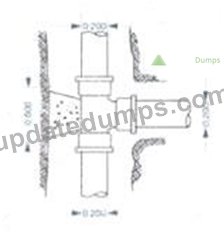
- A. 0.304 m
- B. 0.226 m
- C. 0.030 m
- D. 0.136 m
Answer: B
Explanation:
Thrust blocks resist unbalanced pressure forces at fittings (tees/bends/caps) by mobilizing bearing against undisturbed soil. The basic thrust relationship isForce = Pressure × Areaacting on the pipe's internal cross- sectional area. DIPRA's thrust restraint guide states that internal hydrostatic pressure acts on any plane with a force equal toP times A.
From the diagram, the pipe diameter is0.200 m, so pipe area. Thrust. Required soil bearing area. Given block face area, solve. Thus the minimumis0.226 m (Option C).
NEW QUESTION # 79
What does a system curve illustrate?
- A. The total head loss in a system of pipes as related to total flow
- B. The minimum radius at which a car can safely travel at 50 km/h
- C. The total fl as related to time
- D. The total length of the water mains as related to the water main diameter
Answer: A
Explanation:
Comprehensive and Detailed 150 to 200 words of Engineering documents and resources:
In pumped/pressurized pipe systems, thesystem curverepresents the hydraulic requirement of the piping network: the relationship betweenflow rate (Q)and thehead requiredto overcome elevation differences and losses. As flow increases, friction and minor losses rise (often approximately with Q² in turbulent flow regimes), so the system's required head increases with Q. This curve is used with a pump curve to find the operating point where pump head equals system head at a given flow. Standard civil engineering hydraulics references define head loss as a function of flow through friction and fittings, and system behavior is expressed by total head (static + losses) versus flow, which is exactly what the system curve shows.
Therefore, the system curve illustratestotal head loss (and required head) in the pipe system as a function of total flow, matching optionC.
NEW QUESTION # 80
......
Step by Step Guide to Prepare for Civil-Engineering-Technology Exam: https://www.updatedumps.com/CTTAM/Civil-Engineering-Technology-updated-exam-dumps.html