

CloudSec-Pro Exam Dumps Free Test Engine Verified By Cloud Security Engineer Certified Experts
Use Real Palo Alto Networks Achieve the CloudSec-Pro Dumps - 100% Exam Passing Guarantee
Palo Alto Networks CloudSec-Pro Exam Syllabus Topics:
| Topic | Details |
|---|---|
| Topic 1 |
|
| Topic 2 |
|
| Topic 3 |
|
| Topic 4 |
|
| Topic 5 |
|
NEW QUESTION # 117
The Prisma Cloud administrator has configured a new policy.
Which steps should be used to assign this policy to a compliance standard?
- A. Open the Compliance Standards section of the policy, and then save.
- B. Create the Compliance Standard from Compliance tab, and then select Add to Policy.
- C. Edit the policy, go to step 3 (Compliance Standards), click + at the bottom, select the compliance standard, fill in the other boxes, and then click Confirm.
- D. Custom policies cannot be added to existing standards.
Answer: C
Explanation:
To assign a new policy to a compliance standard in Prisma Cloud, the administrator needs to edit the policy and navigate to the step where compliance standards are managed. By clicking the '+' button, the administrator can add the policy to a specific compliance standard, provide necessary details, and confirm the assignment. This integrates the custom policy into the chosen compliance standard, ensuring that compliance checks include the newly defined policy criteria.
NEW QUESTION # 118
What is the default namespace created by Defender DaemonSet during deployment?
- A. Redlock
- B. Defender
- C. Twistlock
- D. Default
Answer: C
Explanation:
the default when using the script is twistlock, but you can use whatever you want. https://docs.
paloaltonetworks.com/prisma/prisma-cloud/prisma-cloud-admin-compute/configure
/set_diff_paths_daemon_sets
NEW QUESTION # 119
A customer has a requirement to restrict any container from resolving the name www.evil-url.com.
How should the administrator configure Prisma Cloud Compute to satisfy this requirement?
- A. Set www.evil-url.com as a blocklisted DNS name in the default Container runtime policy, and set the effect to block.
- B. Choose "copy into rule" for any Container, set www.evil-url.com as a blocklisted DNS name, and set the effect to prevent.
- C. Set www.evil-url.com as a blocklisted DNS name in the default Container policy and set the effect to prevent.
- D. Choose "copy into rule" for any Container, set www.evil-url.com as a blocklisted DNS name in the Container policy and set the policy effect to alert.
Answer: C
Explanation:
To restrict any container from resolving the name www.evil-url.com, the administrator should set www.evil- url.com as a blocklisted DNS name in the default Container policy and set the effect to prevent. This configuration in Prisma Cloud, or similar CSPM tools, ensures that any attempt to resolve the specified blocklisted DNS name within any container will be prevented, thus enhancing security by proactively blocking potential communication with known malicious domains.
Reference to this feature can be found in the documentation of CSPM tools that offer runtime protection for containers. These tools allow administrators to define security policies that can include DNS-based controls to prevent containers from accessing known malicious or undesirable URLs, thereby preventing potential data exfiltration, malware communication, or other security threats
NEW QUESTION # 120
Which serverless cloud provider is covered by the "overly permissive service access" compliance check?
- A. Alibaba
- B. Amazon Web Services (AWS)
- C. Google Cloud Platform (GCP)
- D. Azure
Answer: B
Explanation:
The "overly permissive service access" compliance check is specifically designed to evaluate and ensure that cloud services are not granted more permissions than necessary, which could lead to potential security risks.
Among the listed options, Amazon Web Services (AWS) is known for its extensive service offerings and the complexity of its Identity and Access Management (IAM) configurations. Prisma Cloud, a comprehensive cloud security platform by Palo Alto Networks, provides extensive support for AWS, including checks for overly permissive service access. This ensures that AWS environments adhere to the principle of least privilege, reducing the attack surface by limiting access to the minimum necessary to perform required tasks.
Prisma Cloud's capabilities in AWS environments are detailed in various resources, including documentation and guides provided by Palo Alto Networks, which highlight its effectiveness in identifying and mitigating risks associated with excessive permissions in AWS services.
NEW QUESTION # 121
Which order of steps map a policy to a custom compliance standard?
(Drag the steps into the correct order of occurrence, from the first step to the last.)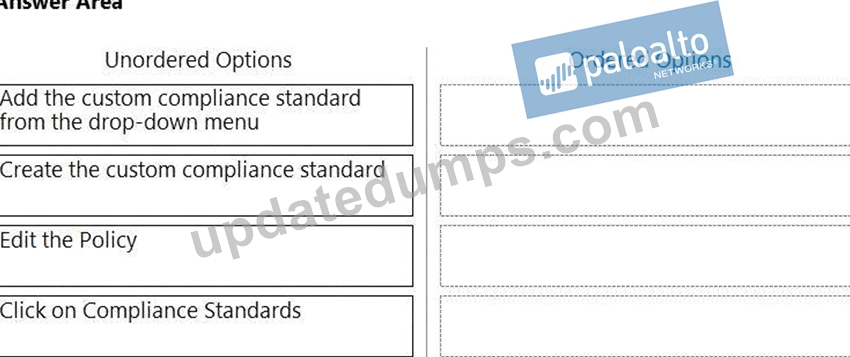
Answer:
Explanation: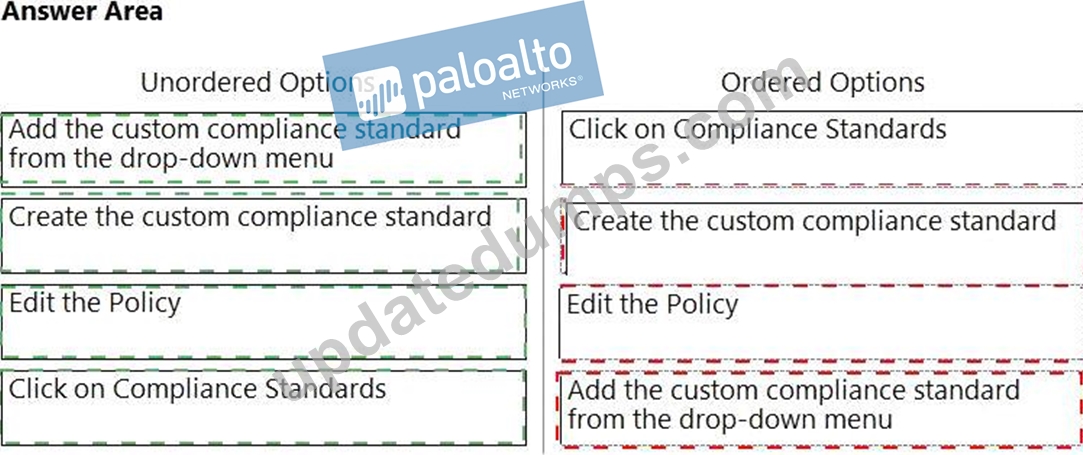
Explanation:
1. click on compliance standard.
2. add custom compliance standard.
3. edit policies.
4. add compliance standard from drop-down menu
https://docs.prismacloudcompute.com/docs/enterprise_edition/compliance/custom_compliance_checks.
html#creating-a-new-custom-check
The process of mapping a policy to a custom compliance standard in a security platform like Prisma Cloud by Palo Alto Networks involves several specific steps. Firstly, one must access the compliance standards, which is typically done by clicking on the "Compliance Standards" section within the platform's interface. This is where all standards, including custom and predefined ones, are listed.
Next, if the custom compliance standard does not already exist, it must be created. This step involves defining the criteria and controls that make up the standard, tailored to the organization's specific requirements.
Once the custom compliance standard is in place, the policy in question needs to be edited. This editing process would involve configuring the policy to align with the compliance controls outlined in the custom standard, ensuring that the policy will enforce or check for the necessary requirements as defined by the standard.
Finally, the last step is to formally associate or map the edited policy with the custom compliance standard.
This is typically done by adding the policy to the standard, which may involve selecting the custom compliance standard from a drop-down menu within the policy settings, confirming that this particular policy should be enforced as part of the compliance checks for that standard.
This ordered process ensures that policies are properly aligned with the organization's compliance goals and can be enforced and reported on accurately within the security platform.
NEW QUESTION # 122
Which statement about build and run policies is true?
- A. Every type of policy has auto-remediation enabled by default.
- B. The four main types of policies are: Audit Events, Build, Network, and Run.
- C. Run policies monitor network activities in the environment and check for potential issues during runtime.
- D. Build policies enable you to check for security misconfigurations in the IaC templates.
Answer: D
Explanation:
A true statement about build and run policies is A. Build policies enable you to check for security misconfigurations in the IaC templates. This capability is crucial for identifying potential security issues early in the development process, allowing for proactive mitigation before deployment, thereby enhancing the overall security posture of the applications and infrastructure being developed.
NEW QUESTION # 123
Which statement accurately characterizes SSO Integration on Prisma Cloud?
- A. Prisma Cloud supports IdP initiated SSO, and its SAML endpoint supports the POST and GET methods.
- B. An administrator who needs to access the Prisma Cloud API can use SSO after configuration.
- C. An administrator can configure different Identity Providers (IdP) for all the cloud accounts that Prisma Cloud monitors.
- D. Okta, Azure Active Directory, PingID, and others are supported via SAML.
Answer: D
Explanation:
Prisma Cloud supports Single Sign-On (SSO) integration through Security Assertion Markup Language (SAML), enabling users to authenticate using their existing identity providers (IdPs) such as Okta, Azure Active Directory, PingID, among others. This SSO integration allows for a seamless user authentication experience, where users can log in to Prisma Cloud using their credentials managed by their organization's IdP. The SAML protocol facilitates this by allowing secure exchange of authentication and authorization data between the IdP and Prisma Cloud.
This integration enhances security by centralizing user authentication, reducing the number of passwords users need to remember, and enabling organizations to enforce their security policies, such as multi-factor authentication (MFA) and password complexity, across their cloud security tools. SAML support is a common feature in cloud security platforms for integrating with various IdPs, making it a verified approach for Prisma Cloud as well.
NEW QUESTION # 124
Which three actions are required in order to use the automated method within Azure Cloud to streamline the process of using remediation in the identity and access management (IAM) module? (Choose three.)
- A. Install azure.servicebus & requests library.
- B. Integrate with Azure Service Bus.
- C. Configure IAM AWS remediation script.
- D. Configure IAM Azure remediation script.
- E. Install boto3 & requests library.
Answer: A,B,D
Explanation:
To use the automated method within Azure Cloud for streamlining the process of using remediation in the identity and access management (IAM) module, the required actions include configuring the IAM Azure remediation script, integrating with Azure Service Bus, and installing the azure.servicebus & requests library.
These steps ensure that the automated remediation system can communicate effectively with Azure services, execute the necessary remediation actions, and address IAM-related alerts by adjusting permissions and access controls as needed. This automation helps maintain a secure and compliant cloud environment by promptly addressing potential IAM issues.
https://docs.paloaltonetworks.com/prisma/prisma-cloud/prisma-cloud-admin/prisma-cloud-iam-security
/remediate-alerts-for-iam-security
NEW QUESTION # 125
Prisma Cloud cannot integrate which of the following secrets managers?
- A. IBM Secret Manager
- B. AWS Secret Manager
- C. AzureKey Vault
- D. HashiCorp Vault
Answer: A
Explanation:
Prisma Cloud integrates with various secret managers to manage sensitive information such as passwords, tokens, and keys. However, it cannot integrate with IBM Secret Manager. The other options, Azure Key Vault, HashiCorp Vault, and AWS Secret Manager, are supported for integration with Prisma Cloud, providing secure storage and handling of secrets.
NEW QUESTION # 126
Which file extension type is supported for Malware scanning in Prisma Cloud Data Security (PCDS)?
- A. .vb
- B. .apk
- C. .bat
- D. .py
Answer: B
Explanation:
bat --> Data Classification
apk --> Malware Scanning
vb --> Data Classification
py --> Data Classification
https://docs.paloaltonetworks.com/prisma/prisma-cloud/prisma-cloud-admin/prisma-cloud-data-security
/monitor-data-security-scan-prisma-cloud/supported-file-extensions
Prisma Cloud Data Security (PCDS) supports various file types for malware scanning, including .apk files, which are Android Package files used for installing applications on Android operating systems. This support is crucial for ensuring that applications deployed on or distributed through Android devices are free from malware and safe for user installation.
NEW QUESTION # 127
Which three options are selectable in a CI policy for image scanning with Jenkins or twistcli? (Choose three.)
- A. Failure threshold
- B. Credential
- C. Scope - Scans run on a particular host
- D. Grace Period
- E. Apply rule only when vendor fixes are available
Answer: A,C,E
Explanation:
https://docs.paloaltonetworks.com/prisma/prisma-cloud/prisma-cloud-admin-compute/continuous_integration
/set_policy_ci_plugins
NEW QUESTION # 128
A customer finds that an open alert from the previous day has been resolved. No auto-remediation was configured.
Which two reasons explain this change in alert status? (Choose two.)
- A. policy was changed.
- B. user manually changed the alert status.
- C. alert was sent to an external integration.
- D. resource was deleted.
Answer: A,D
Explanation:
RESOURCE_DELETED Resource was deleted. USER_DISMISSED Alert was dismissed or snoozed by the Prisma Cloud administrator with role of System admin, Account Group Admin, or Account and Cloud Provisioning Admin. POLICY_UPDATED Policy was updated. This status indicates a change in the policy RQL that results in a resource not being in scope for the policy evaluation.
https://knowledgebase.paloaltonetworks.com/KCSArticleDetail?id=kA14u0000004OQ2CAM
NEW QUESTION # 129
Given this information:
The Console is located at https://prisma-console.mydomain.local The username is: cluster The password is: password123 The image to scan is: myimage:latest Which twistcli command should be used to scan a Container for vulnerabilities and display the details about each vulnerability?
- A. twistcli images scan --address https://prisma-console.mydomain.local -u cluster -p password123 -- details myimage:latest
- B. twistcli images scan --address prisma-console.mydomain.local -u cluster -p password123 -- vulnerability- details myimage:latest
- C. twistcli images scan --console-address https://prisma-console.mydomain.local -u cluster -p password123 -- details myimage:latest
- D. twistcli images scan --console-address prisma-console.mydomain.local -u cluster -p password123 -- vulnerability-details myimage:latest
Answer: A
Explanation:
https://docs.paloaltonetworks.com/prisma/prisma-cloud/prisma-cloud-admin-compute/tools
/twistcli_scan_images
NEW QUESTION # 130
You are tasked with configuring a Prisma Cloud build policy for Terraform. What type of query is necessary to complete this policy?
- A. CloudFormation
- B. Terraform
- C. YAML
- D. JSON
Answer: D
Explanation:
"you can also create configuration policies to scan your Infrastructure as Code (IaC) templates that are used to deploy cloud resources. The policies used for scanning IaC templates use a JSON query instead of RQL."
https://docs.paloaltonetworks.com/prisma/prisma-cloud/prisma-cloud-admin/prisma-cloud-policies/create-a- policy
NEW QUESTION # 131
Which options show the steps required after upgrade of Console?
- A. Uninstall Defenders Upgrade Jenkins PluginUpgrade twistcli where applicableAllow the Console to redeploy the Defender
- B. Upgrade Defenders Upgrade Jenkins Plugin Upgrade twistcli where applicable
- C. Update the Console image in the Twistlock hosted registry Update the Defender image in the Twistlock hosted registry Redeploy Console
- D. Update the Console image in the Twistlock hosted registry Update the Defender image in the Twistlock hosted registry Uninstall Defenders
Answer: B
Explanation:
After the Console has been upgraded, check and upgrade any of the Defenders that have reached the end of their support lifecycle (Defenders are backward compatible for N-2 releases). The Defender release image is built from the UBI8-minimal base image and on upgrade it is a full container image upgrade, which means that the old Defender container is replaced with a new container. Then, upgrade all other Prisma Cloud components, such as the Jenkins plugin. https://docs.paloaltonetworks.com/prisma/prisma-cloud/prisma-cloud- admin-compute/upgrade/upgrade_process_saas
NEW QUESTION # 132
The security team wants to target a CNAF policy for specific running Containers. How should the administrator scope the policy to target the Containers?
- A. scope the policy to Host names.
- B. scope the policy to namespaces.
- C. scope the policy to Defender names.
- D. scope the policy to Image names.
Answer: D
Explanation:
To specifically target running containers with a Cloud Native Application Framework (CNAF) policy in Prisma Cloud, the administrator should scope the policy to Image names. By doing so, the policy will apply to containers based on the images they were created from, allowing for precise targeting of security policies to specific containers. This approach is part of Prisma Cloud's capabilities to provide granular security controls for containerized environments, ensuring that policies are effectively applied to the relevant containers.
https://docs.paloaltonetworks.com/prisma/prisma-cloud/prisma-cloud-admin-compute/waas/deploy_waas
/deployment_containers
NEW QUESTION # 133
Which data security default policy is able to scan for vulnerabilities?
- A. Objects containing Threats
- B. Objects containing Exploits
- C. Objects containing Malware
- D. Objects containing Vulnerabilities
Answer: C
Explanation:
The data security default policy capable of scanning for vulnerabilities is "Objects containing Malware". In cloud security, malware scanning is an essential feature of CSPM tools that allows for the identification of malicious software within objects stored in the cloud. A policy that scans for objects containing malware ensures that any files or code bases in the cloud environment are examined for potential threats, protecting the cloud resources from being compromised.
NEW QUESTION # 134
Which port should a security team use to pull data from Console's API?
- A. 0
- B. 1
- C. 2
- D. 3
Answer: C
Explanation:
Both Console's API and web interfaces, served on port 8083 (HTTPS), require authentication over a different channel with different credentials (e.g. username and password, access key, and so on), none of which Defender holds. https://docs.paloaltonetworks.com/prisma/prisma-cloud/22-06/prisma-cloud-compute-edition- admin/technology_overviews/defender_architecture
NEW QUESTION # 135
What is the order of steps to create a custom network policy?
(Drag the steps into the correct order of occurrence, from the first step to the last.)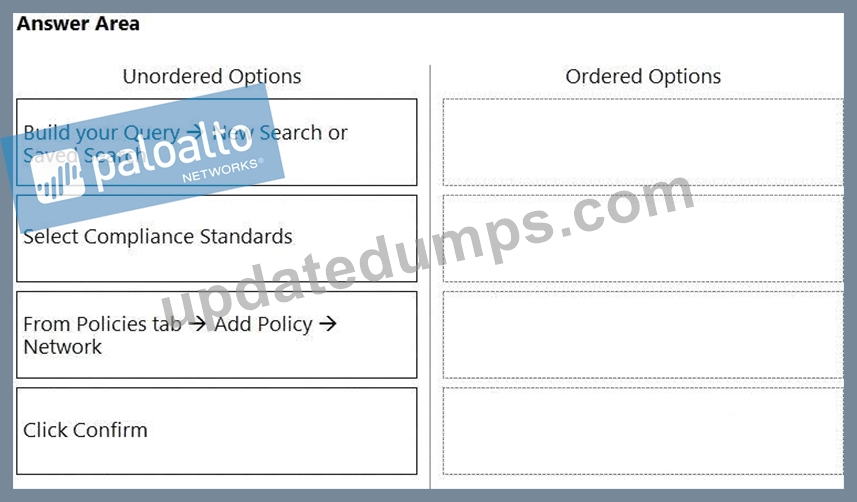
Answer:
Explanation: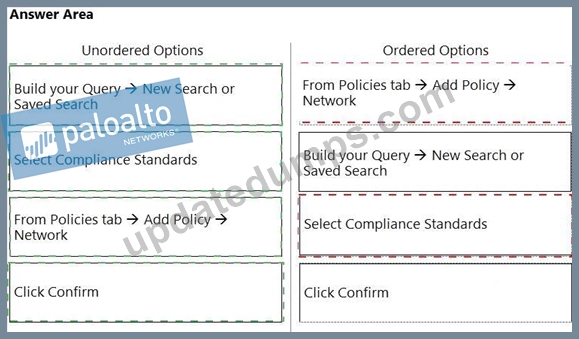
Explanation:
A picture containing table Description automatically generated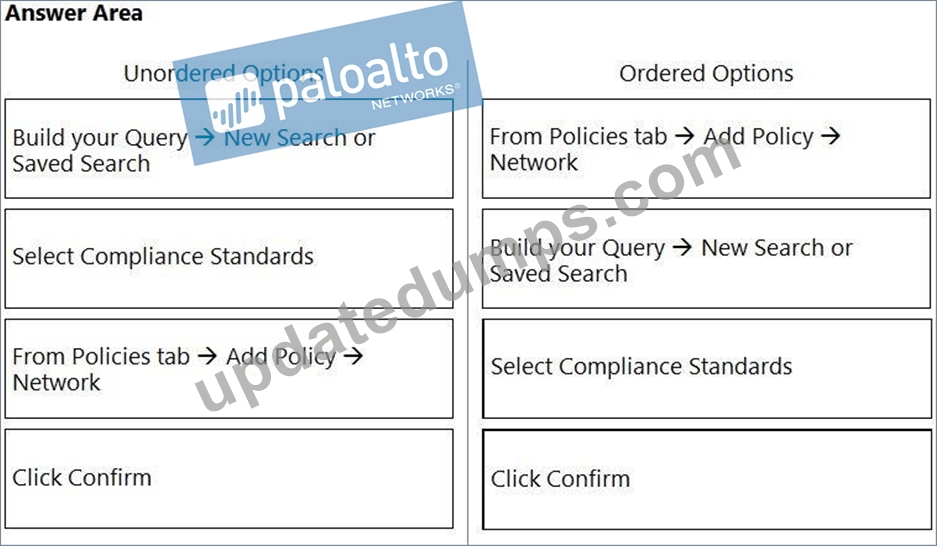
Reference:
https://docs.paloaltonetworks.com/prisma/prisma-cloud/prisma-cloud-admin/prisma-cloud-policies/create-a- policy.html Select Policies and click Add Policy Build the query Add the compliance standards Click Submit.
https://docs.paloaltonetworks.com/prisma/prisma-cloud/prisma-cloud-admin/prisma-cloud-policies/create-a- policy
NEW QUESTION # 136
A customer has a requirement to scan serverless functions for vulnerabilities.
What is the correct option to configure scanning?
- A. Use Lambda layers to deploy a Defender into the function.
- B. Configure a function scan policy from the Defend > Vulnerabilities > Functions page.
- C. Embed serverless Defender into the function.
- D. Configure serverless radar from the Defend > Compliance > Cloud Platforms page.
Answer: B
Explanation:
In Prisma Cloud, the capability to scan serverless functions, such as AWS Lambda functions, for vulnerabilities is an integral part of ensuring cloud security posture management (CSPM) and compliance.
Specifically, option C is correct because Prisma Cloud provides a dedicated section for defining policies related to serverless function vulnerabilities under the "Defend > Vulnerabilities > Functions" page. This feature allows administrators to create and manage policies that automatically scan serverless functions for known vulnerabilities, ensuring that the functions comply with the organization's security standards before they are deployed. This approach aligns with Prisma Cloud's comprehensive security model that covers various aspects of cloud security, including serverless functions, as outlined in the "Guide to Cloud Security Posture Management Tools" document
https://docs.paloaltonetworks.com/prisma/prisma-cloud/22-12/prisma-cloud-compute-edition-admin
/vulnerability_management/serverless_functions
NEW QUESTION # 137
A security team has a requirement to ensure the environment is scanned for vulnerabilities. What are three options for configuring vulnerability policies? (Choose three.)
- A. output verbosity for blocked requests
- B. individual actions based on package type
- C. customize message on blocked requests
- D. individual grace periods for each severity level
- E. apply policy only when vendor fix is available
Answer: B,D,E
Explanation:
https://docs.paloaltonetworks.com/prisma/prisma-cloud/prisma-cloud-admin-compute
/vulnerability_management/vuln_management_rules
Configuring vulnerability policies within Prisma Cloud involves several options that cater to different aspects of vulnerability management and policy enforcement. Options A, C, and D are valid configurations for vulnerability policies:
A). Individual actions based on package type allow for tailored responses to vulnerabilities found in specific types of software packages, enabling more granular control over the remediation process.
C). Applying policies only when a vendor fix is available helps prioritize the remediation of vulnerabilities for which a patch or update has been released by the software vendor, ensuring efficient use of resources in addressing the most actionable security issues.
D). Setting individual grace periods for each severity level allows organizations to define different time frames for addressing vulnerabilities based on their severity, enabling a prioritized and risk-based approach to vulnerability management.
These configurations support a comprehensive vulnerability management strategy by allowing customization and prioritization based on the nature of the vulnerability, the availability of fixes, and the risk level associated with each vulnerability.
NEW QUESTION # 138
Which component(s), if any, will Palo Alto Networks host and run when a customer purchases Prisma Cloud Enterprise Edition?
- A. Defenders
- B. twistcli
- C. Jenkins
- D. Console
Answer: D
Explanation:
In Prisma Cloud Enterprise Edition, Palo Alto Networks hosts and runs the Console component. The Console serves as the central management interface for Prisma Cloud, allowing customers to configure policies, view alerts, and manage their cloud security posture without the need to host this component themselves.
NEW QUESTION # 139
Which IAM Azure RQL query would correctly generate an output to view users who have sufficient permissions to create security groups within Azure AD and create applications?
- A. config from cloud.resource where api.name = 'azure-active-directory-authorization-policy' AND json.
rule = defaultUserRolePermissions exists - B. config from cloud.resource where api.name = 'azure-active-directory-authorization-policy' AND json.rule = defaultUserRolePermissions.allowedToCreateSecurityGroups is true and defaultUserRolePermissions.allowedToCreateApps is true
- C. config where api.name = 'azure-active-directory-authorization-policy' AND json.rule = defaultUserRolePermissions.allowedToCreateSecurityGroups is true and defaultUserRolePermissions.
allowedToCreateApps is true - D. config from network where api.name = 'azure-active-directory-authorization-policy' AND json.rule = defaultUserRolePermissions.allowedToCreateSecurityGroups is false and defaultUserRolePermissions.
allowedToCreateApps is true
Answer: B
Explanation:
The correct RQL query to view users who have sufficient permissions to create security groups within Azure AD and create applications is option D. This query is specifically designed to assess policies within Azure Active Directory (Azure AD) by checking the authorization policy settings related to user default role permissions. The query targets the azure-active-directory-authorization-policy API to fetch configurations (config from cloud.resource) and then filters those configurations based on the JSON rules that dictate whether users are allowed to create security groups (defaultUserRolePermissions.
allowedToCreateSecurityGroups is true) and applications (defaultUserRolePermissions.allowedToCreateApps is true). This query provides a comprehensive check by ensuring both conditions are met, which is necessary for users to have the combined capabilities of creating security groups and applications within Azure AD.
In the context of Prisma Cloud and cloud security principles, the RQL (Resource Query Language) is utilized for querying the configuration state of resources within cloud environments to ensure compliance with security policies. The RQL syntax in option D precisely aligns with the requirements for identifying users with specific permissions, leveraging Prisma Cloud's capability to provide visibility and control over cloud resources, as emphasized in various resources like the "Prisma Cloud Visibility and Control Qualification Guide" and the "Guide to Cloud Security Posture Management Tools." These documents highlight the importance of continuous monitoring and validation of cloud resource configurations to maintain a secure and compliant cloud environment, which is effectively achieved through targeted RQL queries like the one in option D.
References:
"Prisma Cloud Visibility and Control Qualification Guide" discusses the importance of visibility and compliance in cloud environments, which is directly applicable to the use of RQL for querying resource configurations.
"Guide to Cloud Security Posture Management Tools" emphasizes the need for comprehensive visibility and governance across cloud environments, further supporting the rationale behind the specific RQL query used to assess user permissions in Azure AD.
NEW QUESTION # 140
A Systems Engineer is the administrator of a self-hosted Prisma Cloud console. They upgraded the console to the latest version. However, after the upgrade, the console does not show all the policies configured. Before they upgraded the console, they created a backup manually and exported it to a local drive. Now they have to install a Prisma Cloud to restore from the backup that they manually created. Which Prisma Cloud version can they can restore with the backup?
- A. The same version of the Prisma Cloud Self-Hosted Console that the backup created
- B. The latest version of Prisma Cloud Self-Hosted Console
- C. Up to N-2 versions of the Prisma Cloud Self-Hosted Console that the backup created
- D. Any version of Prisma Cloud Self-Hosted Console
Answer: A
Explanation:
https://docs.prismacloud.io/en/compute-edition/31/admin-guide/configure/disaster-recovery In scenarios where a backup is created manually before upgrading a self-hosted console, it is crucial to restore the system using the backup that matches the version of the Prisma Cloud Self-Hosted Console from which it was taken. This ensures compatibility and integrity of the data and configurations. Using a backup with a different version of the console may lead to inconsistencies or loss of information due to potential changes in the software's data structures or features between versions. Therefore, to ensure a successful restoration, the backup must be applied to the same version of the Prisma Cloud Self-Hosted Console that it was created from.
NEW QUESTION # 141
......
Check the Free demo of our CloudSec-Pro Exam Dumps with 260 Questions: https://www.updatedumps.com/Palo-Alto-Networks/CloudSec-Pro-updated-exam-dumps.html