

Feb 04, 2026 Newest PMI-ACP Exam Dumps – Achieve Success in Actual PMI-ACP Exam
Updated PMI PMI-ACP Dumps – Check Free PMI-ACP Exam Dumps (2026)
NEW QUESTION # 268
Which technique is used by a project team to estimate the amount of work that can be done per iteration?
- A. Relative prioritization
- B. Velocity measurement
- C. Planning Poker
- D. Release planning
Answer: B
Explanation:
Explanation/Reference:
Explanation:
NEW QUESTION # 269
A team identifies the number of threats and lists them in the order in which they were identified. After analyzing a cause-and-effect diagram, the ownership of the threats and their treatment is assigned, and a number of risk cards are placed on the Kanban board.
What approach should be used to manage these threats?
- A. Ensure that the prioritization of threats is complete, and that ownership actions are assigned and visible to everyone.
- B. Focus on the threats during the daily stand up and ensure they are visible to the entire team and other interested parties.
- C. Create a risk register detailing the threats, their causes, and their treatment strategies; and complete ownership to provide tighter risk control and a stakeholder communication tool.
- D. Prioritize the risks based on their criticality and timing, and track actions to closure.
Answer: D
NEW QUESTION # 270
A meeting where a team looks back on a past period of work so that they can learn from their experience and apply this learning to future projects is popularly known as?
- A. Status Meeting
- B. Sprint Review Meeting
- C. Sprint Planning Meeting
- D. Retrospective
Answer: D
NEW QUESTION # 271
An organization initiates a pilot project to introduce agile methodology for the successful delivery of projects.
What should the project manager do to share this project's knowledge and learning with wider organizational business groups?
- A. invite people from across the organization to attend retrospectives
- B. Regularly meet with people across the organization to share the project's lessons learned and best practices
- C. Invite people from across the organization to attend the release meeting and project retrospectives
- D. invite people from across the organization to attend daily stand ups
Answer: B
NEW QUESTION # 272
What are the three pillars of Scrum?
- A. Transparency, Inspection, and Adaption
- B. Transparency, Acceptance and Adaptation
- C. Transparency, Inspection, and Empiricism
- D. Retrospectives, Inspection, and Adaptation
Answer: A
NEW QUESTION # 273
An agile team is working on the first sprint, and have already planned the second and third sprints. However, market conditions now require a change to the features. What should the product owner do?
- A. Meet with the agile team lead to prioritize the requirements.
- B. Ask the team to discuss the changes to the features with the customer.
- C. Discuss and prioritize the requirements with the team.
- D. Communicate the importance of the business need to the team and refine the product backlog.
Answer: D
NEW QUESTION # 274
Which of the seven principles of software development is best intended to solve the problem of inventories causing hidden errors in the process?
- A. Optimize the Whole
- B. Fast-Flexible-Flow
- C. Eliminate Waste
- D. Deliver Early and Often
Answer: C
Explanation:
Explanation/Reference:
NEW QUESTION # 275
DRY is an acronym for which Agile development principle?
- A. Develop, Refactor, Yagni
- B. Development Requires You
- C. Don't Repeat Yourself
- D. Deploy Repeatedly
Answer: C
NEW QUESTION # 276
How should a project leader manage stakeholder expectations in an agile project?
- A. Invite stakeholders for the iteration reviews but do not include new stakeholders which may limit project success.
- B. Establish a common vision and success criteria and involve all the stakeholders in the iteration reviews.
- C. Communicate issues to all stakeholders via email and only communicate risks to internal stakeholders.
- D. Involve all the stakeholders in iteration reviews but do not entertain all expectations of all stakeholders.
Answer: B
NEW QUESTION # 277
An experienced product owner presents the epics and corresponding stones during a release planning session with the established team. The executive sponsor asks the team when the features will be delivered.
What should the agile team do?
- A. Consult historical data for project completion
- B. Identify a set of user stones based on the team's velocity
- C. Evaluate how much can be delivered based on the Scrum Master's estimation
- D. Initiate an estimation session
Answer: D
NEW QUESTION # 278
This role would be responsible for determining when a release can occur:
- A. Product Owner
- B. Development Team
- C. Scrum Master
- D. Agile Project Manager
Answer: A
NEW QUESTION # 279
What are the three components of an Agile Project Charter? (Choose three.)
- A. Objectives
- B. Vision
- C. Mission
- D. Success Criteria
- E. Scope
- F. Risks
Answer: B,C,D
NEW QUESTION # 280
During the iteration planning of a newly onboarded agile team, the product owner adds a set of high priority user stories into the iteration backlog. What should the team do first to define the tasks needed to implement the user stories?
- A. Identify the Scrum Master
- B. Assign tasks to each team member
- C. Meet with the customer
- D. Self-organize
Answer: D
Explanation:
The correct answer is A - Self-organize. One of the fundamental principles of agile is that teams are self- organizing and cross-functional. During iteration planning, once the stories are accepted into the sprint, the team collaborates to break down those stories into tasks and assign work among themselves based on skills and interest.
From the PMI Agile Practice Guide:
"Agile teams are self-organizing, meaning they collectively decide how to accomplish their work, rather than being directed by others. This principle supports autonomy and trust, and enhances team ownership and commitment." (PMI Agile Practice Guide, Section 4.3 - Team Performance) Mike Griffiths reinforces:
"Agile teams are trusted to manage themselves. Once user stories are selected during iteration planning, the team decomposes stories into tasks and self-assigns work collaboratively." (Mike Griffiths, PMI-ACP Exam Prep, Chapter 4 - Team Performance) Incorrect options:
* B contradicts agile principles of self-assignment and voluntary collaboration.
* C may be valuable for clarification but is not the first action after stories are added.
* D identifying the Scrum Master is irrelevant to the task breakdown phase.
NEW QUESTION # 281
Which is NOT a Scrum Role?
- A. Team Member
- B. Scrum Master
- C. Project Manager
- D. Product Owner
Answer: C
NEW QUESTION # 282
Agile Teams use Planning Poker for estimation. Which of the following is NOT true about Planning Poker?
- A. It combines expert opinion, analogy, and disaggregation into an enjoyable approach to estimating that results in quick but reliable estimates.
- B. Participants include all of the developers on the team
- C. The highest estimate is considered the final estimate
- D. The team for Planning Poker should not exceed more than 10 participants
Answer: C
NEW QUESTION # 283
A new CIO advocates an agile framework for new IT projects, but the team has reservations. How should the CIO ensure that the team will be aligned with this?
- A. Require all staff and management to attend agile training and adhere to its principles.
- B. Introduce agile principles and processes, then make the change an experiment to obtain buy-in.
- C. Issue a memo of understanding that agile principles should be implemented for all new projects.
- D. Obtain executive team buy-in by conducting a meeting to present the advantages of agile principles and processes.
Answer: D
NEW QUESTION # 284
During a project's last iteration, an agile team struggled with a feature's delivery due to the lack of a required skill. The project has already incurred a five-day delay. A further delay of at least 10 days is anticipated.
What should the agile project leader have done to avoid this situation?
- A. Assigned the feature to another agile team that had members with the required skills
- B. Lowered the feature's priority until a team member acquired the skill to build it
- C. Ensured that the team was comprised of cross-functional, generalized specialists
- D. Provided just-in-time training of the required skill to specific team members
Answer: C
Explanation:
The correct answer is D - Ensured that the team was comprised of cross-functional, generalized specialists.
Agile teams are expected to be cross-functional and self-sufficient. A lack of a required skill that halts progress typically points to an improperly constructed team. Building teams with broad (T-shaped) skills ensures they can collectively deliver value without external dependencies.
From the PMI Agile Practice Guide:
"Agile teams are ideally composed of cross-functional members who have both depth in a specialty and breadth across disciplines. This enables the team to self-organize and deliver complete increments of value." (PMI Agile Practice Guide, Section 4.1 - Building Agile Teams) Mike Griffiths elaborates:
"Agile favors generalized specialists or T-shaped professionals who can collaborate across functions. This improves agility, resilience, and continuity within iterations." (Mike Griffiths, PMI-ACP Exam Prep Book, Chapter 4 - Team Performance) Why the other options are insufficient:
* A is a reactive strategy; proactive skill assessment is preferred.
* B may delay critical features unnecessarily.
* C creates external dependencies, which agile seeks to avoid.
NEW QUESTION # 285
A project's first iteration contains item A, and its second iteration contains item B. The first iteration is behind schedule, which will impact the second iteration. Since items A and B are similar, a team member suggests beginning the design of item B.
What should the agile practitioner do?
- A. Escalate the issue to the customer, and obtain their approval before starting the design of item B
- B. Log the issue in the risk, and request change control board (CCB) approval
- C. Defer starting the design of item B until the second iteration is being planned
- D. Proceed with the design of item B, since it will hasten the second iteration
Answer: C
NEW QUESTION # 286
What is the order the hierarchy of product definition?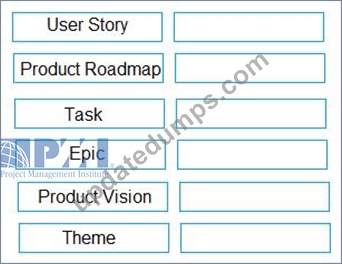
Answer:
Explanation: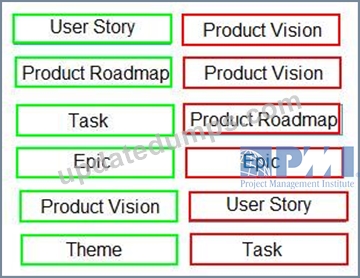
NEW QUESTION # 287
Drag and Drop Question
What is the order the hierarchy of product definition?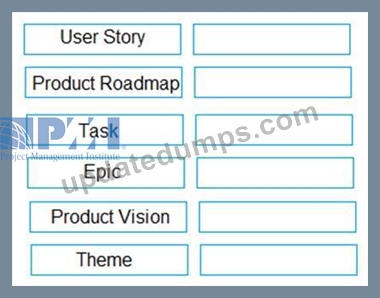
Answer:
Explanation: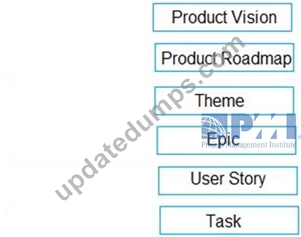
NEW QUESTION # 288
......
Actual PMI-ACP Exam Recently Updated Questions with Free Demo: https://www.updatedumps.com/PMI/PMI-ACP-updated-exam-dumps.html
Valid PMI-ACP exam with PMI Real Exam Questions: https://drive.google.com/open?id=1rSfM9UaIJq02CUdcASLyqq57BQOlrdKk