

[Feb-2026] JN0-637 Dumps With 100% Verified Q&As - Pass Guarantee or Full Refund
Pass Juniper JN0-637 Exam With Practice Test Questions Dumps Bundle
Juniper JN0-637 Exam Syllabus Topics:
| Topic | Details |
|---|---|
| Topic 1 |
|
| Topic 2 |
|
| Topic 3 |
|
| Topic 4 |
|
| Topic 5 |
|
| Topic 6 |
|
NEW QUESTION # 29
Exhibit: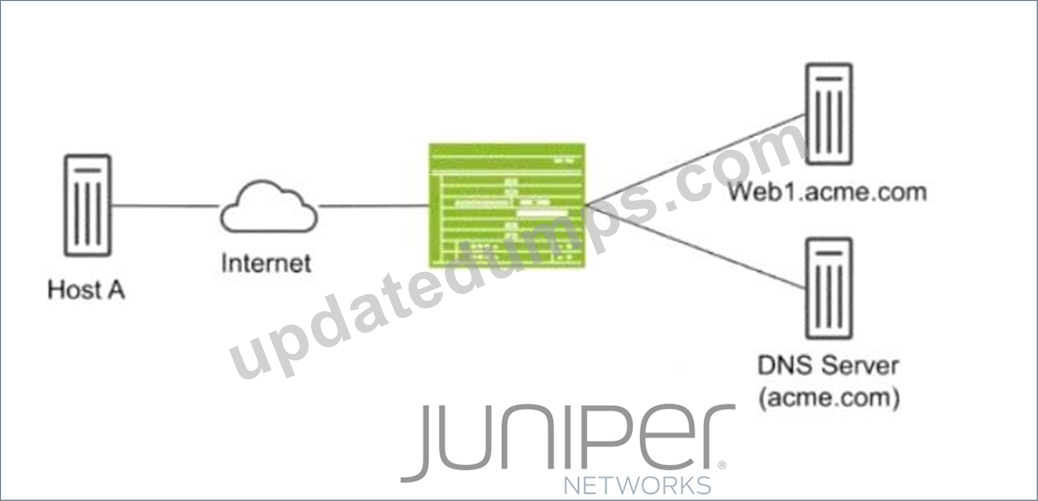
Host A shown in the exhibit is attempting to reach the Web1 webserver, but the connection is failing.
Troubleshooting reveals that when Host A attempts to resolve the domain name of the server (web.acme.
com), the request is resolved to the private address of the server rather than its public IP.
Which feature would you configure on the SRX Series device to solve this issue?
- A. Double NAT
- B. STUN protocol
- C. DNS doctoring
- D. Persistent NAT
Answer: C
Explanation:
DNS doctoring modifies DNS responses for hosts behind NAT devices, allowing them to receive the correct public IP address for internal resources when queried from the public network. This prevents issues where private IPs are returned and are not reachable externally. For details, visit Juniper DNS Doctoring Documentation.
In this scenario, Host A is trying to resolve the domain nameweb.acme.com, but the DNS resolution returns the private IP address of the web server instead of its public IP. This is a common issue in networks where private addresses are used internally, but public addresses are required for external clients.
* Explanation of Answer C (DNS Doctoring):
* DNS doctoringis a feature that modifies DNS replies as they pass through the SRX device. In this case, DNS doctoring can be used to replace the private IP address returned in the DNS response with the correct public IP address for Host A. This allows external clients to reach internal resources without being aware of their private IP addresses.
Configuration Example:
bash
Copy code
set security nat dns-doctoring from-zone untrust to-zone trust
Juniper Security Reference:
* DNS Doctoring Overview: DNS doctoring is used to modify DNS responses so that external clients can access internal resources using public IP addresses. Reference: Juniper DNS Doctoring Documentation.
NEW QUESTION # 30
Exhibit: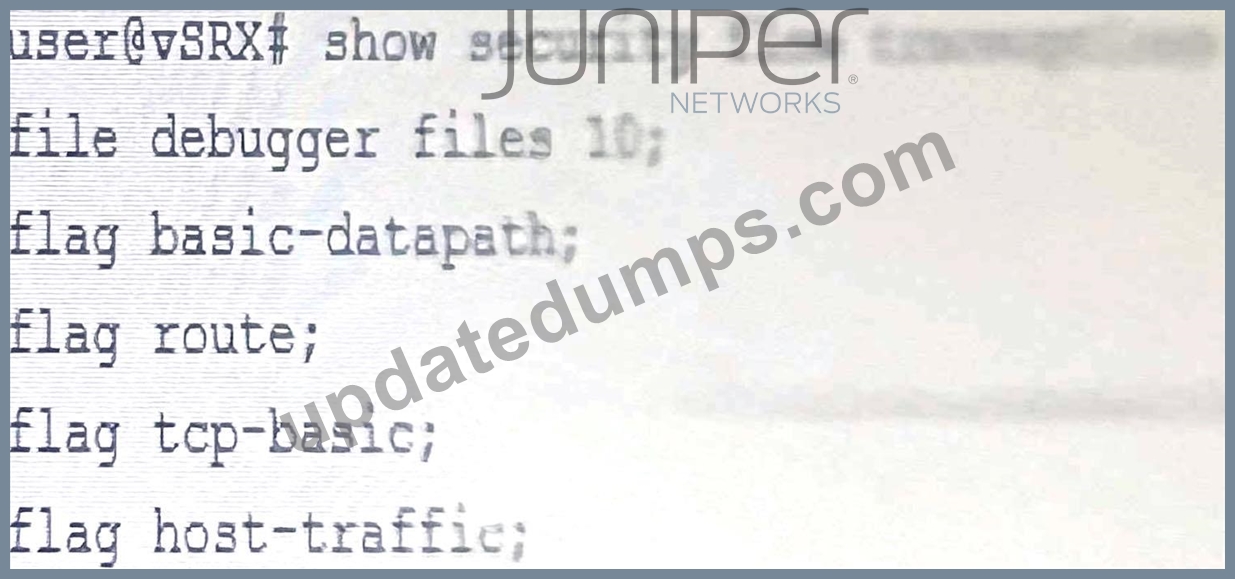
The security trace options configuration shown in the exhibit is committed to your SRX series firewall.
Which two statements are correct in this Scenario? (Choose Two)
- A. The file debugger will be readable only by the user who committed this configuration
- B. Once the trace has generated 10 log files, the trace process will halt.
- C. Once the trace has generated 10 log files, older logs will be overwritten.
- D. The file debugger will be readable by all users.
Answer: B,C
Explanation:
Once the trace has generated 10 log files, older logs will be overwritten. - This is generally true if the configuration includes a file count limit and the 'world-readable' flag. Without the 'world-readable' flag, only the file's owner or superuser can read the file. If the 'no-world-readable' flag is set, only the user that created the file and root can read it.
Once the trace has generated 10 log files, the trace process will halt. - This would be true only if the 'files' statement is used without the 'world-readable' or 'no-world-readable' flag. If 'no-world-readable' is set, the trace files are not readable by all users.
NEW QUESTION # 31
You configured two SRX series devices in an active/passive multimode HA setup.
In this scenario, which statement is correct?
- A. Both devices start in a hold state until the activeness determination process is completed.
- B. Both devices are in the passive state until the activeness determination process is completed.
- C. Both devices are in the active state until the activeness determine determination process is completed.
- D. Both devices start in the undiscovered state until the activeness determination process is completed.
Answer: C
NEW QUESTION # 32
You are deploying a virtualization solution with the security devices in your network Each SRX Series device must support at least 100 virtualized instances and each virtualized instance must have its own discrete administrative domain.
In this scenario, which solution would you choose?
- A. virtual router instances
- B. tenant systems
- C. VRF instances
- D. logical systems
Answer: D
NEW QUESTION # 33
In an effort to reduce client-server latency transparent mode was enabled an SRX series device.
Which two types of traffic will be permitted in this scenario? (Choose Two.)
- A. IPsec
- B. ARP
- C. BGP
- D. Layer 2 non-IP multicast
Answer: B,D
NEW QUESTION # 34
Exhibit: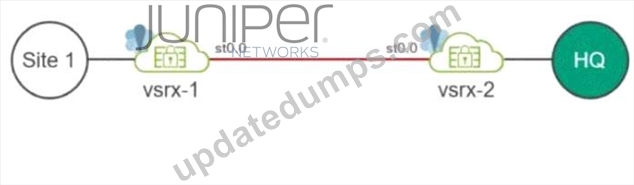
Your company uses SRX Series devices to establish an IPsec VPN that connects Site-1 and the HQ networks.
You want VoIP traffic to receive priority over data traffic when it is forwarded across the VPN.
Which three actions should you perform in this scenario? (Choose three.)
- A. Enable the copy-outer-dscp parameter so that DSCP header values are copied to the tunneled packets.
- B. Configure CoS forwarding classes and scheduling parameters.
- C. Enable the multi-sa parameter to enable two separate IPsec SAs for the VoIP and data traffic.
- D. Enable next-hop tunnel binding.
- E. Create a firewall filter that identifies VoIP traffic and associates it with the correct forwarding class.
Answer: B,D,E
Explanation:
In this scenario, you are prioritizing VoIP traffic over data traffic across an IPsec VPN. Here are the necessary actions:
* Enable next-hop tunnel binding (Answer A): This is required to bind the VPN traffic to a specific tunnel interface (like st0.0). It allows differentiated forwarding behavior (like prioritizing VoIP) for specific traffic types.
Command Example:
bash
Copy code
set interfaces st0.0 next-hop-tunnel-service
* Create a firewall filter (Answer B): The filter will match VoIP traffic based on criteria such as DSCP marking or ports (like port 5060 for SIP). Once identified, the traffic will be associated with a forwarding class, ensuring it gets prioritized.
Command Example:
bash
Copy code
set firewall family inet filter VoIP-Filter term VoIP from protocol udp set firewall family inet filter VoIP-Filter term VoIP from port 5060 set firewall family inet filter VoIP-Filter term VoIP then forwarding-class voice
* Configure CoS (Class of Service) forwarding classes (Answer C): CoS parameters define how the SRX handles different types of traffic (scheduling, shaping, etc.). VoIP traffic must be assigned a higher priority than data.
Command Example:
bash
Copy code
set class-of-service forwarding-classes voice
set class-of-service forwarding-classes data
set class-of-service schedulers voice_scheduler transmit-rate percent 50 These configurations ensure that VoIP traffic is identified, classified, and forwarded with priority.
NEW QUESTION # 35
Exhibit: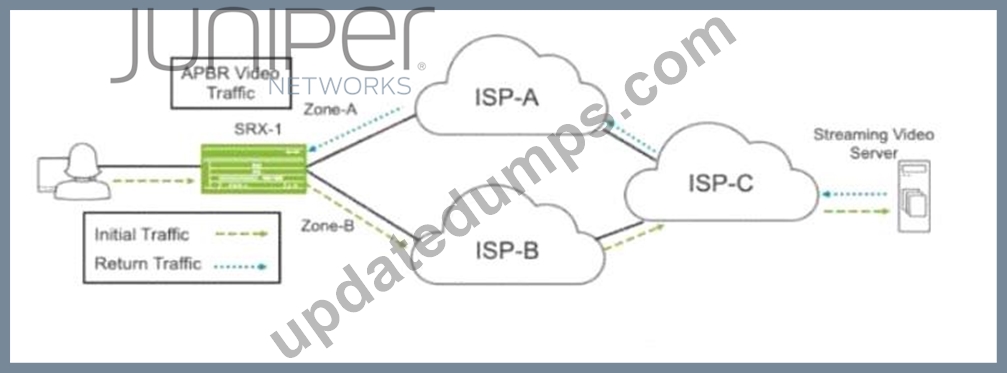
Referring to the exhibit, a default static route on SRX-1 sends all traffic to ISP-A. You have configured APBR to send all requests for streaming video traffic to ISP-B. However, the return traffic from the streaming video server is coming through ISP-A, and the traffic is being dropped by SRX-1. You can only make changes on SRX-1.
How do you solve this problem?
- A. Configure BGP to control the return path of the streaming video traffic.
- B. Place both ISP-facing interfaces in the same zone.
- C. Change the APBR routing instance from a forwarding instance to a virtual router instance.
- D. Enable AppTrack to keep track of the sessions and zones for the streaming video traffic.
Answer: A
Explanation:
Explanation:
NEW QUESTION # 36
Exhibit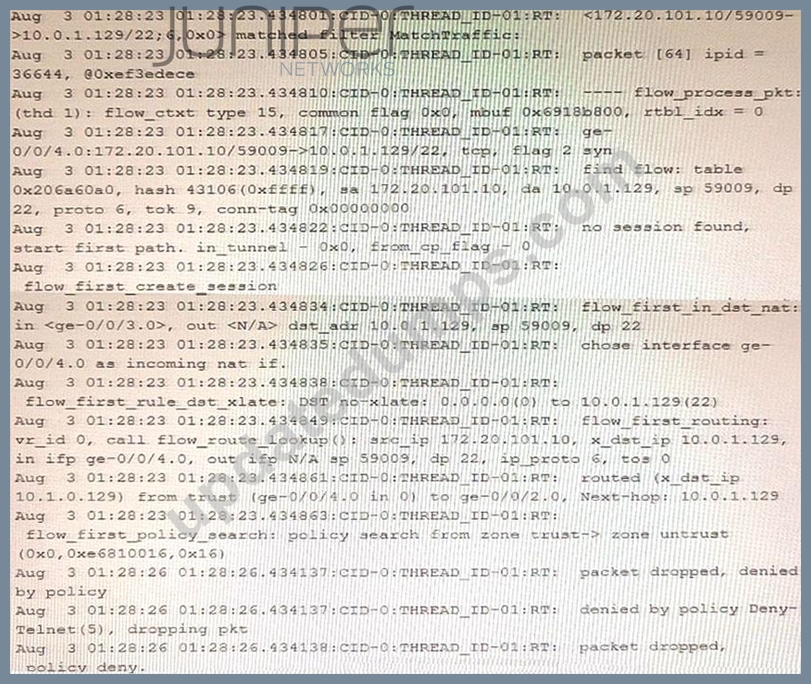
Which two statements are correct about the output shown in the exhibit? (Choose two.)
- A. The packet is explicitly rejected.
- B. The packet is part of an existing session.
- C. The packet is silently discarded.
- D. The packet is part of a new session.
Answer: A,D
NEW QUESTION # 37
Exhibit: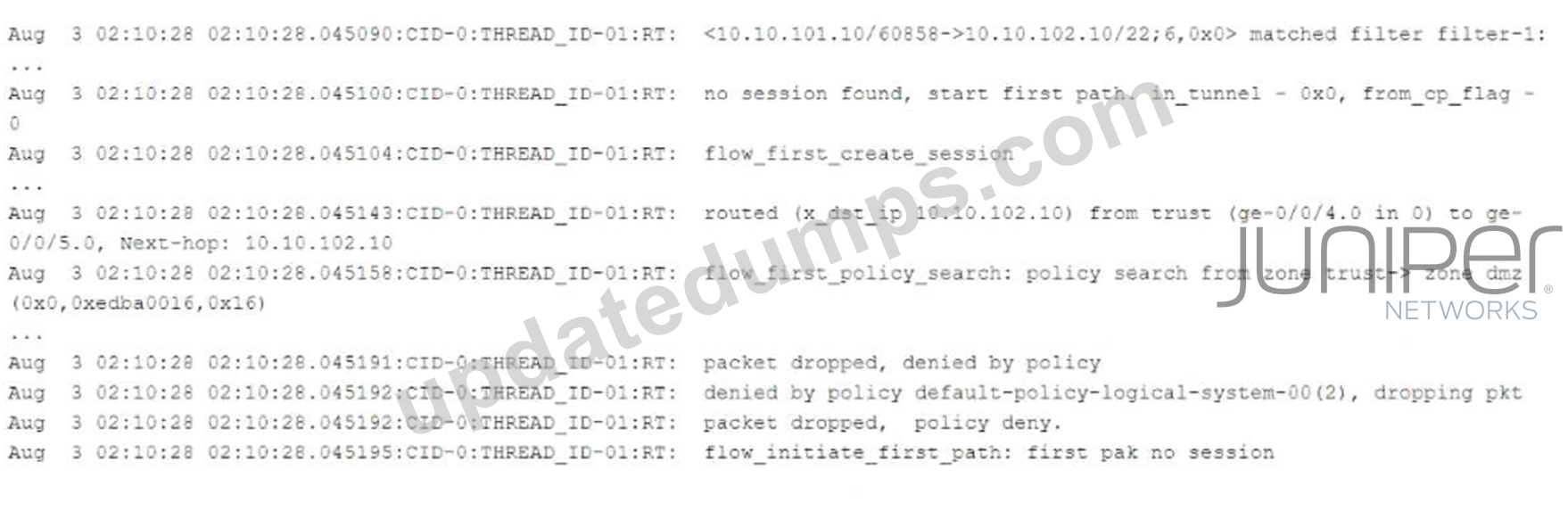
Referring to the flow logs exhibit, which two statements are correct? (Choose two.)
- A. The packet is dropped by the default security policy.
- B. The data shown requires a traceoptions flag of host-traffic.
- C. The data shown requires a traceoptions flag of basic-datapath.
- D. The packet is dropped by a configured security policy.
Answer: A,C
Explanation:
* Understanding the Flow Log Output:
From the flow logs in the exhibit, we can observe the following key events:
* The session creation was initiated (flow_first_create_session), but the policy searchfailed (flow_first_policy_search), which implies that no matching policy was found between the zones involved (zone trust-> zone dmz).
* The packet was dropped with the reason "denied by policy." This shows that the packet was dropped either due to no matching security policy or because the default policy denies the traffic (packet dropped, denied by policy).
* The line denied by policy default-policy-logical-system-00(2) indicates that the default security policy is responsible for denying the traffic, confirming that no explicit security policy was configured to allow this traffic.
* Explanation of Answer A (Dropped by the default security policy):
The log message clearly states that the packet was dropped by the default security policy (default-policy- logical-system-00). In Junos, when a session is attempted between two zones and no explicit policy exists to allow the traffic, the default policy is to deny the traffic. This is a common behavior in Junos OS when a security policy does not explicitly allow traffic between zones.
* Explanation of Answer D (Requires traceoptions flag of basic-datapath):
The information displayed in the log involves session creation, flow policy search, and packet dropping due to policy violations, which are all part of basic packet processing in the data path. This type of information is logged when the traceoptions flag is set tobasic-datapath. The basic-datapath traceoption provides detailed information about the forwarding process, including policy lookups and packet drops, which is precisely what we see in the exhibit.
* The traceoptions flaghost-traffic(Answer C) is incorrect because host-traffic is typically used for traffic destined to or generated from the Junos device itself (e.g., SSH or SNMP traffic to the SRX device), not for traffic passing through the device.
* To capture flow processing details like those shown, you need the basic-datapath traceoptions flag, which provides details about packet forwarding and policy evaluation.
Step-by-Step Configuration for Tracing (Basic-Datapath):
* Enable flow traceoptions:
To capture detailed information about how traffic is being processed, including policy lookups and flow session creation, enable traceoptions for the flow.
bash
Copy code
set security flow traceoptions file flow-log
set security flow traceoptions flag basic-datapath
* Apply the configuration and commit:
bash
Copy code
commit
* View the logs:
Once enabled, you can check the trace logs for packet flows, policy lookups, and session creation details:
bash
Copy code
show log flow-log
This log will contain information similar to the exhibit, including session creation attempts and packet drops due to security policy.
Juniper Security Reference:
* Default Security Policies: Juniper SRX devices have a default security policy to deny all traffic that is not explicitly allowed by user-defined policies. This is essential for security best practices. Reference:
Juniper Networks Documentation on Security Policies.
* Traceoptions for Debugging Flows: Using traceoptions is crucial for debugging and understanding how traffic is handled by the SRX, particularly when issues arise from policy misconfigurations or routing. Reference: Juniper Traceoptions.
By using the basic-datapath traceoptions, you can gain insights into how the device processes traffic, including policy lookups, route lookups, and packet drops, as demonstrated in the exhibit.
NEW QUESTION # 38
You are connecting two remote sites to your corporate headquarters site; you must ensure that all traffic is secured and only uses a single Phase 2 SA for both sites.
In this scenario, which VPN should be used?
- A. Full mesh IPsec VPNs with tunnels between all sites.
- B. An IPsec group VPN with the corporate firewall acting as the hub device.
- C. A full mesh Layer 3 VPN with the corporate firewall acting as the hub device.
- D. A hub-and-spoke IPsec VPN with the corporate firewall acting as the hub device.
Answer: B
Explanation:
https://www.juniper.net/us/en/local/pdf/app-notes/3500202-en.pdf
NEW QUESTION # 39
Exhibit: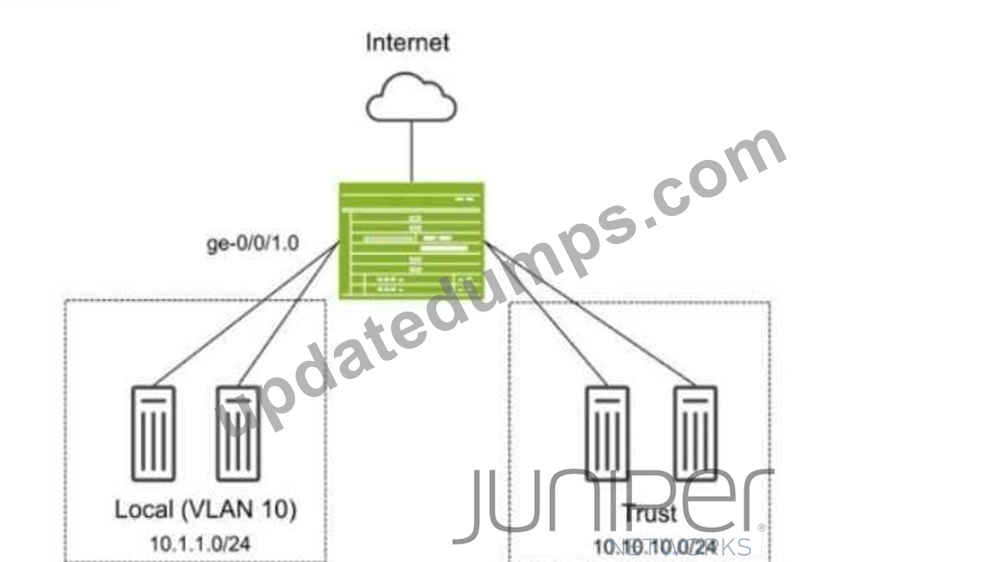
You have deployed an SRX Series device as shown in the exhibit. The devices in the Local zone have recently been added, but their SRX interfaces have not been configured. You must configure the SRX to meet the following requirements:
Devices in the 10.1.1.0/24 network can communicate with other devices in the same network but not with other networks or the SRX.
You must be able to apply security policies to traffic flows between devices in the Local zone.
Which three configuration elements will be required as part of your configuration? (Choose three.)
- A. set interfaces ge-0/0/1 unit 0 family ethernet-switching vlan-members 10
- B. set security zones security-zone Local interfaces irb.10
- C. set protocols l2-learning global-mode switching
- D. set protocols l2-learning global-mode transparent-bridge
- E. set security zones security-zone Local interfaces ge-0/0/1.0
Answer: A,D,E
Explanation:
In this scenario, we need to configure the SRX Series device so that devices in the Local zone (VLAN 10, 10.1.1.0/24 network) can communicate with each other but not with other networks or the SRX itself. Additionally, you must be able to apply security policies to traffic flows between the devices in the Local zone.
NEW QUESTION # 40
Exhibit: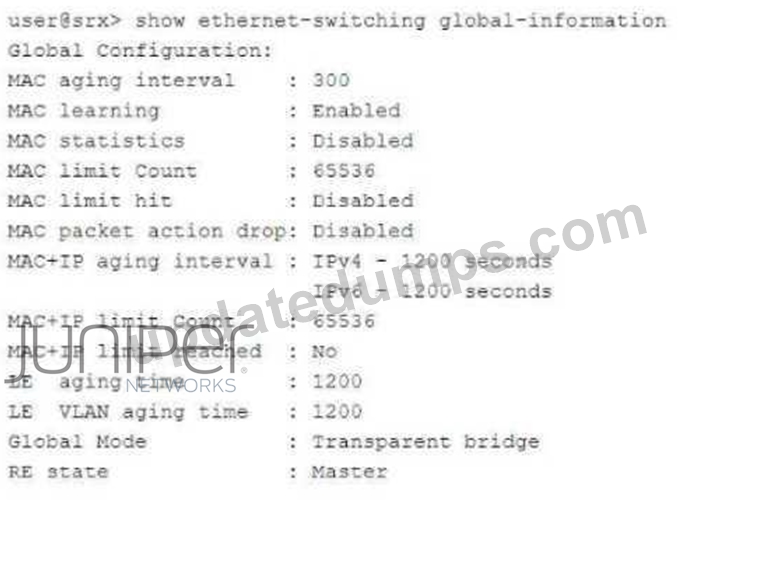
Referring to the exhibit, which two statements are correct? (Choose two.)
- A. The device cannot pass Layer 2 and Layer 3 traffic at the same time.
- B. The device can pass Layer 2 and Layer 3 traffic at the same time.
- C. You can secure inter-VLAN traffic with a security policy on this device.
- D. You cannot secure intra-VLAN traffic with a security policy on this device.
Answer: B,C
Explanation:
The exhibit provides information about an SRX Series device operating in transparent mode (Layer 2) and Layer 3 routing at the same time.
The SRX device can secure inter-VLAN traffic because it supports security policies for Layer 3 traffic between different VLANs. In this case, traffic moving between different VLANs (i.e., Layer 3 traffic) can be processed and controlled using security policies.
The SRX device can handle both Layer 2 and Layer 3 traffic simultaneously. In mixed mode, the device is capable of switching traffic at Layer 2 (intra-VLAN) while also routing traffic at Layer 3 (inter-VLAN). This is evident from the global configuration showing transparent bridge mode and Layer 3 interfaces.
NEW QUESTION # 41
You are attempting to ping the IP address that is assigned to the loopback interface on the SRX series device shown in the exhibit.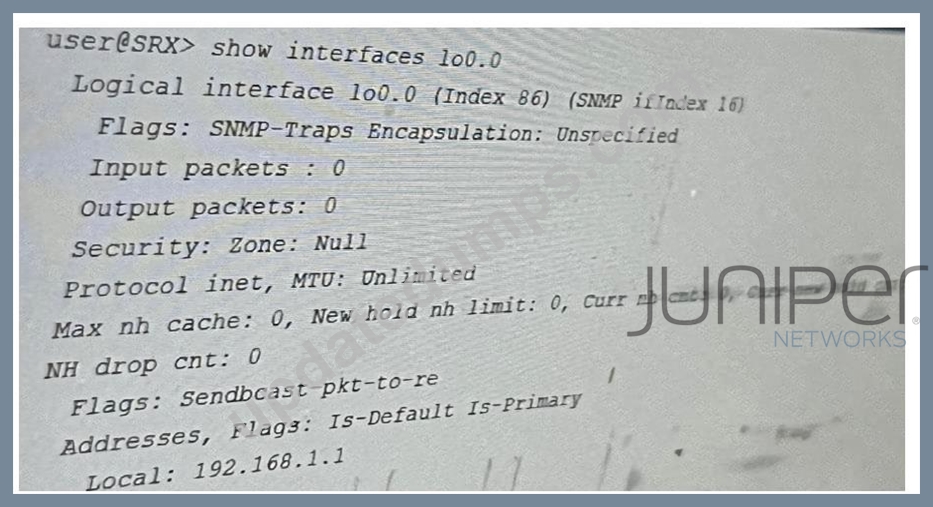
What is causing this problem?
- A. The incorrect interface index ID is assigned to the loopback interface.
- B. The IP address on the loopback interface is a private address.
- C. The loopback interface is not assigned to a security zone.
- D. The loopback interface requires encapsulation.
Answer: A
NEW QUESTION # 42
Click the Exhibit button.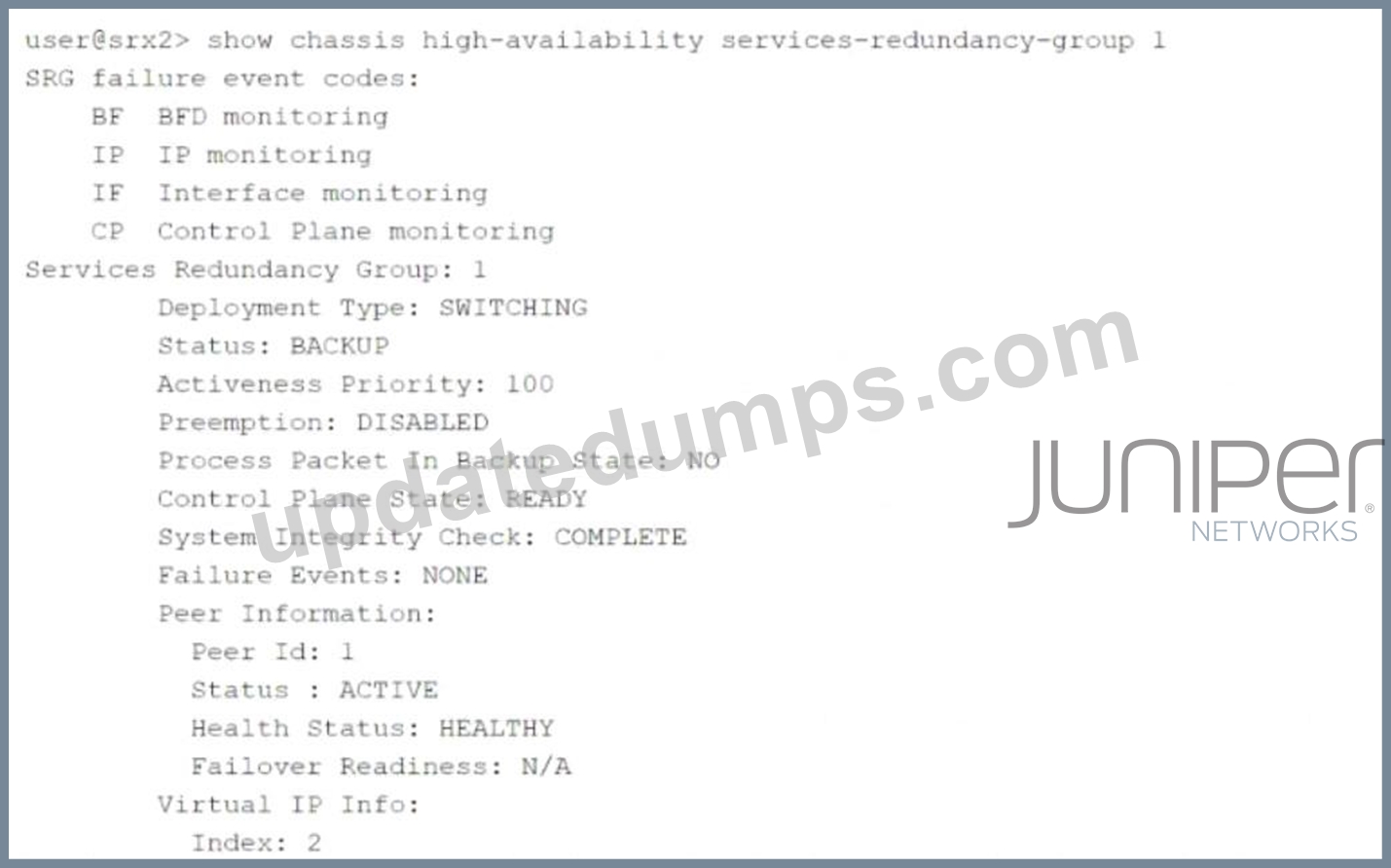
Referring to the exhibit, which two statements are correct? (Choose two.)
- A. This device is the backup node for SRG1.
- B. The ge-0/0/3.0 and ge-0/0/4.0 interfaces are active and will respond to ARP requests to the virtual IP MAC address.
- C. The ge-0/0/3.0 and ge-0/0/4.0 interfaces are not active and will not respond to ARP requests to the virtual IP MAC address.
- D. This device is the active node for SRG1.
Answer: B,D
NEW QUESTION # 43
You need to generate a certificate for a PKI-based site-to-site VPN. The peer is expecting to user your domain name vpn.juniper.net.
Which two configuration elements are required when you generate your certificate request?
(Chose two,)
- A. domain-name vpn.juniper.net
- B. email [email protected]
- C. subject CN=vpn.juniper.net
- D. ip-address 10.100.0.5
Answer: A,C
NEW QUESTION # 44
Exhibit: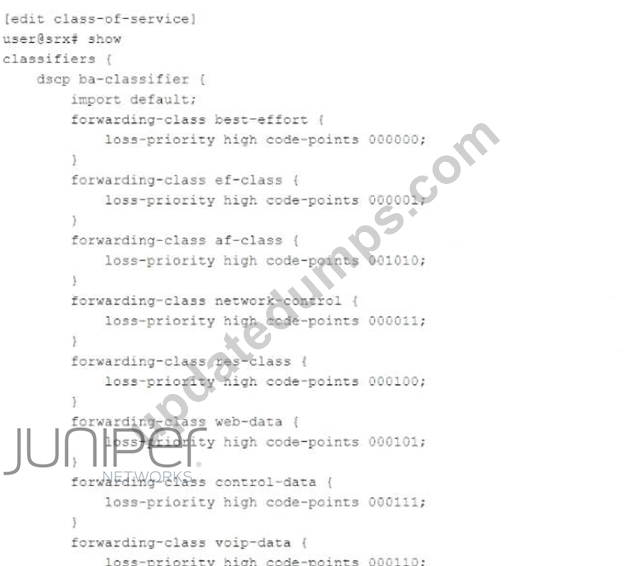
You have configured a CoS-based VPN that is not functioning correctly.
Referring to the exhibit, which action will solve the problem?
- A. You must change the loss priorities of the forwarding classes to low.
- B. You must delete one forwarding class.
- C. You must change the code point for the DB-data forwarding class to 10000.
- D. You must use inet precedence instead of DSCP.
Answer: B
Explanation:
In the exhibit, the CoS-based VPN configuration is not functioning correctly due to an issue with the number of forwarding classes. The maximum number of forwarding classes supported for CoS-based VPNs with multiple SAs (security associations) is typically four forwarding classes. In this case, more than four forwarding classes are defined.
To solve the issue, one forwarding class must be deleted to ensure that the total number of forwarding classes is reduced to four or fewer.
NEW QUESTION # 45
Which Junos security feature is used for signature-based attack prevention?
- A. AppQoS
- B. RADIUS
- C. IPS
- D. PIM
Answer: C
NEW QUESTION # 46
You have deployed automated threat mitigation using Security Director with Policy Enforcer, Juniper ATP Cloud, SRX Series devices, and EX Series switches.
In this scenario, which device is responsible for blocking the infected hosts?
- A. Policy Enforcer
- B. Security Director
- C. EX Series switch
- D. Juniper ATP Cloud
Answer: A
Explanation:
Policy Enforcer interacts with other network elements like EX switches to enforce blocking of infected hosts based on threat intelligence from ATP Cloud and other sources. For more information, refer to Juniper Policy Enforcer Documentation.
In a Juniper automated threat mitigation setup involvingSecurity Director,Policy Enforcer,Juniper ATP Cloud,SRX Series, andEX Seriesswitches, thePolicy Enforceris the component responsible for blocking infected hosts. The role of each component is as follows:
* Policy Enforcer (Correct: Option A):Policy Enforcer receives threat intelligence from Juniper ATP Cloud and instructs SRX devices and EX Series switches to block or quarantine infected hosts. Policy Enforcer pushes policies to these devices to enforce the mitigation actions.
* Security Director (Incorrect):Security Director provides centralized management and visibility but does not directlyenforce policies.
* Juniper ATP Cloud (Incorrect):Juniper ATP Cloud is responsible for analyzing threats and providing intelligence but does not take direct mitigation actions.
* EX Series Switch (Incorrect):EX Series switches can enforce the policy pushed by Policy Enforcer but are not responsible for deciding which hosts to block.
Juniper References:
* Juniper ATP Cloud and Policy Enforcer Documentation: Details the roles of each component in the automated threat mitigation architecture.
NEW QUESTION # 47
Refer to the exhibit,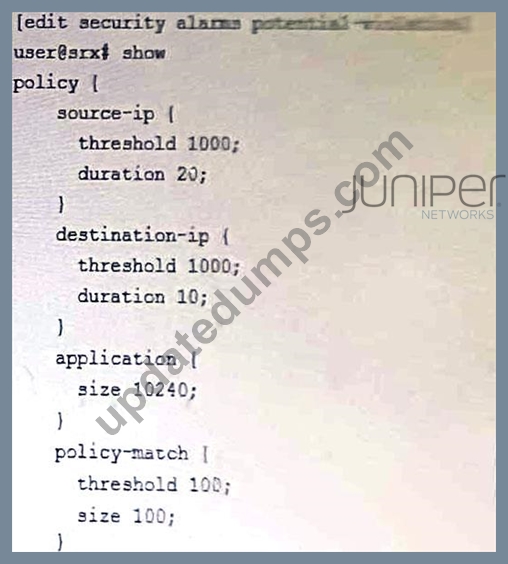
which two potential violations will generate alarm ? (Choose Two)
- A. the ratio of policy violation traffic compared to accepted traffic.
- B. the number of policy violation by a destination TCP port
- C. the number of policy violation to an application within a specified period
- D. the number of policy violations by a source network identifier
Answer: C,D
Explanation:
The exhibit shows a security policy configuration with a threshold of 1000 policy violations by a source network identifier and a threshold of 10 policy violations to an application within a specified period. If either of these thresholds are exceeded, an alarm will be generated. Therefore, the correct answer is A and D. The other options are incorrect because:
B) The ratio of policy violation traffic compared to accepted traffic is not a criterion for triggering an alarm.
The security policy configuration does not specify any ratio or percentage of policy violation traffic that would cause an alarm.
C) The number of policy violation by a destination TCP port is also not a criterion for triggering an alarm.
The security policy configuration does not specify any threshold or duration for policy violation by a destination TCP port.
Reference: policy (Security Alarms)
Monitoring Security Policy Violations
NEW QUESTION # 48
You are connecting two remote sites to your corporate headquarters site.You must ensure that all traffic is secured and sent directly between sites In this scenario, which VPN should be used?
- A. hub-and-spoke IPsec VPN
- B. Layer 2 VPN
- C. full mesh Layer 3 VPN with EBGP
- D. IPsec ADVPN
Answer: D
NEW QUESTION # 49
......
2026 Valid JN0-637 test answers & Juniper Exam PDF: https://www.updatedumps.com/Juniper/JN0-637-updated-exam-dumps.html
Free Juniper JN0-637 Exam Questions and Answer from Training Expert UpdateDumps: https://drive.google.com/open?id=1nZ3UR8JC1hUbpnOsLsf-C9iAcO6A2-mE