

[May 03, 2026] Prepare For The JN0-253 Question Papers In Advance
JN0-253 PDF Dumps Real 2026 Recently Updated Questions
Juniper JN0-253 Exam Syllabus Topics:
| Topic | Details |
|---|---|
| Topic 1 |
|
| Topic 2 |
|
| Topic 3 |
|
| Topic 4 |
|
NEW QUESTION # 25
Your organization currently uses Access Assurance for 802.1X authentication of wireless users using user certificates. All users are currently placed in the same VLAN after authentication.
There are multiple VLANs at your sites.
In this scenario, how would you configure Access Assurance to make the network more secure?
- A. Configure user authentication using EAP-TTLS and assign WxLAN roles based on AD user group.
- B. Configure MAC Authentication Bypass (MAB) and assign WxLAN roles based on groups of MAC addresses.
- C. Configure host (machine) authentication using EAP-TLS and assign WxLAN roles based on AD user group.
- D. Configure user authentication using EAP-TLS and assign WxLAN roles based on AD user group.
Answer: D
Explanation:
Juniper Mist Access Assuranceprovidescloud-based network access control (NAC)by integratingRADIUS
,identity-based policy enforcement, andWxLAN role-based segmentation. It allows administrators to assign users and devices to specific VLANs or network segments dynamically based on authentication attributes, thereby improving bothsecurityandpolicy granularity.
According to theJuniper Mist Access Assurance Configuration Guide, to enhance network security in a multi-VLAN environment, you should:
"Use EAP-TLS (certificate-based authentication) for secure user identification, and dynamically assign WxLAN roles or VLANs based on Active Directory (AD) group membership." Here's whyDis correct:
* EAP-TLSensuresmutual authenticationbetween client and RADIUS server using digital certificates
- preventing credential theft or spoofing.
* Integrating withActive Directoryallowsrole-based access control (RBAC), enabling dynamic VLAN or WxLAN assignment. This ensures users from different groups (e.g., staff, contractors, guests) are automatically segmented into appropriate network zones.
Option breakdown:
* A (MAB): Used for non-802.1X devices (e.g., printers), less secure for user authentication.
* B (EAP-TTLS): Username/password-based and less secure than certificate-based EAP-TLS.
* C (Host authentication): Verifies devices only, not user identity-insufficient for user-level control.
Therefore, the most secure and scalable configuration is:
#D. Configure user authentication using EAP-TLS and assign WxLAN roles based on AD user group.
References:- Juniper Mist Access Assurance Deployment and Configuration Guide- Juniper Mist Cloud NAC and 802.1X Authentication Documentation- Juniper Mist Secure Access and WxLAN Role-Based Policy Guide
NEW QUESTION # 26
What are two solutions that Juniper Mist Location Services provide? (Choose two.)
- A. asset location
- B. GPS location
- C. geofencing
- D. wayfinding
Answer: A,D
Explanation:
Juniper Mist Location Services provide asset location and wayfinding. According to official Juniper documentation: "Juniper Mist provides location accuracy for wayfinding, asset visibility, and user engagement," leveraging cloud-native vBLE and Wi-Fi technologies.
* Asset location enables organizations to locate high-value resources, personnel, or IoT devices in real time with rich analytics, making it easy to find assets and people using the Mist dashboard and APIs.
* Wayfinding gives users turn-by-turn indoor navigation and mapping via mobile SDKs and the Mist cloud.While geofencing can be achieved as part of location-based engagement features, it is not listed as a primary Mist Location Service solution. GPS location is not directly supported; Mist Location Services operate indoors using Wi-Fi and BLE signals, not satellite GPS.
Reference:Juniper Mist Location Services Overview , Indoor Location Services Solution Brief.
NEW QUESTION # 27
What are two benefits of Juniper Mist Wired Assurance? (Choose two.)
- A. Configuration settings for multi-gig access ports that are not available in the Junos CLI.
- B. Support for ZTP.
- C. Ability to deploy campus fabric architectures in minutes based on intent.
- D. It is the only way to configure Virtual Chassis settings for Juniper EX switches.
Answer: B,C
Explanation:
Juniper Mist Wired Assurance provides several benefits aimed at simplifying network management and enhancing performance.
Ability to deploy campus fabric architectures in minutes based on intent: Wired Assurance leverages automation and intent-based networking to quickly deploy and manage complex campus fabric architectures. This feature significantly reduces the time and effort required to set up and maintain such networks.
Support for ZTP (Zero Touch Provisioning): Wired Assurance includes ZTP capabilities, which allow for the automatic provisioning and configuration of switches as soon as they are connected to the network. This reduces the need for manual intervention and speeds up the deployment process. These features are part of a broader suite of tools that Wired Assurance provides to streamline network operations, improve reliability, and enhance visibility into network performance.
NEW QUESTION # 28
Which two Juniper devices are used in Juniper Mist WAN Assurance? (Choose two.)
- A. Session Smart Routers
- B. QFX Series Switches
- C. SRX Series Firewalls
- D. EX Series Switches
Answer: A,C
Explanation:
Juniper Mist WAN Assuranceis a cloud-based service that extends Mist AI capabilities to the WAN edge, providing visibility, automation, and AI-driven analytics for WAN devices. It focuses on ensuringend-to-end service assurancefor users and applications across distributed networks.
According to theJuniper Mist WAN Assurance and SD-WAN Deployment Guide, the supported devices include:
"Juniper SRX Series Firewalls and Session Smart Routers (SSR) are integrated with Mist WAN Assurance for telemetry collection, service-level monitoring, and AI-driven troubleshooting."
* SRX Series Firewalls (A):Provide secure WAN connectivity and send real-time telemetry (including throughput, latency, and packet loss metrics) to Mist Cloud.
* Session Smart Routers (C):Power the AI-driven SD-WAN solution with application-aware routing and session intelligence, fully integrated into Mist Cloud for advanced visibility and analytics.
EXandQFXswitches are used withWired Assurance, not WAN Assurance.
Therefore, the correct answers areA. SRX Series FirewallsandC. Session Smart Routers.
References:- Juniper Mist WAN Assurance and SD-WAN Deployment Guide- Juniper Mist Cloud Operations and Assurance Documentation- Juniper Mist AI WAN and Telemetry Overview
NEW QUESTION # 29
You have five clients on the network and 20 minutes of statistics for each client.
In this scenario, how many user minutes does this equal?
- A. 0
- B. 1
- C. 2
- D. 3
Answer: C
Explanation:
Identify the Scenario: Five clients on the network and 20 minutes of statistics for each client.
Calculation:
User Minutes = 100.
Conclusion:
The total user minutes in this scenario is 100.
NEW QUESTION # 30
You are asked to configure Mist to send e-mail alerts to your organization administrators, who all have mailboxes that reside on the same e-mail server. Alerts are being generated and are visible in the Mist GUI, but only some administrators are receiving the alert e-mails.
What is the problem in this scenario?
- A. Your e-mail server is blocking e-mail from Mist.
- B. The affected administrators have not enabled e-mail notifications in their Mist My Account settings.
- C. The user e-mail addresses are not correctly formatted.
- D. The organization does not have sufficient alert subscriptions.
Answer: B
Explanation:
Identify the Problem: Alerts are being generated and visible in the Mist GUI, but only some administrators receive the alert emails.
Possible Issues:
User email addresses not correctly formatted.
Email server blocking Mist emails.
Insufficient alert subscriptions.
Administrators not enabling email notifications.
Root Cause:
Since some administrators receive the alerts, email formatting and server blocking issues can be ruled out.
If alert subscriptions were insufficient, no administrators would receive the alerts. The most likely cause is that the affected administrators have not enabled email notifications in their Mist My Account settings.
Resolution:
Ensure that all administrators have enabled email notifications in their Mist My Account settings.
NEW QUESTION # 31
Which Juniper Mist location-based service improves accuracy?
- A. User Engagement
- B. Asset Visibility
- C. Proximity Detection
- D. Wi-Fi Location
Answer: B
Explanation:
Among Juniper Mist'sLocation-Based Services,Asset Visibilityprovides the most accurate location tracking capabilities. This is achieved through the use ofvBLE (virtual Bluetooth Low Energy)technology, which leverages a patented16-element BLE antenna arrayintegrated into Mist Access Points forAngle of Arrival (AoA)calculations.
According to theJuniper Mist Location-Based Services Technical Overview:
"Asset Visibility delivers sub-meter location accuracy by using BLE-based triangulation combined with Mist AI's machine learning algorithms for continuous calibration." WhileWi-Fi locationoffers approximate device tracking based on signal strength and triangulation, and Proximity Detectionidentifies nearby devices,Asset Visibilityprovides precise real-time tracking of BLE- tagged objects and devices.
User Engagement, on the other hand, focuses on customer-facing mobile interactions, not accuracy optimization.
Therefore, the correct answer isC. Asset Visibility.
References:- Juniper Mist Location-Based Services and Asset Visibility Documentation- Juniper Mist vBLE Architecture Overview- Juniper Mist Cloud Location Accuracy Optimization Guide
NEW QUESTION # 32
When viewing the LATEST UPDATES on the Marvis Actions page, you see an action labeled AI VALIDATED.
What does this status mean?
- A. The issue was marked resolved by an administrator.
- B. The issue is resolved but was not manually marked resolved.
- C. The issue was identified and resolved entirely by Marvis.
- D. The issue is unresolved.
Answer: C
Explanation:
In theJuniper Mist Marvis Actions dashboard, issues and recommendations are displayed with status labels indicating their progress and resolution method. One of these statuses isAI VALIDATED, which signifies that the issue was automatically detected, diagnosed, and resolved byMarvis AIwithout requiring manual intervention.
According to theJuniper Mist Marvis Virtual Network Assistant Operations Guide:
"AI VALIDATED indicates that Marvis has confirmed and resolved a network issue autonomously using AI- driven automation and telemetry correlation." This means Marvis performed the full troubleshooting cycle-identifying the anomaly, validating its cause, and confirming resolution-based on continuous monitoring and real-time network analytics.
Other statuses include:
* UNRESOLVED:Issue is ongoing and needs attention.
* RESOLVED:Marked manually by an administrator after resolution.
* AI VALIDATED:Confirmed and closed automatically by Marvis AI.
Therefore, the correct answer isA. The issue was identified and resolved entirely by Marvis.
References:- Juniper Mist Marvis Virtual Network Assistant Operations Guide- Juniper Mist AI Actions and Insights Documentation- Juniper Mist Cloud Analytics and Troubleshooting Overview
NEW QUESTION # 33
You are asked to configure a site in Juniper Mist.
Which statement describes completing this step?
- A. You must define your organization within the site.
- B. You must first configure the country, time zone, and location at the organization level.
- C. You must configure the site within your organization.
- D. You must claim your site by scanning the access point's QR code.
Answer: C
Explanation:
You must configure the site within your organization-this is the correct process according to Juniper Mist's official configuration guides. When setting up a deployment, first an organization is created in the Mist cloud.
Within this organization, sites are added for each physical location. The Mist documentation says: "You can create Sites in the Juniper Mist portal from the Organization > Site Configuration menu. Add or update sites as needed." The configuration requires the site name, country, and location to be set at the site level-not the organization level. Claiming APs via QR codes and organization definition are separate steps in device onboarding and initial setup.
Reference:Juniper Mist Management Guide , Mist Edge Teleworker Solution User Guide , Juniper Mist Access Points
NEW QUESTION # 34
What are device-specific WAN Edge templates used for in an SD-WAN configuration?
- A. To monitor network events and stop attacks
- B. To automatically generate configuration elements specific to device models
- C. To automate the WLAN template process
- D. To perform traffic inspection for WAN edge devices
Answer: B
Explanation:
In theJuniper Mist SD-WANsolution,device-specific WAN Edge templatesare used to streamline the deployment and configuration ofJuniper SRX or SSR (Session Smart Router)devices serving as WAN Edge nodes. These templates ensure consistent and accurate configurations across a distributed WAN environment while accounting for differences in hardware models and interface types.
According to theJuniper Mist WAN Assurance and SD-WAN Configuration Guide, device-specific templates:
"Automatically generate configuration elements tailored to the hardware platform, including interfaces, ports, and device capabilities." They are part of Mist'scloud-managed SD-WAN automation framework, which combines WAN Assurance and AI-driven insights to manage branch connectivity. The templates simplify provisioning by populating device-level parameters such as:
* Interface naming and mapping based on the device model.
* Hardware-specific configurations like tunnel endpoints, IP addressing, and routing settings.
* Security and performance policies consistent with the organization's SD-WAN design.
OptionsA,C, andDare incorrect because:
* A(WLAN template automation) pertains to wireless network configuration, not WAN edge devices.
* C(traffic inspection) relates to firewall or security policies handled by SRX's UTM features, not templates.
* D(monitoring and attack prevention) falls under Mist's security or analytics capabilities, not the template function.
Therefore, the correct answer isB. To automatically generate configuration elements specific to device models.
References:- Juniper Mist WAN Assurance and SD-WAN Configuration Guide- Juniper Mist Cloud Device Template Management Documentation- Juniper Mist AI-Driven SD-WAN Deployment Overview
NEW QUESTION # 35
What are two requirements to use the Wired Visibility option of Juniper Mist Wireless Assurance?
(Choose two.)
- A. A Mist AP must be deployed in the network.
- B. The SNMP protocol must be configured on the switch.
- C. A cloud-ready switch must be deployed in the network.
- D. The LLDP protocol must be configured on the switch.
Answer: A,D
Explanation:
The Wired Visibility feature in Juniper Mist relies on Mist APs to gather insights about wired network devices. The APs act as sensors to collect data from connected switches and devices.
LLDP (Link Layer Discovery Protocol) is required for discovering neighboring devices, identifying switch port details, and enabling Wired Visibility to provide comprehensive insights.
NEW QUESTION # 36
What is required for Marvis Minis to operate?
- A. Minimum AP firmware
- B. WLAN template
- C. WAN Assurance subscription
- D. Premium Analytics subscription
Answer: A
Explanation:
Marvis Minisis an advanced feature within the Juniper Mist AI ecosystem designed to performautonomous, synthetic network testing. It uses Mist Access Points (APs) to simulate client behavior-such as association, authentication, DHCP, DNS, and application reachability-to proactively detect service issuesbefore real users are affected.
According to theJuniper Mist Marvis Minis Deployment GuideandMarvis AI documentation, the key requirement for enabling Marvis Minis is that all participating access points must be running aminimum supported firmware versionthat includes the Minis agent functionality.
The documentation specifies:
"Marvis Minis requires APs running the minimum firmware version that supports synthetic testing. APs on earlier versions will not be capable of running Minis tests or reporting results to the Mist Cloud." Additional subscriptions such asWAN Assurance,Premium Analytics, orWLAN templatesare not prerequisites for operation. WhileMarvis licensingmust be active, the feature itself relies primarily on compatible firmware within the Mist-managed APs.
Therefore, the correct answer isC. Minimum AP firmware- ensuring the APs are on a supported firmware release is essential for Marvis Minis functionality.
References:- Juniper Mist Marvis Minis Deployment and Configuration Guide- Juniper Mist AI Operations and Troubleshooting Documentation- Juniper Mist Wireless Assurance and Firmware Management Guide
NEW QUESTION # 37
Which users have rights to invite new administrators to a Mist organization?
- A. users with the "Invite Admin" permission
- B. super user only
- C. any user with an organization account
- D. network admin user only
Answer: B
NEW QUESTION # 38
Which SLE reports RF interference?
- A. Capacity
- B. AP Health
- C. Roaming
- D. Coverage
Answer: A
Explanation:
Use the Wireless Capacity SLE to track user experiences with RF channel capacity (bandwidth) on your wireless network.
NEW QUESTION # 39
Which device detects a Layer 1 bad cable action within Marvis Actions?
- A. wireless client
- B. access point
- C. wired client
- D. Mist Edge
Answer: D
Explanation:
The Mist Edge device is responsible for detecting Layer 1 issues, such as bad cable actions, within the Marvis Actions framework.
Mist Edge integrates with Marvis AI to provide detailed insights into network health, including physical layer issues like faulty cables, which can impact network performance. By identifying and alerting administrators to these problems, Mist Edge helps maintain the integrity and reliability of the network infrastructure.
NEW QUESTION # 40
Which two statements are correct about the Juniper Mist vBLE Asset Visibility mode? (Choose two.)
- A. The vBLE antenna is in the transmit mode.
- B. The vBLE antenna communicates with mobile devices running the Juniper Mist location SDK.
- C. The vBLE antenna is in the receive mode.
- D. The vBLE antenna tracks chirps from BLE tags.
Answer: C,D
Explanation:
Juniper Mist'svirtual Bluetooth Low Energy (vBLE)technology is designed to deliverprecise indoor location servicesusing cloud-managed access points equipped with integrated BLE antenna arrays. The system supports multiple operational modes, includingEngagement Mode(for mobile app interactions) and Asset Visibility Mode(for BLE tag tracking).
According to theJuniper Mist Location Services Documentation, inAsset Visibility Mode, the vBLE antenna functions primarily inreceive modeto detect and process signals emitted fromBLE asset tags. These tags periodically transmit Bluetooth "chirps" that are received by multiple APs. Mist Cloud then usesangle-of- arrival (AoA)andRSSI triangulation algorithmsto determine the exact location of the asset within the facility.
The documentation specifies:
"In Asset Visibility Mode, the vBLE antenna operates in receive mode and listens for BLE tag beacons (chirps). The system triangulates these signals to calculate the real-time location of tracked assets." Conversely,Engagement Modeis the configuration in which vBLE operates intransmit modeto interact with mobile devices running the Mist SDK - which corresponds to location-based engagement or proximity notifications.
Thus, the correct answers are:
* A. The vBLE antenna is in the receive mode
* B. The vBLE antenna tracks chirps from BLE tags
References:- Juniper Mist Location-Based Services Configuration Guide- Juniper Mist vBLE Architecture and Operation Modes Documentation- Juniper Mist Cloud Location Services Technical Overview
NEW QUESTION # 41
Which statement is correct when a subscription expires?
- A. The devices remain operational, and all functionality remains available for a one-year grace period.
- B. The devices remain operational, but the Mist management GUI functionality related to expired subscriptions is hidden from the user.
- C. The devices become inactive and unreachable through the Mist management GUI.
- D. The devices remain operational, but you are not allowed to manage the devices using the Mist management GUI.
Answer: D
Explanation:
When a Mist subscription expires, the devices associated with that subscription continue to operate normally, ensuring there is no immediate disruption to network operations. However, management capabilities through the Mist management GUI are restricted. This means that while the devices remain functional, you cannot make configuration changes, monitor, or manage them using the Mist management interface until the subscription is renewed. This restriction emphasizes the importance of maintaining active subscriptions for full access to Mist's management features.
NEW QUESTION # 42
Which Radio Resource Management (RRM) changes are only made once a day between 2:00 AM and 3:00 AM local time?
- A. RF template changes to channel width
- B. channel and power level changes triggered by SSID scheduling
- C. channel and power level changes triggered by DFS events
- D. channel and power settings across a site based on long-term statistics and baselines
Answer: D
Explanation:
Identify the Changes: Radio Resource Management (RRM) changes and their timings.
RRM Changes:
Channel and power settings based on long-term statistics.
RF template changes to channel width.
Changes triggered by SSID scheduling.
Changes triggered by DFS events.
Timing of Changes:
Long-term RRM changes to channel and power settings are typically scheduled once a day to avoid disrupting network performance.
NEW QUESTION # 43
Which statement is true about unsupervised AI learning?
- A. It is used to analyze and classify unlabeled datasets.
- B. It is used to analyze and classify labeled datasets.
- C. A human must label the dataset before the AI can be trained on it.
- D. A human labels the dataset after the AI trains on it.
Answer: A
NEW QUESTION # 44
You are asked to configure WPA3/Enterprise (802.1X) security on the corporate employee SSID on every access point in your multi-site organization.
Which Juniper Mist template would you use for this task?
- A. WAN Edge template
- B. WLAN template
- C. RF template
- D. Switch template
Answer: B
Explanation:
In theJuniper Mist Cloud architecture, aWLAN templateis used to define wireless network parameters, including SSIDs, authentication methods, and access control settings. These templates allow administrators to apply consistent Wi-Fi configurations across multiple access points and sites.
According to theJuniper Mist Wireless Assurance Configuration Guide, the WLAN template:
"Defines the configuration for SSIDs, including security mode (WPA2, WPA3, 802.1X), authentication servers, VLAN assignment, and user access policies." To configureWPA3/Enterprise (802.1X)security for employee SSIDs, administrators must create or edit a WLAN template and selectWPA3-Enterpriseas the security type. The template can then be associated with all sites in the organization, ensuring uniform deployment.
Other template types serve different purposes:
* Switch template:Used for wired configuration and port profiles.
* WAN Edge template:Used for SD-WAN and WAN Assurance configurations.
* RF template:Used to manage radio parameters such as channel, power, and band.
Therefore, the correct answer isC. WLAN template.
References:- Juniper Mist Wireless Assurance Configuration and Deployment Guide- Juniper Mist Cloud WLAN Template Management Documentation- Juniper Mist Cloud Organization and Site Configuration Overview
NEW QUESTION # 45
In the Mist UI, what are two Marvis Actions for the AP category? (Choose two.)
- A. Health Check Failed
- B. MTU Mismatch
- C. High CPU
- D. Coverage Hole
Answer: A,D
Explanation:
Coverage Hole: Marvis Actions can identify coverage holes where the wireless signal is weak or absent, indicating potential areas that need additional access points or adjustments.
Health Check Failed: This action indicates that the health check, which monitors the performance and connectivity of an access point, has failed, suggesting issues that need to be addressed.
NEW QUESTION # 46
Exhibit: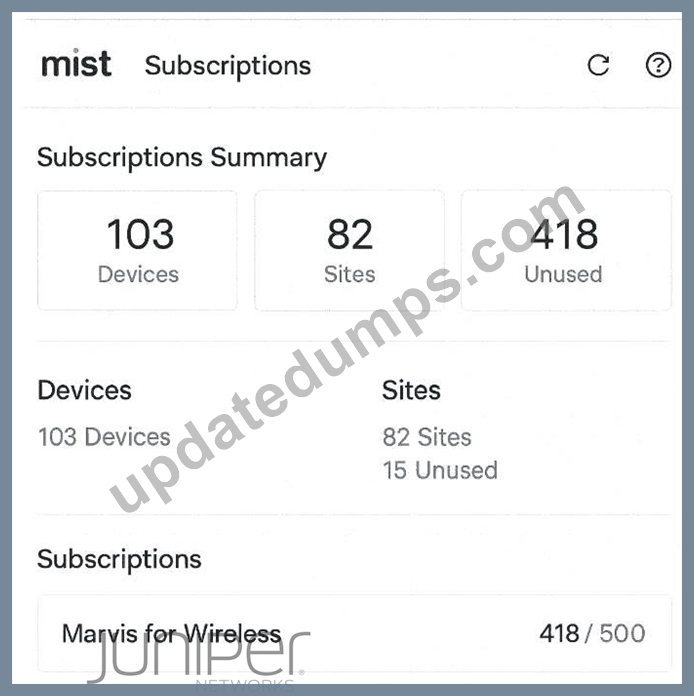
Referring to the exhibit, how many sites have unused Marvis for Wireless subscriptions?
- A. 0
- B. 1
- C. 2
- D. 3
Answer: C
Explanation:
In theJuniper Mist Cloud, theSubscriptionspage provides administrators with detailed information about the status of service licenses and subscriptions associated with devices, sites, and organizations. This includes visibility into the number of active devices, sites, and anyunused subscriptionsacross the organization.
According to theJuniper Mist Cloud Licensing and Subscription Management Guide, the "Sites" section under Subscriptions Summary shows:
"The total number of configured sites within the organization and the number of sites that currently do not have assigned subscriptions." In the exhibit, the summary shows:
* 82 Sitestotal
* 15 Unusedsites
This indicates that15 sites currently have no active or assigned Marvis for Wireless subscriptions. The
"Unused" label under Sites refers specifically to the count of sites not yet utilizing their allocated subscription entitlements.
Therefore, the correct answer isB. 15.
References:- Juniper Mist Cloud Licensing and Subscription Management Guide- Juniper Mist Cloud Administration and Operations Documentation- Juniper Mist AI Service Subscription Overview
NEW QUESTION # 47
Which two subscriptions are required to use Marvis Minis? (Choose two.)
- A. WiFi Management and Assurance
- B. Marvis for Wireless
- C. Premium Analytics
- D. vBLE Engagement
Answer: A,B
Explanation:
To use Marvis Minis, both theWiFi Management and AssuranceandMarvis for Wirelesssubscriptions are required. According to the official Juniper documentation, Marvis Minis "does not require a separate subscription. Any organization with an active Marvis for Wireless subscription is automatically entitled for Marvis Minis support." However, the Marvis for Wireless subscription operates on top of the foundational WiFi Management and Assurance subscription, which is necessary to operate APs and the wireless network within the Mist Cloud. As stated: "In addition to your base Assurance subscriptions (Wireless Assurance, WAN Assurance, or Wired Assurance), you also need Marvis subscriptions for each device..." Therefore, both are prerequisites for using Marvis Minis, ensuring full wireless management with AI-powered digital twin validation.
Reference:Juniper Mist Marvis Minis Overview , Marvis Subscription Reference
NEW QUESTION # 48
Which two statements describe SLEs? (Choose two.)
- A. SLEs use data science to troubleshoot network issues on an ad hoc basis.
- B. SLEs display a detailed list of Wi-Fi clients who have connected to the network.
- C. SLEs use machine learning to provide a proactive approach to understanding the end-user experience.
- D. The metrics analyzed to meet specific SLE goals are categorized into classifiers.
Answer: C,D
Explanation:
InJuniper Mist AI,Service Level Expectations (SLEs)form the foundation ofWireless AssuranceandWired Assurance. They provide adata-driven, proactive methodto measure and maintain the quality of user experience, going beyond traditional device-centric monitoring.
According to theJuniper Mist AI Operations GuideandWireless Assurance Documentation, SLEs:
"Leverage machine learning and data science to deliver a proactive understanding of end-user experience and identify root causes of performance issues." Each SLE (such asTime to Connect,Roaming,Throughput,Coverage, andCapacity) is composed of classifiers, which break down performance metrics into measurable, root-cause categories. Examples include DHCP,DNS,Authentication, andSignal Qualityclassifiers.
This classifier-based structure enables Mist AI to automatically correlate problems and highlight the most probable cause of degradation-eliminating the need for manual troubleshooting or reactive analysis.
OptionsBandDare incorrect because SLEs arenot ad hoc toolsfor manual troubleshooting and donot simply list connected clients. Instead, they provide intelligent, AI-driven insights into user experience across the network.
Therefore, the correct statements are:
* A. SLEs use machine learning to provide a proactive approach to understanding the end-user experience.
* C. The metrics analyzed to meet specific SLE goals are categorized into classifiers.
References:- Juniper Mist Wireless Assurance and SLE Overview- Juniper Mist AI Operations and Analytics Guide- Juniper Mist Cloud Monitoring and SLE Classifier Documentation
NEW QUESTION # 49
......
JN0-253 Dumps and Practice Test (104 Exam Questions): https://www.updatedumps.com/Juniper/JN0-253-updated-exam-dumps.html
Released Juniper JN0-253 Updated Questions PDF: https://drive.google.com/open?id=16xJk6U060bJE1Sq3PSu-ZIotQRllubf6