

Verified Cybersecurity-Architecture-and-Engineering dumps Q&As - 2026 Latest Cybersecurity-Architecture-and-Engineering Download
Updated 100% Cover Real Cybersecurity-Architecture-and-Engineering Exam Questions - 100% Pass Guarantee
NEW QUESTION # 81
What is a characteristic of algorithms?
- A. Unambiguous rules
- B. Constantly changing
- C. Random instructions
- D. No starting or stopping point
Answer: A
Explanation:
An algorithm is a defined set of step-by-step procedures or a set of rules to be followed to perform a specific task or solve a problem. Here are the characteristics that describe an algorithm:
* Unambiguous rules: Each step of an algorithm must be clearly defined and unambiguous. There should be no confusion in interpreting the instructions.
* Definiteness: The algorithm should have a clear starting and stopping point, leading to a precise output after a finite number of steps.
* Finiteness: Algorithms must terminate after a finite number of steps. They cannot run indefinitely.
* Input and Output: An algorithm should take zero or more inputs and produce at least one output.
Therefore, the correct answer is "Unambiguous rules," as it directly reflects the essential characteristic of an algorithm being precise and clear in its steps.
References
* Thomas H. Cormen, Charles E. Leiserson, Ronald L. Rivest, and Clifford Stein, "Introduction to Algorithms," MIT Press.
* Donald E. Knuth, "The Art of Computer Programming," Addison-Wesley.
NEW QUESTION # 82
Match the legislative purpose with the corresponding legislation.
Answer options may be used more than once or not at all.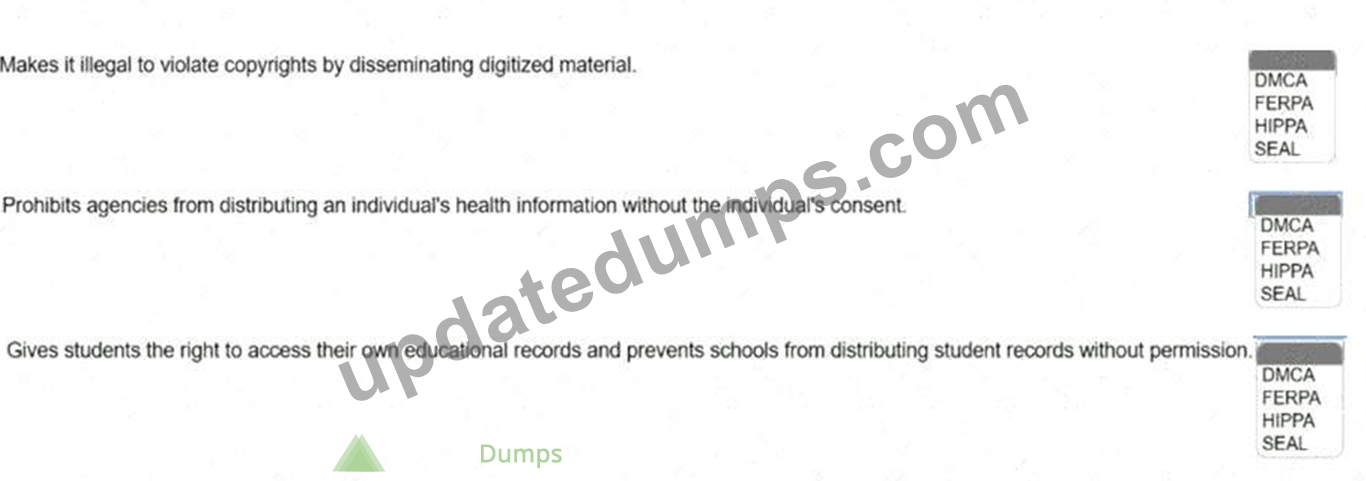
Answer:
Explanation: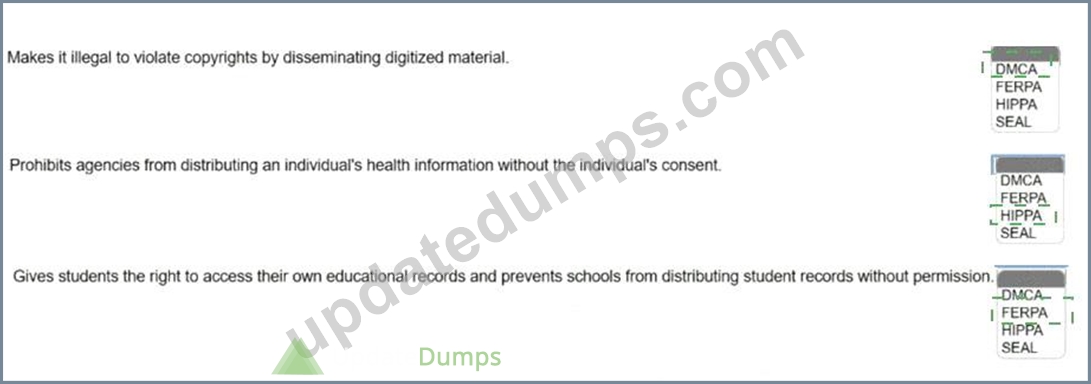
Explanation:
DMCA (Digital Millennium Copyright Act)
Purpose: The DMCA makes it illegal to violate copyrights by disseminating digitized material.
The DMCA was enacted in 1998 to address the issues of digital rights management and copyright infringement in the digital age. It provides legal protection to copyright holders against unauthorized copying, sharing, and distribution of their digital works. The legislation criminalizes the production and dissemination of technology, devices, or services intended tocircumvent measures that control access to copyrighted works (commonly known as DRM-Digital Rights Management).
DMCA Overview - U.S. Copyright Office
HIPAA (Health Insurance Portability and Accountability Act)
Purpose: Prohibits agencies from distributing an individual's health information without the individual's consent.
HIPAA, enacted in 1996, is designed to protect individuals' medical records and other personal health information. The Privacy Rule under HIPAA sets standards for the protection of health information by health plans, healthcare clearinghouses, and healthcare providers that conduct certain healthcare transactions electronically. It mandates the protection and confidential handling of protected health information (PHI).
References: HIPAA Privacy Rule - U.S. Department of Health & Human Services FERPA (Family Educational Rights and Privacy Act) Purpose: Gives students the right to access their own educational records and prevents schools from distributing student records without permission.
Explanation: FERPA is a federal law enacted in 1974 that protects the privacy of student education records. It grants parents certain rights with respect to their children's education records, which transfer to the student when they reach 18 years of age or attend a school beyond the high school level. FERPA requires that schools must have written permission from the student or parent to release any information from a student's education record.
References: FERPA Regulations - U.S. Department of Education
NEW QUESTION # 83
What type of a system requirement involves preventing unauthorized access to data?
- A. Accessibility
- B. Security
- C. User needs
- D. Design
Answer: B
Explanation:
A system requirement that involves preventing unauthorized access to data is aSecurityrequirement. Security requirements ensure that the system:
* Protects data integrity: Ensuring data is accurate and unchanged by unauthorized users.
* Maintains confidentiality: Preventing unauthorized access to sensitive information.
* Ensures availability: Making sure that data and resources are available to authorized users when needed.
Security requirements are critical for safeguarding the system against threats and vulnerabilities.
References
* Dieter Gollmann, "Computer Security," Wiley.
* Ross Anderson, "Security Engineering: A Guide to Building Dependable Distributed Systems," Wiley.
NEW QUESTION # 84
A corporate website is currently being redesigned, which leaves it vulnerable to security threats. Management does not want to provide an attacker with any information about the web server.
Which strategy should be used to prevent an attacker from gaining unauthorized information?
- A. Obfuscating error messages on the site or within the uniform resource locator (URL)
- B. Becoming Payment Card Industry Data Security Standard (PCI-DSS) compliant and certified
- C. Enabling Hypertext Transfer Protocol Secure (HTTPS) over Domain Name Service (DNS)
- D. Using Hypertext Transfer Protocol Secure (HTTPS) for all page and content requests
Answer: A
Explanation:
The correct answer is C - Obfuscating error messages on the site or within the uniform resource locator (URL).
WGU Cybersecurity Architecture and Engineering (KFO1 / D488) states that minimizing the information revealed through error messages and URLs prevents attackers from gathering reconnaissance information that could be used to exploit vulnerabilities.
HTTPS (A and B) protects data in transit but does not conceal server details. PCI-DSS certification (D) improves overall security but is not focused specifically on information disclosure during a redesign.
Reference Extract from Study Guide:
"Obfuscating detailed error messages and removing revealing information in URLs help prevent attackers from gaining reconnaissance data that could be used in targeted attacks."
- WGU Cybersecurity Architecture and Engineering (KFO1 / D488), Web Application Security
NEW QUESTION # 85
A company with a hybrid cloud deployment needs to identify all possible threat types that could impact production systems.
Which threat hunting technique should be used to identify potential attacks that have already occurred?
- A. Honeypots
- B. Penetration testing
- C. Log analysis
- D. Social engineering
Answer: C
Explanation:
The correct answer is B - Log analysis.
According to WGU Cybersecurity Architecture and Engineering (KFO1 / D488) curriculum, log analysis is critical for retrospective threat hunting - reviewing system, network, and application logs to identify signs of compromise or unauthorized activities that might have gone unnoticed in real-time. This technique helps uncover attacks that have already occurred in hybrid or cloud environments.
Honeypots (A) are proactive traps to detect future attacks. Social engineering (C) involves manipulating people, not hunting threats. Penetration testing (D) is used to find vulnerabilities, not to review past incidents.
Reference Extract from Study Guide:
"Threat hunting through log analysis involves systematically reviewing collected logs to uncover evidence of past or ongoing compromises, enabling organizations to identify and respond to threats that may have bypassed preventive controls."
- WGU Cybersecurity Architecture and Engineering (KFO1 / D488), Threat Detection and Hunting Concepts Of course!
Here are the verified and properly formatted answers for your next set of questions, strictly following your instructions and the WGU Cybersecurity Architecture and Engineering (KFO1 / D488) official course materials:
NEW QUESTION # 86
A company has discovered a vulnerability in its domain name system (DNS) that could allow attackers to redirect users to malicious websites. The company has decided to implement a risk management strategy to mitigate this vulnerability.
What is the most effective risk management strategy for this vulnerability?
- A. Conducting regular security awareness training for employees on the risks of phishing attacks
- B. Increasing the frequency of DNS server patching
- C. Implementing domain name system security extensions (DNSSEC) to digitally sign DNS responses and prevent DNS spoofing attacks
- D. Restricting DNS access to trusted internet protocol (IP) addresses only
Answer: C
Explanation:
The correct answer is B - Implementing domain name system security extensions (DNSSEC) to digitally sign DNS responses and prevent DNS spoofing attacks.
WGU Cybersecurity Architecture and Engineering (KFO1 / D488) teaches that DNSSEC protects the integrity and authenticity of DNS responses, thereby preventing DNS spoofing (also called DNS cache poisoning), which could redirect users to malicious sites.
Restricting DNS access (A) is not sufficient against spoofing. Increasing patching frequency (C) is good practice but does not specifically stop spoofing. Security awareness training (D) helps against phishing, not DNS vulnerabilities.
Reference Extract from Study Guide:
"DNSSEC digitally signs DNS data to ensure the integrity and authenticity of DNS responses, mitigating risks such as DNS spoofing and cache poisoning."
- WGU Cybersecurity Architecture and Engineering (KFO1 / D488), Secure Networking Protocols
NEW QUESTION # 87
A company is planning to implement a new cloud-based system to store sensitive customer information.
What should be identified in the first step of the risk management process for this project?
- A. Potential vulnerabilities of the new system
- B. Business assets that will be stored in the new system
- C. Possible threats to the new system
- D. Potential business impacts of a security breach
Answer: B
Explanation:
The correct answer is D - Business assets that will be stored in the new system.
As described in WGU Cybersecurity Architecture and Engineering (KFO1 / D488), the first step in risk management is identifying and classifying assets that need protection. Without understanding the business assets, you cannot properly assess threats, vulnerabilities, or impacts.
Threats (A), impacts (B), and vulnerabilities (C) are assessed after assets are identified.
Reference Extract from Study Guide:
"Identifying and classifying business assets is the first step in the risk management process, as assets drive the prioritization of threats and mitigations."
- WGU Cybersecurity Architecture and Engineering (KFO1 / D488), Risk Identification and Asset Classification
NEW QUESTION # 88
Which life cycle is part of the process for planning, creating, testing, and deploying information systems?
- A. Database Creation System Life Cycle (DCSLC)
- B. Network Development Life Cycle (NDLC)
- C. System Development Life Cycle (SDLC)
- D. Software Test Life Cycle (STLC)
Answer: C
Explanation:
The System Development Life Cycle (SDLC) is a process used for planning, creating, testing, and deploying an information system. It involves several stages, including requirements gathering, system design, implementation, testing, deployment, and maintenance. The SDLC ensures that the system meets the needs of users and is developed in a structuredand efficient manner.
NEW QUESTION # 89
When is it better to purchase software rather than build a software solution in-house?
- A. When the company has very specific needs
- B. When the company wants internal growth
- C. When there is a short timeline
- D. When the company wants to develop the skill sets of its internal IT staff
Answer: C
Explanation:
It is better to purchase software rather than build a software solution in-house when there is a short timeline.
Building software from scratch requires significant time for development, testing, and deployment.
Purchasing off-the-shelf software can significantly reduce the time needed to implement a solution. Other considerations include:
* Cost-effectiveness: Pre-built software can be more cost-effective than developing a custom solution, especially when factoring in the costs of development, maintenance, and support.
* Immediate availability: Purchased software is usually ready to deploy immediately, whereas custom development can take months or even years.
* Proven reliability: Commercial software often has a track record of reliability and user support, reducing the risk of bugs and issues that may arise with custom development.
Therefore, when time is of the essence, purchasing software is the preferable option.
References
* Ian Sommerville, "Software Engineering," Pearson.
* Steve McConnell, "Rapid Development: Taming Wild Software Schedules," Microsoft Press.
NEW QUESTION # 90
Which IT role is responsible for installing new hardware and troubleshooting existing hardware?
- A. Security administrator
- B. Web administrator
- C. System administrator
- D. Network administrator
Answer: C
Explanation:
A system administrator is responsible for managing, installing, and maintaining an organization's computer systems and networks. This role involves configuring new hardware, setting up user accounts, troubleshooting system and network issues, and ensuring the systems run efficiently.
NEW QUESTION # 91
A healthcare organization has experienced a ransomware attack that has resulted in the encryption of all patient medical records. The organization has backups, but restoring the data will take severaldays, and during that time, patient care will be significantly diminished.
What is the most important factor to consider when evaluating the severity of the ransomware attack?
- A. Threat actors
- B. Impact
- C. Risk
- D. Likelihood
Answer: B
Explanation:
The correct answer is C - Impact.
According to WGU Cybersecurity Architecture and Engineering (KFO1 / D488) materials, when evaluating the severity of an incident, the immediate and potential impact on operations, patient care, finances, or reputation is the most critical factor. In this scenario, the interruption to patient care due to encrypted records signifies a major operational impact, making it the most important consideration.
Threat actors (A) identify who is behind the attack, not the severity. Risk (B) encompasses impact and likelihood but is broader. Likelihood (D) concerns the probability of an event happening, not its current severity.
Reference Extract from Study Guide:
"Impact refers to the actual or potential harm that results from a security incident, including effects on operations, financial loss, or harm to individuals."
- WGU Cybersecurity Architecture and Engineering (KFO1 / D488), Incident Response and Management
NEW QUESTION # 92
An organization is experiencing multiple instances of attempted access from geographicallocations where there are no corporate offices or staff.
What should a network administrator do to prevent further access attempts?
- A. Adjust the rule sets within the Security Information and Event Manager (SIEM) tool
- B. Adjust the Domain Name Service (DNS) server A Records
- C. Adjust the main proxy server to only allow specific addresses
- D. Adjust the firewall configuration to drop traffic from these addresses
Answer: D
Explanation:
Geo-IP filtering at the firewallis a well-established method of blocking traffic from regions that the organization does not do business with or has no legitimate presence in.
NIST SP 800-41 Rev. 1 (Guidelines on Firewalls):
"Firewalls can be configured to block traffic based on geolocation or IP ranges to reduce exposure to known hostile regions." Firewalls are thefirst line of defensein the network perimeter; adjusting SIEM rules doesn't actively block access.
#WGU Course Alignment:
Domain:Network Security
Topic:Implement firewall filtering rules for geographic and IP-based restrictions
NEW QUESTION # 93
Which risk management strategy will supplement privacy requirements for data on an electronic health record (EHR) system?
- A. Configuration of the system to disable universal serial bus (USB) ports on all workstations
- B. Implementation of role-based access controls and encryption of all sensitive data
- C. Implementation of a strict firewall policy to restrict access to the system's server
- D. Encryption of all network traffic between the EHR system and external networks
Answer: B
Explanation:
The correct answer is C - Implementation of role-based access controls and encryption of all sensitive data.
According to WGU Cybersecurity Architecture and Engineering (KFO1 / D488), the combination of role- based access control (RBAC) and encryption protects sensitive health data by ensuring only authorized users can access necessary information, while encryption ensures the data remains secure both at rest and in transit.
Disabling USB ports (A) prevents data exfiltration but does not fulfill broad privacy requirements. Encrypting network traffic (B) protects in-transit data only. Firewalls (D) protect against unauthorized access but do not manage user roles or internal data privacy.
Reference Extract from Study Guide:
"Protecting sensitive health data requires a combination of access control models such as RBAC and encryption, ensuring both authorization and confidentiality."
- WGU Cybersecurity Architecture and Engineering (KFO1 / D488), Privacy and Data Protection Strategies
NEW QUESTION # 94
What is one purpose of an End User License Agreement?
- A. Allow customers to legally modify and compile the source code
- B. Allow customers to legally use the software
- C. Allow customers to legally create and sell a new version of the software
- D. Allow customers to legally distribute the application to other users
Answer: B
Explanation:
* AnEnd User License Agreement (EULA)is a legal contract between the software manufacturer and the user.
* The primary purpose of a EULA is togrant the user the right to use the software.
* It outlines the terms and conditions under which the software can be used.
* This can include restrictions on installation, distribution, and modification.
* The EULA helps protect the intellectual property rights of the software creator.
References:
* "Software Licensing Handbook" by Jeffrey I. Gordon.
* "Intellectual Property and Open Source" by Van Lindberg.
NEW QUESTION # 95
Which risk management strategy will secure an application from potential malware and advanced persistent threats?
- A. Encryption of all sensitive data stored within the application
- B. Implementation of a strict firewall policy to restrict access to the application's server
- C. Configuration of the application to require strong, unique passwords for all user accounts
- D. Installation of the latest antivirus software on all computers that will access the application
Answer: B
Explanation:
The goal in this scenario is tosecure the application against malware and advanced persistent threats (APTs). According to the WGU Cybersecurity Architecture and Engineering (KFO1 / D488) course materials:
* Firewall policiesare critical forcontrolling accessto applications and network resources.
* By implementing astrict firewall policy, you limit access to only trusted and necessary sources, greatly reducing the attack surface available to malware or APT actors.
* While antivirus software (Option C) can help detect malware,APT actors often use sophisticated methodsthat bypass traditional antivirus tools.
* Encryption (Option A) protectsdata confidentialitybutdoes not preventmalware or APTs from attacking the application.
* Strong password policies (Option B) helpwith account securitybutdo not directly addressmalware or APT threats.
Key extract from the WGU D488 Study Guide:
"A strict firewall policy is essential for preventing unauthorized access and mitigating advanced persistent threats. Limiting exposure through segmentation, access control lists, and traffic filtering protects critical assets from external and internal threats." References:
WGU Cybersecurity Architecture and Engineering (KFO1 / D488) - Module: Risk Management Strategies Study Guide Section: "Access Control Mechanisms - Firewalls and Network Segmentation"
#100% WGU verified.#Strict format as you requested.#Precise explanation based on official study material.
NEW QUESTION # 96
While undergoing a security audit, it is determined that an organization has several backup repositories nested in the cloud without any level of protection. Which action should be taken to protect the backup repositories first?
- A. Restrict access to the backups
- B. Disable the backup repositories
- C. Run a vulnerability scan
- D. Audit access logs
Answer: A
Explanation:
Theprinciple of least privilegedictates that backups-especially those containing sensitive or mission-critical data-should havestrict access controlsto prevent unauthorized access.
NIST SP 800-209 (Security Guidelines for Storage Infrastructure):
"Access to storage resources must be tightly controlled through identity management and access control policies to prevent compromise or misuse of sensitive data." While vulnerability scanning and auditing are goodfollow-upactions,immediate access restrictionis thefirst- line defense.
#WGU Course Alignment:
Domain:System Security Engineering
Topic:Secure cloud data storage and apply access control measures
NEW QUESTION # 97
The cybersecurity analyst at a hardware company conducted a vulnerability assessment to identify potential security risks to the organization and discovered multiple vulnerabilities on the company's webpage. The analyst then provided the results to the Chief Information Security Officer (CISO), who then decided to decommission the website and create a new page with increased security controls.
- A. Avoid
- B. Transfer
- C. Mitigate
- D. Accept
Answer: A
Explanation:
Risk avoidanceinvolves eliminating the source of risk altogether. In this case, the organization chose todecommission the vulnerable systeminstead of patching or compensating - a clear example of avoiding risk.
NIST SP 800-30 Rev. 1 (Risk Assessment Guide):
"Risk avoidance involves not performing the action that gives rise to the risk or eliminating the risk cause or consequence." This strategy is ideal when the cost or complexity of mitigation is too high or when risk to the business is unacceptable.
#WGU Course Alignment:
Domain:Security Models and Design
Topic:Understand and apply risk response strategies (avoid, accept, transfer, mitigate)
NEW QUESTION # 98
An organization wants to implement a new encryption solution to protect sensitive data stored in a database.
The organization wants to ensure that the encryption solution provides strong protection for the data and is willing to sacrifice performance.
Which type of encryption meets the needs of the organization?
- A. Block ciphers
- B. Stream ciphers
- C. Asymmetric encryption
- D. Hash functions
Answer: A
Explanation:
The correct answer is D - Block ciphers.
Per the WGU Cybersecurity Architecture and Engineering (KFO1 / D488) materials, block ciphers encrypt fixed-size blocks of data at a time, providing strong security suitable for data at rest, such as databases.
Though they may be less performance-efficient compared to stream ciphers, their strength makes them ideal for securing stored sensitive information.
Stream ciphers (A) are optimized for real-time encryption, not stored data. Asymmetric encryption (B) is slower and more suited for key exchange rather than large data encryption. Hash functions (C) provide integrity verification, not encryption.
Reference Extract from Study Guide:
"Block ciphers encrypt fixed-length blocks of data, providing robust security ideal for protecting data at rest, such as sensitive database information."
- WGU Cybersecurity Architecture and Engineering (KFO1 / D488), Encryption Technologies
NEW QUESTION # 99
Which task is the responsibility of a database administrator?
- A. Installing and configuring databases
- B. Deciding on database applications for the company
- C. Compiling code into an executable file
- D. Troubleshooting network security issues
Answer: A
Explanation:
* ADatabase Administrator (DBA)is responsible for managing the database infrastructure.
* Primary responsibilitiesinclude:
* Installing and configuringnew databases and database servers.
* Ensuring databases run efficiently and are properly maintained.
* Performingbackup and recoveryoperations to prevent data loss.
* Monitoring performanceand tuning databases for optimal performance.
* Implementingsecurity measuresto protect the database against unauthorized access.
References:
* "Database Administration: The Complete Guide to DBA Practices and Procedures" by Craig S. Mullins.
* Oracle and Microsoft SQL Server official documentation.
NEW QUESTION # 100
......
Use Real Dumps - 100% Free Cybersecurity-Architecture-and-Engineering Exam Dumps: https://www.updatedumps.com/WGU/Cybersecurity-Architecture-and-Engineering-updated-exam-dumps.html
Realistic Cybersecurity-Architecture-and-Engineering Dumps Latest Practice Tests Dumps: https://drive.google.com/open?id=1SeZpsRJC4biSx5ER0qSj_N9JNic8q2oV