

[Feb-2022] MuleSoft MCD-Level-1 Dumps – Reduce Your Chance of Failure in MCD-Level-1 Exam
To help you achieve your ultimate goal, we suggest the actual MuleSoft MCD-Level-1 dumps for your MuleSoft Certified Developer - Level 1 (Mule 4) exam preparation to use as your guideline.
NEW QUESTION 113
Refer to the exhibit.
A Mule event is composed of a hierarchy of objects. Where in the hierarchy are variables stored?
- A. Mule message
- B. Mule event
- C. Mule message payload
- D. Mule message attributes
Answer: B
Explanation:
NEW QUESTION 114
Refer to the exhibits. Client sends the request to ClientRequestFlow which calls ShippingFlow using HTTP Request activity.
During E2E testing it is found that that HTTP:METHOD_NOT_ALLOWED error is thrown whenever client sends request to this flow.
What attribute you would change in ClientRequestFlow to make this implementation work successfully?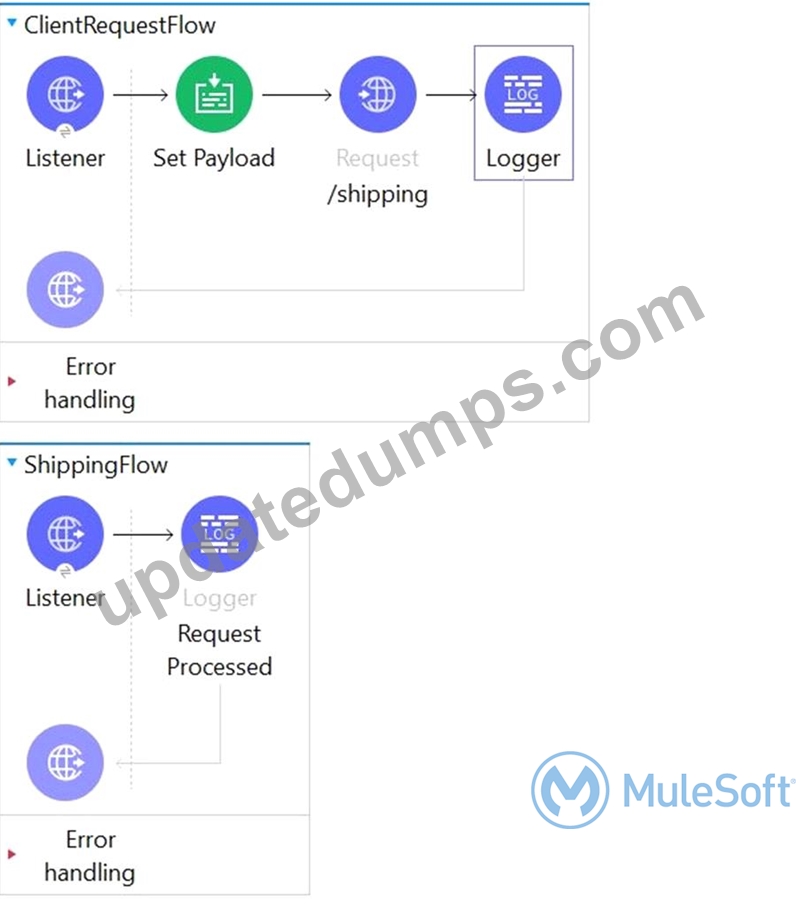


- A. Change the protocol attribute value to "HTTPS"
- B. Change the allowed method attributes value to "POST"
- C. Change the method attribute value to "*"
- D. Change the path attribute value to "/api/ship"
Answer: B
Explanation:
Correct answer is Change the method attributes value to "POST".
It can be fixed in either of the two ways as below.
1) Changing method attribute to POST in ClientRequestFlow
2) Setting allowedMethods as PUT in ShippingFlow (but doesn't fit as question mentions about changing ClientRequestFlow)
NEW QUESTION 115
Refer to the exhibit.
What data is expected by the POST /accounts endpoint?
A)
B)
C)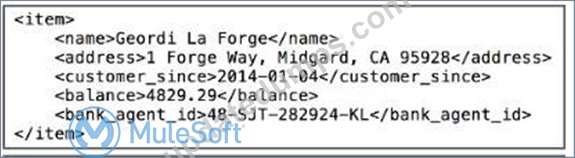
D)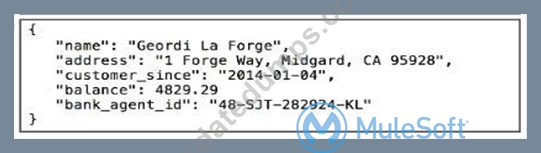
- A. Option B
- B. Option C
- C. Option A
- D. Option D
Answer: D
NEW QUESTION 116
Why would a Mule application use the ${http.port} property placeholder for its HTTP Listener port when it is deployed to CloudHub?
- A. Allows CloudHub to automatically change the HTTP port to allow external clients to connect to the HTTP Listener
- B. Allows CloudHub to automatically register the application with API Manager
- C. Allows MuleSoft Support to troubleshoot the application by connecting directly to the HTTP Listener
- D. Allows clients to VPN directly to the application at the Mule application's configured HTTP port
Answer: A
NEW QUESTION 117
What of the below is not a feature of API Notebooks?
- A. API documentation
- B. Creates a client for an API
- C. Perform authenticated live calls on a real server
- D. Creates a mock service for an API
Answer: D
Explanation:
Correct answer is Creates a mock service for an API
API Notebook is an open source, shareable web application for API documentation, interactive API tutorial and example generatation, and a client for your API endpoints. Using API Notebook, you can make requests and quickly transform the responses into readable format. However it cannot be used to mock service for an API.
MuleSoft Doc Ref : https://docs.mulesoft.com/api-manager/1.x/api-notebook-concept
NEW QUESTION 118
In the Database On Table Row operation, what does the Watermark column enable the On Table Row operation to do?
- A. To delete the most recent records retrieved from a database to enable database caching
- B. To save the most recent records retrieved from a database to enable database caching
- C. To avoid duplicate processing of records in a database.
- D. To enable duplicate processing of records in a database
Answer: C
Explanation:
The correct answer is To avoid duplicate processing of records in a database.
If a watermark column is provided, the values taken from that column are used to filter the contents of the next poll, so that only rows with a greater watermark value are returned. If an ID column is provided, this component automatically verifies that the same row is not picked twice by concurrent polls.
Mule doc reference : https://docs.mulesoft.com/db-connector/1.8/database-documentation#listener
NEW QUESTION 119
Which of the below activity doesn't support parallel execution?
- A. Batch job
- B. Parallel For Each
- C. Scatter-Gather Router
- D. First Successful Router
Answer: B
Explanation:
The First Successful router iterates through a list of configured processing routes until one of the routes executes successfully. This is sequential execution. In all other options mentioned in the question ,we can achieve parallel execution.
NEW QUESTION 120
Refer
to the exhibits. A web client submits a request to http://localhost:8081/fliqhts?destination=SFO and the Web Service Consumer throws a WSC:BAD_REQUEST error.
What is the next step to fix this error?
- A. Set a header In the Consume operation equal to the destination query parameter
- B. set a property m the Consume operation equal to the destination query parameter
- C. set a JSON payload before the Consume operation that contains the destination query parameter
- D. set a SOAP payload before the Consume operation that contains the destination query parameter
Answer: D
NEW QUESTION 121
Refer to the exhibits.

A JSON payload is set in the Set Payload transformer.
What is logged by the Logger?
- A. "String"
- B. "Array"
- C. "JSON"
- D. "Object"
Answer: D
NEW QUESTION 122
Refer to the exhibits.

A JSON payload is set in the Set Payload transformer.
What is logged by the Logger?
- A. "String"
- B. "Array"
- C. "JSON"
- D. "Object"
Answer: D
NEW QUESTION 123
Refer to the exhibits.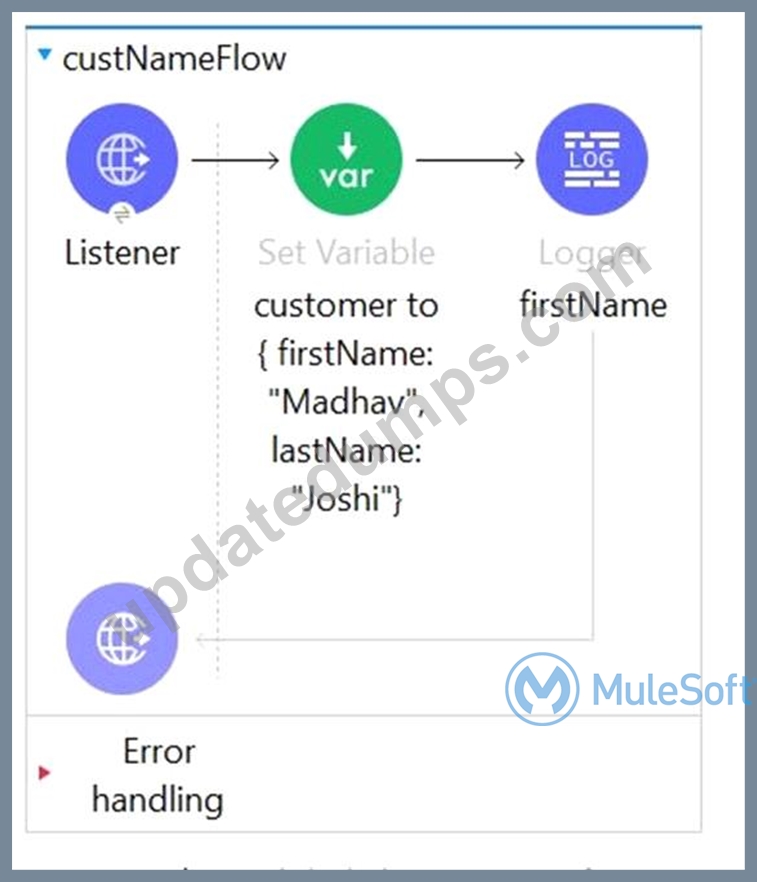

Set paylaod transformer is set the firstName and lastName of the customer as shown in below images.
What is the correct Dataweave expression which can be added in message attribute of a Logger activity to access firstName (which in this case is Madhav) from the incoming event?
- A. vars."customer.firstName"
- B. firstName
- C. vars."customer"."firstName"
- D. customer.firstName
Answer: C
Explanation:
Correct answer is vars."customer"."firstName"
Please you can also access firstName using this syntax vars.customer.firstName.
NEW QUESTION 124
Refer to the exhibits.
Larger image
Larger image
Larger image
The Mule application configures and uses two HTTP Listener global configuration elements.
Mule application is run in Anypoint Studio.
If the mule application starts correctly, what URI and port numbers can receive web client requests? If the mule applications fails to start , what is the reason for the failure?
- A. The mule application start successfully
Web client requests can only be received at URI on port 2222 but not on port 3333 - B. The mule application start successfully
Web client requests can be received at URI on port 2222 and on port 3333. - C. The mule application fails to start
There is URL path conflict because both HTTP Listeners are configured with same path - D. The mule application fails to start because of the port binding conflict as HTTP request also use same port i.e. 3333
Answer: B
Explanation:
In this case both the flows can start without any error and requests can be received on both ports. Flow names httpListener1 can call other flow using HTTP request without any issues.
NEW QUESTION 125
Refer to the exhibits.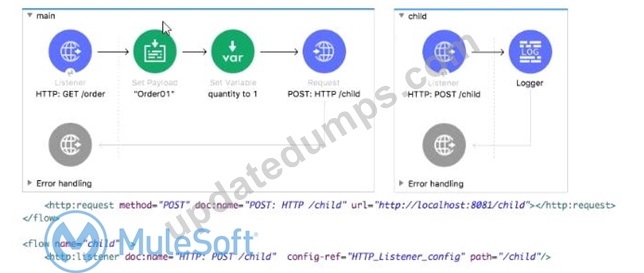
The main flow contains an HTTP Request. The HTTP Listeners and HTTP Request use default configurations.
What values are accessible in the child flow after a web client submits a request to http://localhost:8081/order? col or = red?
- A. payload
quantity var - B. payload
- C. payload
quantity var color query param - D. payload
color query param
Answer: B
NEW QUESTION 126
According to MuleSoft. what is the first step to create a Modern API?
- A. Performance tune and optimize the backend systems and network
- B. Create a prototype of the API implementation
- C. Gather a list of requirements to secure the API
- D. Create an API specification and get feedback from stakeholders
Answer: D
Explanation:
First step in creating Modern API is to create an API specification and get feedback from stakeholders so that any future issues can be identified at early stage thereby reducing overall delivery time
NEW QUESTION 127
By default, what happens to a file after it is read using an FTP connector Read operation?
- A. The file is deleted from the folder
- B. The file is renamed in the same folder
- C. The file is moved to a different folder
- D. The file stays in the same folder unchanged
Answer: D
Explanation:
File is not updated when FTP read operations is performed.
MuleSoft Doc Ref : https://docs.mulesoft.com/file-connector/1.3/file-read
NEW QUESTION 128
Mule application contains ActiveMQ JMS dependency. Mule application was compiled and run successfully in Anypoint Studio. The mule application must now be exported from Anypoint Studio and shared with other developer. What export options should be selected to create the smallest JAR file that can be imported into other developer's Anypoint Studio and run successfully?
- A. Select both Attach Project Sources and Include project modules and dependencies option
- B. Select the Include project modules and dependencies option only
- C. De-select both Attach Project Sources and Include project modules and dependencies option
- D. Select only Attach Project Sources only
Answer: D
Explanation:
Correct answer is Select only Attach Project Sources only
You must keep the Attach Project Sources option selected to be able to import the packaged JAR file back into a Studio workspace.
Deselect the Include project modules and dependencies option.
This option skips bundling the actual modules and external dependencies required to run the Mule application in a Mule runtime engine, creating a lightweight JAR file package that does not include any dependencies specified in the Mule application's pom.xml file.
The generated JAR file is not a functional deployable archive and cannot be deployed to a Mule runtime engine, but instead offers a way to archive only the source files that make up the Mule application. This is the same as using the -lightWeightPackage flag when packaging using the Mule Maven Plugin and is useful if you want to distribute your project to other Studio installations because it only keeps a reference to all its dependencies. When you import a lightweight package into Studio, all your dependencies are automatically downloaded MuleSoft Doc Ref : https://docs.mulesoft.com/studio/7.8/import-export-packages
NEW QUESTION 129
Refer to the exhibits.

The Validation component in the Try scope throws an error.
What response message is returned to a client request to the main flow's HTTP Listener?
The Validation component in the Try scope throws an error. What response message is returned to a client request to the main flow's HTTP Listener?
- A. Error - main flow
- B. Error - Try scope
- C. Success - main flow
- D. Validation Error
Answer: D
NEW QUESTION 130
Refer to the exhibit.
In the execution of the Scatter-Gather, the "steep 1 sec" Flow Reference takes about 1 second to complete, and the "sleep 5 sees" Row Reference takes about 5 seconds to complete.
About how many seconds does it take from the time the Scatter-Gather is called until the Set Payload transformer is called?
- A. 0
- B. 1
- C. 2
- D. 3
Answer: C
NEW QUESTION 131
What is the output type of the DataWeave map operator?
- A. Object
- B. Array
- C. String
- D. Map
Answer: A
NEW QUESTION 132
Refer to the exhibits.
The Set Payload transformer's value is set to {'year': '2020'}.
What message value should be added to the Logger component to output the message 'The year is 2020', without hardcoding 2020?
- A. '#[The year is " + paytoad.year]'
- B. The year is #[payload.year]'
- C. #["The year is "++ payload.year].
- D. '#[The year is $(pay load .year)]*
Answer: C
NEW QUESTION 133
According to Semantic Versioning, which version would you change for incompatible API changes?
- A. PATCH
- B. MINOR
- C. MAJOR
- D. No change
Answer: C
Explanation:
Correct answer is MAJOR
MAJOR version when you make incompatible API changes, MINOR version when you add functionality in a backwards compatible manner, and PATCH version when you make backwards compatible bug fixes.
For details refer to this documentation : https://semver.org/
NEW QUESTION 134
Refer to the exhibits.
What payload and quantity are togged at the end of the main flow?
- A. [orderlorder2order3order4, 14]
- B. [[1,2,3,4], 10]
- C. [[order1, order2, order3, order4], 14]
- D. [[1,2,3,4], 14]
Answer: D
NEW QUESTION 135
Refer to the exhibits.

The <when> expression for the Choice router needs to be written.
What is a valid <when> expression to route Mule events to the non-default flow?
- A. #['MuleSoft' == paytoad'company']
- B. #[ company = "MuleSoft" ]
- C. #[ if( company = "MuleSoft") ]
- D. #[ if( 'MuteSoff == paytoad.company) ]
Answer: D
NEW QUESTION 136
......
Accurate & Verified Answers As Seen in the Real Exam here: https://www.updatedumps.com/MuleSoft/MCD-Level-1-updated-exam-dumps.html