

Guaranteed Success in Looker certifications LookML-Developer Exam Dumps
Google LookML-Developer Daily Practice Exam New 2021 Updated 51 Questions
Google LookML-Developer Exam Syllabus Topics:
| Topic | Details |
|---|---|
| Topic 1 |
|
| Topic 2 |
|
| Topic 3 |
|
| Topic 4 |
|
| Topic 5 |
|
NEW QUESTION 25
Users report that every time they change the filter on their Explore, the filters take a very long time to populate.
How can the developer improve the filtering experience with this Explore?
- A. Use an access_filter parameter to automatically apply filters.
- B. Add an always_filter parameter to restrict the filter suggestions.
- C. Add persistence to the base view of the Explore.
- D. Limit the filter suggestions using the suggestions parameter.
Answer: D
NEW QUESTION 26
The developer is creating an Explore that includes the product users, and orders views that will meet the following guidelines.
Joins between the orders and users views should not incur high performance costs.
Users of this Explore will primarily be looking at data from the orders view.
Users of this Explore should only be able to see orders from the retailer "Fashion.ly".
The only field the users need from the products view is product.name.
Which LookML should the developer use?
A)
B)
C)
D)
- A. Option B
- B. Option C
- C. Option A
- D. Option D
Answer: D
NEW QUESTION 27
A LookML developer creates a new model and a test dashboard from the model. The developer shares the link to the new dashboard with users, but the users report that all they see is the "Model Not Found" error.
What is a possible cause of this issue?
- A. The developer has not pushed the new model to Production Mode.
- B. The users do not have permission to access this dashboard.
- C. The developer has not added users to the new model set.
- D. The new model is missing an Explore definition.
Answer: C
NEW QUESTION 28
A developer has a persistent derived table view called user_facts that contains aggregated data for each user. The developer needs to query the data from this table in another derived table view called user_region_facts.
Which strategy should the developer use to write the query for user_region_facts that will leverage the existing derived table?
- A. Copy the name of the database table in the scratch schema for the user_facts derived table.
- B. Use ${user_facts.SQL_TABLE_NAME} to reference the user_facts derived table.
- C. Write a subquery in the FROM clause and alias with ${user_facts}.
- D. Writhe the query form user_facts into a common table expression (WITH user_facts AS...).
Answer: D
NEW QUESTION 29
The daily_forecast Explore used by the sales team needs to be cached for 24 hours. All other Explores used by the sales team need to be cached for one hour.
What is a scalable way to configure this caching logic?
- A. Define two datagroups for the model. Create a persistent derived table (PDT) for the daily_forecast Explore, and apply datagroup_trigger to it using the datagroup for 24-hour caching.
- B. Define two datagroups for the model. Apply persist_with at the model level with the datagroup for 1-hour caching, and apply persist_with to daily_forecast with the datagroup for 24-hour caching.
- C. Define max_cache_age on daily_forecast Explores of 24 hours. Define max_cache_age on all other Explores for one hour.
- D. Define for the model one datagroup that caches for 1 hour. Create a persistent derived table (PDT) for the daily_forecast Explore, and apply sql_trigger_value to it selecting the current date.
Answer: B
NEW QUESTION 30
A LookML developer has created a model with many Explores in it. Business users are having a difficult time locating the Explore they want in the long list displayed.
Which two actions can the LookML developer take to improve the user interface? (Choose two.)
- A. Combine the Explores into just a few Explores that each join to many views.
- B. Apply the group_label parameter to organize the Explores under different headings.
- C. Apply the hidden parameter with a value of yes to Explores that only exist to power specific Looks, dashboards, or suggestion menus.
- D. Modify the business users' roles so they do not have this model in their model set.
- E. Apply the fields parameter so that each Explore has fewer fields in it.
Answer: A,D
NEW QUESTION 31
A developer needs to build a new dimension that offers an age-based cohort representation of users.
Which LookML code should the developer use to meet the requirement?
A)
B)
C)
D)
- A. Option B
- B. Option D
- C. Option C
- D. Option A
Answer: A
NEW QUESTION 32
A user reports an error message on an Explore: "Non-unique value/primary key (or sql_distinct_key), value overflow or collision when computing sum".
What should the LookML developer check for in the joined views of the Explore?
- A. A unique primary key is defined in each view.
- B. The sum measure used is defined correctly.
- C. Symmetric_aggregates: no is not present in the Explore definition.
- D. No concatenated primary keys are used.
Answer: C
NEW QUESTION 33
A developer needs to implement three persistent derived tables (PDTs) as described below.
The PDTs need to be refreshed after the daily ETL pipeline adds incremental loads to the underlying tables.
Each PDT is built off of one underlying table in the database (one PDT per table).
The underlying tables for each PDT are updated one after the other, and a new row is added to an ETL log table each time a table is updated.
Due to the unpredictable nature of the ETL pipeline, each PDT does not refresh at the same time from day to day.
Each PDT takes over an hour to build, and to save on compute costs each PDT should only be refreshed once per day.
How can the developer set up the PDTs according to these requirements?
- A. Create three separate datagroups tied to three PDTs that run when each corresponding table's row count changes.
- B. Create three separate datagroups tied to three PDTs that run when a new row is added to the ETL log table.
- C. Create one datagroup tied to all three PDTs that runs when the total row count across all three tables changes.
- D. Create one datagroup tied to all three PDTs that parameterizes the view name for each PDT in the SQL trigger condition.
Answer: B
NEW QUESTION 34
Users have built a popular dashboard and want to have change management built in for any edits made to the dashboard. The developer sets up version control for the model on which the dashboard is based.
What should the developer build to meet the business requirement?
- A. An Explore LookML file based on the dashboard.
- B. A dashboard LookML file included in the project.
- C. A native derived table based on the dashboard.
- D. A link to the dashboard included in the project.
Answer: B
NEW QUESTION 35
Business users report that they are unable to build useful queries because the list of fields in the Explore is too long to find what they need.
Which three LookML options should a developer use to curate the business user's experience? (Choose three.)
- A. Use a derived table to show only the relevant fields.
- B. Add a group_label parameter to relevant fields to organize them into logical categories.
- C. Use the hidden parameter to remove irrelevant fields from the Explore.
- D. Add a description parameter to each field with context so that users can search key terms.
- E. Create a separate project for each business unit containing only the fields that the unit needs.
Answer: A,B,D
NEW QUESTION 36
A developer needs to model out LookML to convert existing reports into Looker. The existing reports are:
Report 1: A report with order and order_items data, which finds the order with the largest total value of the order_item prices.
Report 2: A report with order and order_items data, which finds the order with the largest total number of products ordered.
Report 3: A report with data on every product, whether or not it has been ordered.
Each database table used is updated in real time as orders are made.
How should the developer construct an Explore using the order_items view as the base view?
- A. Create one persistent derived table to calculate Reports 1 and 2, and join in the products view with a full_outer join.
- B. Create one ephemeral derived table to calculate Report 1, create one ephemeral derived table to calculate Report 2, and join in the products view with a left_outer join.
- C. Create one ephemeral derived table to calculate Reports 1 and 2, and join in the products view with a full_outer join.
- D. Create one persistent derived table to calculate Report 1, create one persistent derived table to calculate Report 2, and join in the products view with a full_outer join.
Answer: D
NEW QUESTION 37
A user needs to create a report that shows a count of all orders and of orders over $100.
Which solution should the developer implement to meet these requirements?
- A. A sql_always_where parameter
- B. A front-end filter in the Explore
- C. An always_filter parameter
- D. A filtered measure
Answer: B
NEW QUESTION 38
The developer has moved the orders Explore (shown below) from model_a to model_b, where both models are in the same project, and all users have access to both models.
Connection: "demo"
include: ".view"
explore: orders {}
What will happen after making this change?
- A. Dashboard tiles and Looks that rely on this Explore will return an error.
- B. Dashboard tiles and Looks will be automatically pointed to the orders Explore in model_b.
- C. Dashboard tiles and Looks that rely on this Explore will be deleted.
- D. Dashboard tiles and Looks will redirect to the new database connection.
Answer: C
NEW QUESTION 39
A developer has User Specific Time Zones enabled for a Looker instance, but wants to ensure that queries run in Looker are as performant as they can be. The developer wants to add a datatype: date parameter to all dimension_group definitions without time data in a table-based view, so that time conversions don't occur for these fields.
How can the developer determine to which fields this parameter should be applied through SQL Runner?
- A. Open the Explore query in SQL Runner and validate whether removing the conversion from date fields changes the results.
- B. Use the Describe feature in SQL Runner to determine which fields include time data.
- C. Open the Explore query in SQL Runner to determine which fields are converted.
- D. Use the CAST function in SQL Runner to ensure that all underlying fields are dates and conversions are not applied.
Answer: D
NEW QUESTION 40
A user is seeing an error in the Explore that indicates the primary key defined for a one-million-row table is not unique.
How can the developer use SQL Runner to troubleshoot quickly?
- A. Create a query that concatenates two columns to create a compound primary key.
- B. Create a query that counts how many occurrences of the primary key value are in the base view, and sort by count.
- C. Create a query that selects the primary key from the base view, and look for duplicates.
- D. Create a query that selects all the fields from the table, and sort by primary key.
Answer: A
NEW QUESTION 41
A developer wants to create a measure that shows the item count broken out by category. When a second, more granular dimension is added to the same query, the count broken out by category should still represent the original aggregation and be duplicated on each line. The business wants this "count" in "category" available in the Explore section without any additional work done by the end user. For example:
The Count column represents the count for each combination of Category and Item.
The Count in Category column represents the count for each Category only.
How can the developer address this need with a LookML object?
- A. Calculate the overall count using table calculations in the Explore.
- B. Create a measure filtered on Category, and make the filter value controlled by a parameter.
- C. Create a measure with type: sum_over_dimension, and make the dimension value controlled by a parameter.
- D. Calculate the measure using a derived table, and then join that derived table back into the Explore.
Answer: D
NEW QUESTION 42
A LookML developer has written the following persistent derived table. It references orders_rollup, another persistent derived table that also rebuilds with the same SQL trigger value.
Which change is needed to guarantee that user_facts will always rebuild with the latest data from orders_rollup?
- A. Change the sql_trigger_value parameter for both persistent derived tables to a datagroup_trigger parameter, and set them to use the same datagroup.
- B. Change the orders_rollup view reference to the literal table name from the database's scratch schema.
- C. Change the sql_trigger_value parameter of user_facts to select the current date plus one hour, so it triggers an hour after orders_rollup.
- D. Change the orders_rollup view reference to ${orders_rollup.DERVIED_TABLE_NAME}
Answer: A
NEW QUESTION 43
Only users with department attributes of Finance and Executive should be able to access the revenue view. Only users with the value of Executive for the department user attribute should be able to view the total_revenue field.
Given the code snippet below:
How should the required access grants be structured to set up this system of access?
- A. required_access_grants: [grant_a] in the revenue view, required_access_grants: [grant_a, grant_b] in the total_revenue field
- B. required_access_grants: [grant_b] in the revenue view, required_access_grants: [grant_a] in the total_revenue field
- C. required_access_grants: [grant_a, grant_b] in the revenue view, required_access_grants: [grant_a] in the total_revenue field
- D. required_access_grants: [grant_b] in the financial_data Explore, required_access_grants: [grant_a] in the total_revenue field
Answer: A
NEW QUESTION 44
A developer commits changes after adding LookML for a new measure. Upon pulling from production, the developer notices the following lines in the LookML: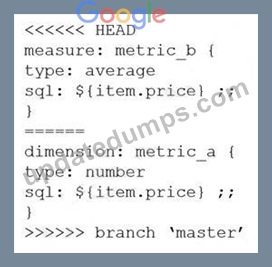
- A. Remove "<<<<<< HEAD", "======", and everything following "======"
- B. Remove everything between "<<<<<< HEAD" and ">>>>>> branch 'master'"
- C. Remove everything between "<<<<<< HEAD" and "======", and ">>>>>> branch 'master'"
- D. Remove "<<<<<< HEAD", "======", and ">>>>>> branch 'master'"
Answer: B
NEW QUESTION 45
......
Test Engine to Practice LookML-Developer Test Questions: https://www.updatedumps.com/Google/LookML-Developer-updated-exam-dumps.html