

Pass 1Z0-083 Exam in First Attempt Guaranteed 100% Cover Real Exam Questions [Nov-2021]
Valid 1Z0-083 test answers & Oracle 1Z0-083 exam pdf
The benefit in Obtaining the 1Z0-083 Exam Certification
- Organization owners invest a lot in their employees when it comes to their training with the goal of making them quicker, more efficient, and more knowledgeable about their role
- Oracle Database Administrator provide opportunities to get a job easily in which they are interested in instead of wasting years and ending without getting any experience
- Oracle Database Administrator will be confident and stand different from others as their skills are more trained than non-certified professionals
- Oracle Database Administrator can give you an edge at that time easily when candidates appear for a job interview employers seek to notify something which differentiates the individual to another
- Oracle Database Administrator Certification is distinguished among competitors
- Oracle Database Administrator have the knowledge to use the tools to complete the task efficiently and cost effectively than the other non-certified professionals lack in doing so
- Certified Professional will reduce the time he spends on tasks, meaning he can get more done this could help reduce company downtime when repairing faults on a system or fixing hardware problems
- Becoming Oracle Database Administrator means one thing you are worth more to the company and therefore more to yourself in the form of an upgraded pay package
- Oracle Database Administrator provides practical experience to candidates from all the aspects to be a proficient worker in the organization
- Oracle Database Administrator has more useful and relevant networks that help them in setting career goals for themselves
- Oracle Database Administrator networks provide you with the right career direction than non certified usually are unable to get
How much Oracle Database Administration II Exam Number: 1Z0-083 costs
- Types of questions: Performance Based Questions
- Passing Score: 60% or higher
- Examination Fees: $250 USD
- Examination Name: Oracle Database Administration II Exam Number: 1Z0-083
- No. of Questions: 85 Questions
- Length of Exam: 150 min
NEW QUESTION 10
Automatic Shared Memory Management is disabled for one of your database instances.
Some SQL statements perform poorly due to excessive hard parse activity, thereby degrading performance. What would be your next step?
- A. Run the SQL Tunning Advisor.
- B. Run the Memory Advisor for the Program Global Area.
- C. Run the SQL Access Advisor.
- D. Run the Memory Advisor for the shared pool.
- E. Run the Memory Advisor for the System Global Area.
Answer: D
NEW QUESTION 11
Automatic Shared Memory Management is disabled for one of your database instances.
Some SQL statements perform poorly due to excessive hard parse activity, thereby degrading performance.
What would be your next step?
- A. Run the SQL Tunning Advisor.
- B. Run the Memory Advisor for the Program Global Area.
- C. Run the SQL Access Advisor.
- D. Run the Memory Advisor for the shared pool.
- E. Run the Memory Advisor for the System Global Area.
Answer: D
NEW QUESTION 12
A database is configured in ARCHIVELOG mode.
Full RMAN backups are taken and no backup to trace has been taken of the control file. A media failure has occurred.
In which two scenarios is complete recovery possible? (Choose two.)
- A. after losing an archived log from before the most recent backup
- B. when any archived log from, before, or after the most recent backup is corrupt.
- C. after losing an archived log from after the most recent backup
- D. after losing all copies of the control file
- E. after losing the SYSTEM tablespace
Answer: A,B
NEW QUESTION 13
Which two are true about diagnosing Oracle Database failure situations using Data Recovery Advisor?
(Choose two.)
- A. A failure can be closed only when it has been repaired.
- B. Data Recovery Advisor can be used if a database is closed.
- C. Data Recovery Advisor can proactively check for failures.
- D. The Data Recovery Advisor CHANGE FAILUREcommand can be used only to change failure priorities.
- E. Using the Data Recovery Advisor LIST FAILUREcommand always requires that the database for which failures are to be listed is in MOUNTstate.
Answer: C,D
Explanation:
Explanation/Reference:
NEW QUESTION 14
Which two are true about poorly performing SQL statements and their tuning in Oracle database instances?
(Choose two.)
- A. SQL statements doing joins always do more physical I/O than single table queries.
- B. Poorly performing SQL statements can be tuned automatically by the Oracle server.
- C. SQL statements performing many physical I/Os can always have their performance improved by creating indexes.
- D. SQL statements doing only logical reads never require tuning because they do no physical I/O.
- E. The solution that best optimizes one SQL statement can degrade the performance of others.
Answer: B,D
NEW QUESTION 15
Which two are true about changing the LOCAL_UNDO_ENABLED property to false in a CDB? (Choose two.)
- A. After the change, any user with the required privilege can create an undo tablespace in the PDBs.
- B. Any new PDB and existing PDBs are automatically configured to use the default undo tablespace in CDB$ROOT.
- C. After the change, each existing PDB has to be reopened for the new undo mode to take effect.
- D. After the change, only a common user with the required privilege can create an undo tablespace in CDB&ROOT.
- E. After the change, only one undo tablespace can exist in CDB$ROOT.
- F. Undo tablespaces existing in PDBs must be dropped before the change.
Answer: B,E
Explanation:
Explanation
You can set a CDB in local UNDO mode either at CDB creation or by altering the CDB property. When the database property LOCAL_UNDO_ENABLE is FALSE, which is the default, there is only one UNDO tablespace that is created in the CDB root, and that is shared by all containers. When LOCAL_UNDO_ENABLE is TRUE, every container in the CDB uses local undo and each PDB must have its own local UNDO tablespace. To maintain ease of management and provisioning, UNDO tablespace creation happens automatically and does not require any action from the user. When a PDB is opened and an UNDO tablespace is not available, its automatically created.
NEW QUESTION 16
Examine this command:
$ rhpctl move database -sourcehome Oracle_home_path -destinationhome Oracle_home_path For which two purposes can you use this command? (Choose two.)
- A. to switch to a patched Oracle Database home
- B. to switch to a read-only Oracle home
- C. to switch back to the previous Oracle home as part of a rollback operation
- D. to switch the Oracle Database home when using a centralized Rapid Home Provisioning server
- E. to switch an existing Oracle Database home to a newer release of Oracle software on the same server
Answer: A,E
NEW QUESTION 17
Which three are true about thresholds, metrics, and server-generated alerts? (Choose three.)
- A. They are generated by SMON when a tablespace is 97% full.
- B. Metrics are statistical counts for a specific unit.
- C. A space usage management alert is automatically cleared after the underlying problem is resolved.
- D. All metrics are instance related.
- E. STATISTICS_LEVEL must be set to ALL to generate alerts.
- F. Cleared stateful alerts are displayed by querying DBA_ALERT_HISTORY.
Answer: B,C,F
NEW QUESTION 18
Which three are true about upgrading Oracle Grid Infrastructure? (Choose three.)
- A. The newer version is installed in a separate Oracle Grid Infrastructure home on the same server as the existing version.
- B. Existing Oracle Database instances must be shut down before starting the upgrade.
- C. The upgrade process will automatically install all mandatory patches for the current version of Oracle Grid Infrastructure.
- D. Only the grid user can perform the upgrade.
- E. An existing Oracle base can be used.
- F. A direct upgrade can be performed only from the immediately preceding Oracle Grid Infrastructure version.
Answer: B,C,D
Explanation:
Reference:
https://docs.oracle.com/database/121/CWLIN/procstop.htm#CEGEDCDB
NEW QUESTION 19
While backing up to an SBT channel, you determine that the read phase of your compressed Recovery Manager (RMAN) incremental level 0 backup is a bottleneck.
FORCE LOGGING is enabled for the database.
Which two could improve read performance? (Choose two.)
- A. Increase the size of tape I/O buffers.
- B. Disable FORCE LOGGING for the database.
- C. Increase the level of RMAN multiplexing.
- D. Enable asynchronous disk I/O.
- E. Increase the size of the database buffer cache.
Answer: C,D
NEW QUESTION 20
Which three actions are performed by the Oracle Preinstallation RPM, oracle-database-server-xxxx- preinstall, for Oracle Grid Infrastructure, where xxxx is the Oracle version and release? (Choose three.)
- A. creating the oracle OS user
- B. creating the grid OS user
- C. creating the OSDBA (dba) group
- D. performing checks to ensure minimum configuration requirements for Oracle Grid Infrastructure are met
- E. creating thte oraInventory (oinstall) group
- F. configuring the OS for Oracle Automatic Storage Management shared storage access
Answer: A,C,E
Explanation:
Reference:
https://docs.oracle.com/cd/E11882_01/install.112/e41961/prelinux.htm#CWLIN2932
NEW QUESTION 21
Which three are true about requirements for various FLASHBACK operations? (Choose three.)
- A. FLASHBACK DATA ARCHIVE requires undo to store all versions of all rows of a table being tracked.
- B. FLASHBACK transaction query requires undo to retrieve all versions of a row that existed between two points in time.
- C. FLASHBACK drop requires that the RECYCLEBIN parameter be set to ON.
- D. FLASHBACK version query requires that the RECYCLEBIN parameter be set to ON.
- E. FLASHBACK version query requires undo to retrieve all versions of a row that existed between two points in time.
- F. FLASHBACK drop requires undo to retrieve all versions of a row that existed between two points in time.
Answer: B,C,E
Explanation:
Reference:
https://books.google.com.pk/books?id=0iwrL9P25Z0C&pg=PA35&lpg=PA35&dq=FLASHBACK+transaction
+query+requires+undo+to+retrieve+all+versions+of+a+row+that+existed+between+two+points+in
+time&source=bl&ots=MJnYl5CZ1u&sig=ACfU3U0dWP-NPd- U8uu3zbaoi3YZzT0FTQ&hl=en&sa=X&ved=2ahUKEwigi5_Jl9joAhXzUBUIHUh4DksQ6AEwAnoECAsQJg#v= onepage&q=FLASHBACK%20transaction%20query%20requires%20undo%20to%20retrieve%20all% 20versions%20of%20a%20row%20that%20existed%20between%20two%20points%20in%20time&f=false
https://docs.oracle.com/cd/E18283_01/server.112/e17120/tables011.htm
NEW QUESTION 22
Which three are true about an application seed pluggable database (PDB)?
- A. It is automatically synchronized with its application root PDB when an application is installed.
- B. It Is automatically synchronized with its application root PDB when an application is upgraded.
- C. A new application PDB created by cloning an application seed PDB can have an up-to-date version of the application installed after cloning completes.
- D. It cannot be added to an application container after the application container has already been created.
- E. A new application PDB created by cloning an application seed PDB can have an old version of the application installed after cloning completes.
- F. It is not required in an application container.
- G. It cannot be dropped from its application container.
Answer: A,C,E
NEW QUESTION 23
Examine this output: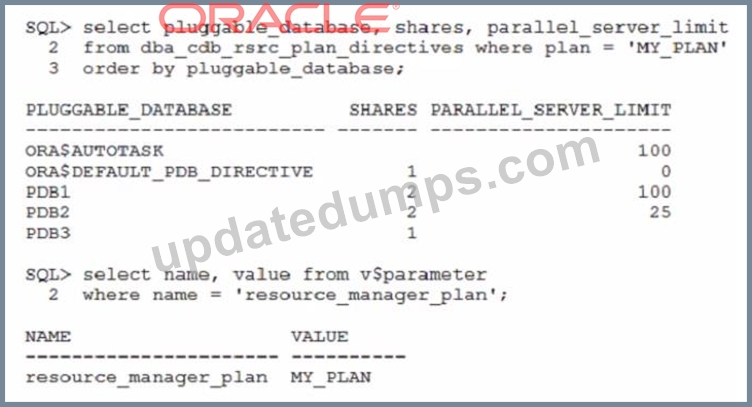
Which two are true?
- A. PDB3 is guaranteed to receive at least 20% of the available system resources if there is enough demand.
- B. PDB1 is always limited to 40% of the available system resources regardless of demand.
- C. Any PDB not specified in the plan will be unable to execute statements in parallel.
- D. Any PDB not specified in the plan will be able to use a maximum of 16.5% of the available system resources.
- E. PDB2 is guaranteed at least 25% of the available parallel execution processes if there is enough demand.
- F. PDB3 can use all available parallel execution processes at times.
Answer: C,E
NEW QUESTION 24
Oracle Managed Files (OMF) is enabled in a CDB and this command is successfully executed:
Which three are true?
- A. A default service Is created for the application root APP1.
- B. Application PDBs that are subsequently created in the APP1 application container will be cloned from APP1$SEED.
- C. APP1 can never be unplugged.
- D. An application root PDB is created for APP1.
- E. An application seed PDB Is created for APP1.
- F. Application PDBs that are subsequently created in the APP1 application container will be cloned from PDB$SEED.
Answer: A,B,D
NEW QUESTION 25
Which two are true about monitoring waits for sessions and services?
- A. v$session_wait and v$session both contain details of the event on which a waiting session is currently waiting.
- B. v$session_wait and v$session both contain details of the event on which a non-waiting session last waited.
- C. v$session_event displays all waits for all past and existing sessions if the wait has occurred at least once for a session.
- D. v$session_wait_class displays waits broken down by wait class only for waiting sessions.
- E. v$service_event displays wait counts for every wait event whether waited on or not, for each service.
Answer: C,E
NEW QUESTION 26
......
1Z0-083 Exam Questions – Valid 1Z0-083 Dumps Pdf: https://www.updatedumps.com/Oracle/1Z0-083-updated-exam-dumps.html
Verified 1Z0-083 dumps Q&As - Pass Guarantee: https://drive.google.com/open?id=1lDlo3qGgPHULscQLf02kPni9b_CLzxp_