

Dec-2024 HashiCorp VA-002-P Actual Questions and 100% Cover Real Exam Questions
VA-002-P Free Exam Questions and Answers PDF Updated on Dec-2024
Earning the VA-002-P certification is a valuable achievement for professionals in the field of infrastructure management. It demonstrates a high level of proficiency in using and managing Vault, which is a critical tool for organizations that want to ensure the security and privacy of their sensitive data. Additionally, the certification can help professionals advance their careers and increase their earning potential.
NEW QUESTION # 53
The following is a snippet from a Terraform configuration file:
1. provider "aws" {
2. region = "us-east-1"
3. }
4. provider "aws" {
5. region = "us-west-1"
6. }
which, when validated, results in the following error:-
1. Error: Duplicate provider configuration
2.
3. on main.tf line 5:
4. 5: provider "aws" {
5.
6. A default provider configuration for "aws" was already given at
7. main.tf:1,1-15. If multiple configurations are required, set the "______"
8. argument for alternative configurations.
Fill in the blank in the error message with the correct string from the list below.
- A. alias
- B. version
- C. multi
- D. label
Answer: A
Explanation:
An alias meta-argument is used when using the same provider with different configurations for different resources.
https://www.terraform.io/docs/configuration/providers.html#alias-multiple-provider-instances
NEW QUESTION # 54
From the code below, identify the implicit dependency:
1. resource "aws_eip" "public_ip" {
2. vpc = true
3. instance = aws_instance.web_server.id
4. }
5. resource "aws_instance" "web_server" {
6. ami = "ami-2757f631"
7. instance_type = "t2.micro"
8. depends_on = [aws_s3_bucket.company_data]
9. }
- A. The EIP with an id of ami-2757f631
- B. The S3 bucket labeled company_data
- C. The AMI used for the EC2 instance
- D. The EC2 instance labeled web_server
Answer: D
Explanation:
The EC2 instance labeled web_server is the implicit dependency as the aws_eip cannot be created until the aws_instance labeled web_server has been provisioned and the id is available.
Note that aws_s3_bucket.example is an explicit dependency.
NEW QUESTION # 55
To prepare for day-to-day operations, the root token should be safety saved outside of Vault in order to administer Vault
- A. False
- B. True
Answer: A
Explanation:
It is generally considered a best practice to not persist root tokens. Instead, a root token should be generated using Vault's operator generate-root command only when absolutely necessary.
For day-to-day operations, the root token should be deleted after configuring other auth methods which will be used by admins and Vault clients.
NEW QUESTION # 56
The userpass auth method has the ability to access external services in order to provide authentication to Vault.
- A. FALSE
- B. TRUE
Answer: A
Explanation:
The userpass auth method uses a local database that cannot interact with any services outside of the Vault instance.
NEW QUESTION # 57
Which of the following Terraform files should be ignored by Git when committing code to a repo? (select two)
- A. terraform.tfvars
- B. terraform.tfstate
- C. output.tf
- D. variables.tf
Answer: A,B
Explanation:
The .gitignore file should be configured to ignore Terraform files that either contain sensitive data or aren't required to save.
The terraform.tfstate file contains the terraform state of a specific environment and doesn't need to be preserved in a repo. The terraform.tfvars file may contain sensitive data, such as passwords or IP addresses of an environment that you may not want to share with others.
NEW QUESTION # 58
Which of the following variable declarations is going to result in an error?
- A. variable "example" {
type = object({})
} - B. variable "example" {}
- C. variable "example" {
description = "This is a variable description"
type = list(string)
default = {}
} - D. variable "example" {
description = "This is a test"
type = map
default = {"one" = 1, "two" = 2, "Three" = "3"}
}
Answer: B
Explanation:
Lists are defined with [ ], maps are defined with { }.
https://www.terraform.io/docs/configuration/types.html#structural-types
NEW QUESTION # 59
What Terraform feature is shown in the example below?
1. resource "aws_security_group" "example" {
2. name = "sg-app-web-01"
3. dynamic "ingress" {
4. for_each = var.service_ports
5. content {
6. from_port = ingress.value
7. to_port = ingress.value
8. protocol = "tcp"
9. }
10. }
11. }
- A. dynamic block
- B. local values
- C. data source
- D. conditional expression
Answer: A
Explanation:
You can dynamically construct repeatable nested blocks like ingress using a special dynamic block type, which is supported inside resource, data, provider, and provisioner blocks
NEW QUESTION # 60
In order to extend a Consul storage backend, Consul nodes should be provisioned across multiple data centers or cloud regions.
- A. False
- B. True
Answer: A
Explanation:
Consul nodes in the same cluster should not be provisioned across multiple data centers or cloud regions due to the low-latency requirements.
NEW QUESTION # 61
From the options below, select the benefits of using a batch token over a service token. (select three)
- A. has accessors
- B. can be a root token
- C. used for ephemeral, high-performance workloads
- D. no storage cost for token creation
- E. lightweight and scalable
Answer: C,D,E
Explanation:
Service Tokens
Service tokens are what users will generally think of as "normal" Vault tokens. They support all features, such as renewal, revocation, creating child tokens, and more. They are correspondingly heavyweight to create and track.
Batch Tokens
Batch tokens are encrypted blobs that carry enough information for them to be used for Vault actions, but they require no storage on disk to track them. As a result, they are extremely lightweight and scalable but lack most of the flexibility and features of service tokens.
Reference link:- https://www.vaultproject.io/docs/concepts/tokens
NEW QUESTION # 62
Which of the following represents a feature of Terraform Cloud that is NOT free to customers?
- A. VCS integration
- B. private module registry
- C. workspace management
- D. roles and team management
Answer: D
NEW QUESTION # 63
When creating a dynamic secret in Vault, Vault returns what value that can be used to renew or revoke the lease?
- A. lease_id
- B. token_revocation_id
- C. revocation_access
- D. vault_accessor
Answer: A
Explanation:
When reading a dynamic secret, such as via vault read, Vault always returns a lease_id. This is the ID used with commands such as vault lease renew and vault lease revoke to manage the lease of the secret.
vault lease lookup
Usage: vault lease <subcommand> [options] [args]
This command groups subcommands for interacting with leases. Users can revoke or renew leases.
Renew a lease:
$ vault lease renew database/creds/readonly/2f6a614c...
Revoke a lease:
$ vault lease revoke database/creds/readonly/2f6a614c...
Subcommands:
renew Renews the lease of a secret
revoke Revokes leases and secrets
Reference link:- https://www.vaultproject.io/docs/concepts/lease
NEW QUESTION # 64
When registering a plugin with Vault, where would you configure the location where the binaries are located in order for Vault to properly register the plugin?
- A. in the UI underneath the plugin tab
- B. within the CLI command when registering a plug
- C. in the Vault configuration file using plugin_directory=<path>
- D. in the plugin configuration file using directory=<path>
Answer: C
Explanation:
The plugin directory is a configuration option of Vault, and can be specified in the configuration file. This setting specifies a directory in which all plugin binaries must live; this value cannot be a symbolic link. A plugin can not be added to Vault unless it exists in the plugin directory. There is no default for this configuration option, and if it is not set plugins can not be added to Vault.
Reference link:- https://www.vaultproject.io/docs/internals/plugins
NEW QUESTION # 65
During a terraform apply, a resource is successfully created but eventually fails during provisioning. What happens to the resource?
- A. the terraform plan is rolled back and all provisioned resources are removed
- B. it is automatically deleted
- C. the resource is marked as tainted
- D. Terraform attempts to provide the resource up to three times before exiting with an error
Answer: C
Explanation:
If a resource successfully creates but fails during provisioning, Terraform will error and mark the resource as "tainted". A resource that is tainted has been physically created, but can't be considered safe to use since provisioning failed.
Terraform also does not automatically roll back and destroy the resource during the apply when the failure happens, because that would go against the execution plan: the execution plan would've said a resource will be created, but does not say it will ever be deleted.
NEW QUESTION # 66
A user runs terraform init on their RHEL based server and per the output, two provider plugins are downloaded:
1. $ terraform init
2.
3. Initializing the backend...
4.
5. Initializing provider plugins...
6. - Checking for available provider plugins...
7. - Downloading plugin for provider "aws" (hashicorp/aws) 2.44.0...
8. - Downloading plugin for provider "random" (hashicorp/random) 2.2.1...
9.
10. Terraform has been successfully initialized!
Where are these plugins downloaded to?
- A. /etc/terraform/plugins
- B. The .terraform.d directory in the directory terraform init was executed in.
- C. The .terraform/plugins directory in the directory terraform init was executed in.
- D. The .terraform.plugins directory in the directory terraform init was executed in.
Answer: C
Explanation:
By default, terraform init downloads plugins into a subdirectory of the working directory, .terraform/plugins, so that each working directory is self-contained.
NEW QUESTION # 67
True or False:
A list(...) may contain a number of values of the same type while an object(...) can contain a number of values of different types.
- A. False
- B. True
Answer: B
Explanation:
A collection type allows multiple values of one other type to be grouped together as a single value. This includes a list, map, and set.
A structural type allows multiple values of several distinct types to be grouped together as a single value. This includes object and tuple.
NEW QUESTION # 68
If a client is currently assigned the following policy, what additional policy can be added to ensure they cannot access the data stored at secret/apps/confidential but still, read all other secrets?
- A. path "secret/apps/*" {
capabilities = ["deny"]
} - B. path "secret/apps/confidential/*" {
capabilities = ["deny"]
} - C. path "secret/apps/confidential" {
capabilities = ["deny"]
} - D. path "secret/apps/*" {
capabilities = ["create", "read", "update", "delete", "list"]
}
path "secret/*" {
capabilities = ["read", "deny"]
}
Answer: C
Explanation:
"Deny" capability generally takes precedence over "allow" capability.
Therefore, if you add the correct deny statement, the user will be able to read all secrets except for the data stored at secret/apps/confidential
NEW QUESTION # 69
After a client has authenticated, what security feature is used to make subsequent calls?
- A. listener
- B. pgp
- C. key shard
- D. token
- E. ldap
- F. path
Answer: D
Explanation:
After authenticating, a client is issued a security token which is associated with a policy. That token is used to make a subsequent request to Vault, such as read, write, etc.
NEW QUESTION # 70
When multiple arguments with single-line values appear on consecutive lines at the same nesting level, HashiCorp recommends that you:
- A. align their equals signs
ami = "abc123"
instance_type = "t2.micro" - B. put arguments in alphabetical order
name = "www.pythonfanclub.com"
records = [aws_eip.lb.public_ip]
type = "A"
ttl = "300"
zone_id = aws_route53_zone.primary.zone_id - C. place all arguments using a variable at the top
ami = var.aws_ami
instance_type = var.instance_size
subnet_id = "subnet-0bb1c79de3EXAMPLE"
tags = {
Name = "HelloWorld"
} - D. place a space in between each line
type = "A"
ttl = "300"
zone_id = aws_route53_zone.primary.zone_id
Answer: A
Explanation:
HashiCorp style conventions suggest you that align the equals sign for consecutive arguments for easing readability for configurations ami = "abc123" instance_type = "t2.micro"
NEW QUESTION # 71
Vault configuration files can be written in what languages? (select two)
- A. XML
- B. YAML
- C. JSON
- D. HCL
Answer: C,D
Explanation:
The Vault configuration file supports either JSON or HCL, which is HashiCorp Configuration Language
NEW QUESTION # 72
Which of the following policies would permit a user to generate dynamic credentials on a database?
- A. path "database/creds/read_only_role" {
capabilities = ["sudo"]
} - B. path "database/creds/read_only_role" {
capabilities = ["read"]
} - C. path "database/creds/read_only_role" {
capabilities = ["list"]
} - D. path "database/creds/read_only_role" {
capabilities = ["generate"]
}
Answer: B
Explanation:
The HTTP request is a GET which corresponds to a read capability. Thus, to grant access to generate database credentials, the policy would grant read access on the appropriate path.
NEW QUESTION # 73
When administering Vault on a day-to-day basis, why is logging in with the root token, as shown below, a bad idea? (select two).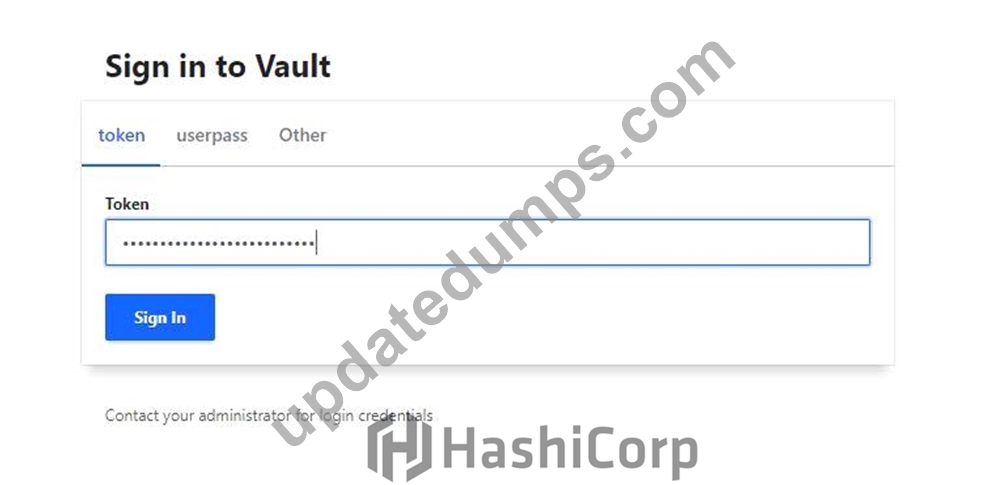
- A. It's easier to just use the root token than to configure additional auth methods
- B. the root token isn't a secure way of logging into Vault
- C. the root token should be revoked and not used on a day-to-day basis
- D. the root token is attached to the root policy, which likely provides too many privileges to a user
Answer: C,D
Explanation:
The root token should never be used on a day-to-day basis and should always be revoked once a permanent auth method has been configured.
NEW QUESTION # 74
......
HashiCorp VA-002-P Real 2024 Braindumps Mock Exam Dumps: https://www.updatedumps.com/HashiCorp/VA-002-P-updated-exam-dumps.html
Latest VA-002-P Exam Dumps Recently Updated 202 Questions: https://drive.google.com/open?id=1WU0hN5Jk-I2LiS-pqOq4umrqfmb-E_BG